Washoku is not the name of one recipe or a promise that every Japanese meal follows the same rules. It is a broad food culture built from knowledge, skills, customs, ingredients, and ways of sharing meals. Everyday rice and soup, regional preserved foods, New Year dishes, and refined restaurant cooking can all sit within that culture.
This distinction matters because “washoku” is often reduced to attractive plates or a fixed formula. The deeper idea includes how ingredients are produced, how season is expressed, how food is preserved, and how culinary knowledge moves between generations.
What UNESCO Actually Recognized
In 2013, UNESCO inscribed “Washoku, traditional dietary cultures of the Japanese, notably for the celebration of New Year” on the Representative List of the Intangible Cultural Heritage of Humanity. UNESCO describes it as a social practice involving skills, knowledge, practices, and traditions related to producing, processing, preparing, and consuming food—not as a list of protected dishes. The complete wording is available on the official UNESCO washoku page.
New Year is emphasized because practices such as preparing symbolic foods, pounding rice cakes, selecting special tableware, and sharing the meal make the social and seasonal dimensions especially visible.
Four Relationships Make Washoku Easier to Understand
1. Food and nature
Seasonal fish, vegetables, edible wild plants, seaweed, mushrooms, and fruit connect cooking to local environments. Seasonality does not mean every ingredient must be harvested that morning; preserved foods and stored staples also express knowledge developed around climate and scarcity.
2. Staple and supporting dishes
Japanese rice commonly anchors the meal while soup, pickles, vegetables, fish, meat, or tofu provide contrast. The familiar phrase ichiju sansai—one soup and three dishes—describes an influential arrangement, but it is not a rule that every home meal must satisfy.
3. Preservation and fermentation
Miso, soy sauce, vinegar, pickles, dried fish, kombu, and fermented sushi reflect techniques for controlling time. Koji supports several major seasonings, while salt, drying, smoking, and lactic-acid fermentation create other paths to flavor and storage.
4. Food and community
Festival dishes, family New Year preparations, school food education, and regional recipes all transmit knowledge. The UNESCO description specifically notes the role of families, community groups, teachers, and cooking instructors in passing on skills.
A Cook’s Design Grid: Five Tastes, Five Colors, and Five Methods
Standing at the cutting board, I experience washoku less as a fixed catalog of dishes than as a way to create harmony. The ingredient, season, method, color, aroma, vessel, and the other dishes all influence one another. The traditional groups of five give cooks a practical vocabulary for checking that balance.
| Framework | Five elements | How I use it in the kitchen |
|---|---|---|
| Goho: five methods | Raw/cutting, simmering, grilling, steaming, deep-frying | Vary heat, texture, aroma, and moisture instead of repeating one technique |
| Gomi: five tastes | Sweet, sour, salty, bitter, umami | Build contrast and restraint so one seasoning does not flatten the entire meal |
| Goshiki: five colors | Red, yellow, blue/green, white, black/dark | Check visual rhythm using ingredients, garnish, empty space, and tableware |
| Gokan: five senses | Sight, sound, smell, touch, taste | Consider steam from a lid, the sound of a crisp bite, vessel temperature, and aroma as part of service |
MAFF’s culinary training materials describe these as essentials of Japanese cuisine, but they are a design grid rather than a demand that every plate display every element. Five colors do not automatically guarantee nutrition, and a home dinner does not fail because it contains only two cooking methods. In a course, however, the grid helps me notice when everything has become brown, soft, sweet, or simmered—and then introduce contrast with a green garnish, a raw or grilled preparation, bitterness, acidity, or a crisp texture.
The word nama in the five methods is often translated simply as “raw,” but the professional emphasis is also on cutting. Knife work decides how sashimi feels, how vegetables absorb broth, and whether a garnish expresses delicacy or strength. Doing less to an ingredient can require more precise judgment, not less technique.
Dashi Creates Structure Without Heavy Seasoning
Dashi is one of the recurring structures of washoku. Kombu, katsuobushi, niboshi, or dried shiitake can create a light broth with strong savoriness, allowing the cook to use salt and soy sauce with greater precision.
The Ministry of Agriculture, Forestry and Fisheries presents vegetables, rice, fish, ichiju sansai, celebratory foods, tableware, and dashi as connected elements in The Washoku Way, its English-language guide to Japanese food culture. This breadth is why dashi is important but should not be treated as the sole definition of washoku.
How I Draw Ichiban Dashi and Niban Dashi
For a clear first stock, or ichiban dashi, I begin by learning the water and kombu rather than relying on one universal temperature. A controlled extraction around 60°C can draw glutamate with little harshness; other kitchens begin in cold water and heat gradually. I remove the kombu before a vigorous boil, bring the liquid to the condition required by the recipe, add katsuobushi, and strain without squeezing it aggressively. The aim for a clear soup is aroma, transparency, and a finish that disappears cleanly.
The familiar synergy comes from different umami compounds: glutamate is abundant in kombu, while katsuobushi supplies inosinate. Their combination can taste fuller than either stock alone, allowing salt and soy sauce to be used with precision. Timing, shaving thickness, water hardness, kombu variety, and intended dish all affect the method, so “60°C” should be read as one controlled approach rather than the only correct recipe.
For niban dashi, the used kombu and bonito can be heated again and fresh bonito added near the end. The second stock is less about the fleeting top aroma prized in a clear soup and more about extracting enough body for simmered dishes, sauces, or preparations in which other seasonings will join it. Using each stock where its character is useful is part of avoiding waste as well as building flavor.
Season Is Communicated Through More Than Freshness
A meal may suggest early spring through bamboo shoots, summer through chilled noodles and glassware, autumn through mushrooms and maple motifs, or winter through a shared hot pot. Cutting style, color, garnish, serving temperature, and the material of the bowl can reinforce the same seasonal message.
Refined kaiseki makes this especially visible, but everyday cooking also changes with weather, availability, school calendars, festivals, and household habits.
Hashiri, Sakari, and Nagori: Three Ways to Read a Season
A cook can divide seasonality into hashiri, the anticipated beginning; sakari, the height of availability or condition; and nagori, the lingering end. Hashiri may be presented lightly to communicate freshness and expectation. Sakari often allows the ingredient’s mature flavor or abundance to stand more directly. Nagori can be paired with the first ingredient of the next season, turning the menu into a transition rather than a calendar label.
These words describe culinary perception, not guaranteed biological facts. An ingredient at nagori is not automatically leaner, and the point of sakari differs by region, weather, fishing conditions, cultivar, and the quality a chef wants. The cook still has to examine the actual ingredient.
Four Seasonal Decisions From the Cutting Board
- Spring—young bamboo shoot and wakatake soup: after removing harshness appropriately, I simmer the bamboo shoot in a fragrant first dashi and pair it with wakame. Kinome is lightly struck between the palms immediately before service to release its aroma.
- Summer—hamo with ume: the fine bones require repeated, closely spaced knife cuts that stop before cutting through the skin. The number varies with the fish and portion; the goal is that the bones are not intrusive after brief cooking, while the flesh opens attractively and remains moist.
- Autumn—matsutake and hamo in a dobin: lingering hamo and early matsutake can share one vessel, expressing two seasons meeting. The lidded pot carries aroma to the guest before the broth is tasted.
- Winter—Shogoin turnip and yellowtail: these ingredients can appear in different preparations rather than one fixed canonical dish. A warming simmered dish, yellowtail with daikon, or turnip-based kabura-mushi each requires its own structure; a light starch-thickened sauce can help retain heat.
Tableware completes the decision. Glass and celadon can suggest coolness in summer; pottery with greater visual and physical weight or covered lacquerware can hold warmth in winter. “The vessel is the clothing of the dish” is useful because color, rim shape, depth, touch, and heat retention change how the diner encounters the food.
Washoku Is Larger Than Sushi
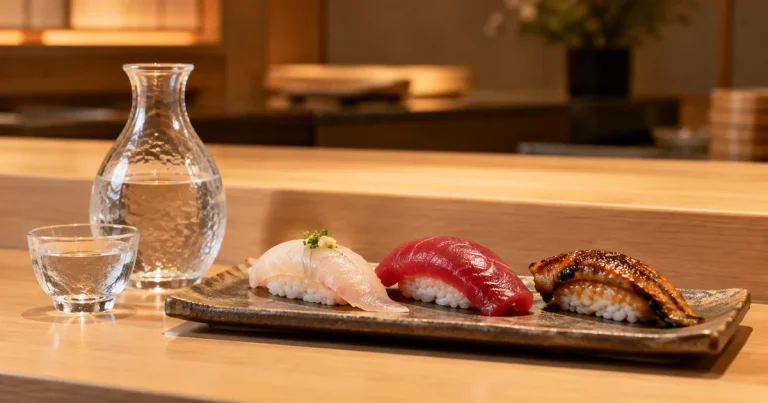
Sushi is one important Japanese food tradition, but it cannot represent washoku by itself. Regional noodles, grilled fish, simmered vegetables, tofu dishes, pickles, rice cakes, tempura, and home-style soups reveal different histories and techniques.
The category also changes over time. New ingredients and cooking technologies can enter Japanese kitchens while older methods continue. Cultural continuity does not require food to remain frozen in one historical moment.
Regional Difference Is Part of the Tradition
Climate, agriculture, fishing grounds, transport, and trade produced strong regional differences. Miso may be based on rice, barley, or soybean koji; soy sauce styles vary in color and intensity; preserved fish and vegetable dishes answer local conditions.
For that reason, a statement such as “Japanese people always eat…” should be treated cautiously. Household, region, generation, occasion, and personal preference all matter. Washoku is a shared cultural framework with many local expressions, not a single national menu.
Kanto and Kansai: Useful Tendencies, Not Two Uniform Cuisines
A common comparison describes Kanto cooking as more assertive in katsuobushi and dark soy sauce, and Kansai cooking as more visibly led by kombu and light-colored usukuchi soy sauce. This can help a traveler understand why a Tokyo soba broth may look darker than a Kyoto clear soup. Yet color is not a direct measure of saltiness, and neither region uses only one stock or soy sauce. Dish, restaurant, and local subregion matter.
Eel offers a more tangible contrast. Kanto-style preparation commonly uses back-opening, skewering, grilling, steaming, and a final grilling with sauce, creating a soft texture. Kansai-style jiyaki commonly uses belly-opening and direct grilling without the same steaming stage, emphasizing crisp skin and a more forceful roasted quality. The popular explanation linking back-opening to samurai aversion to belly-cutting is a memorable story, but it should not be presented as proven history.
Everyday Meal Formats Show the Principles Clearly
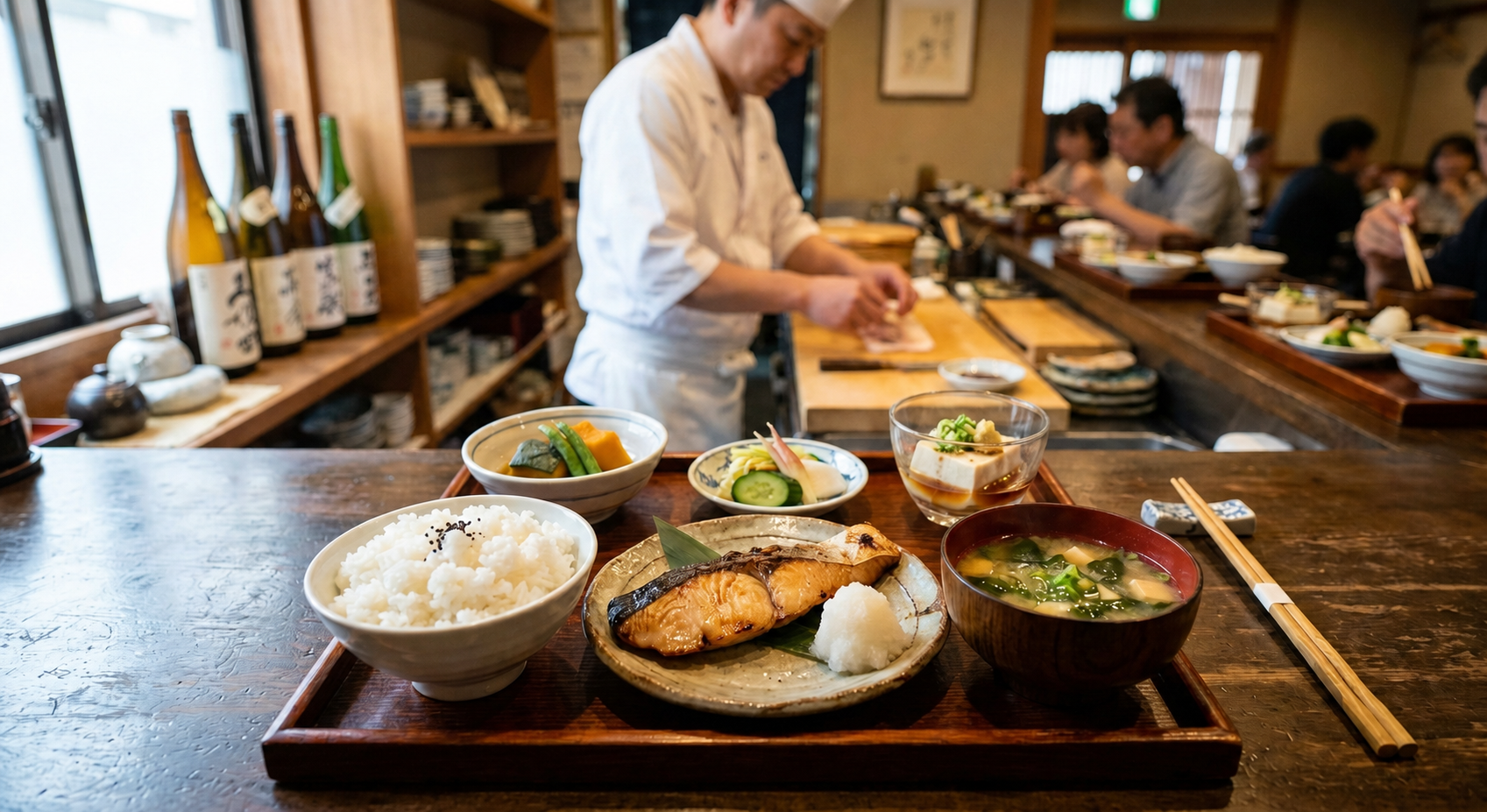
A teishoku often places rice, soup, a main dish, and small sides together. A bento applies balance and seasonality to a portable container. Neither needs to be luxurious to show attention to color, texture, and the relationship between staple and accompaniments.
These formats also demonstrate practicality. Washoku includes meals designed for work, school, travel, preservation, and family routines—not only ceremonial or restaurant dining.
What Washoku Does Not Automatically Mean
- Not automatically vegetarian: dashi may contain katsuobushi or dried fish.
- Not automatically gluten-free: soy sauce, barley miso, and processed foods may contain gluten sources.
- Not always raw: simmering, grilling, steaming, frying, drying, and fermenting are central techniques.
- Not always formal: home cooking and convenience foods exist within modern Japanese food culture.
- Not one nutritional formula: the balance of an individual meal depends on ingredients and portions.
Practical Washoku Advice for Travelers
The philosophy of washoku becomes easier to appreciate when the practical details of dining are clear. Many uncomfortable moments arise not from difficult etiquette but from an unspoken charge, a restriction reported too late, or a course ordered without understanding what is included.
Otoshi, Table Charges, and Market Price
At many izakaya, a small dish called otoshi arrives automatically and is connected to a table or cover charge. It is not necessarily a free gift or an attempt to add an item secretly. JNTO’s dining guidance confirms that such appetizers are commonly not complimentary and recommends asking staff if the charge is unclear. The amount varies by restaurant and location; travelers may encounter several hundred yen, but there is no reliable nationwide fixed range.
Jika, or market price, needs a different question. Seasonal seafood can change sharply in cost according to auction, size, origin, and supply. Asking “How much is today’s recommendation?” before ordering is sensible, not impolite. Also confirm whether a quoted course includes tax, service charge, private-room fees, drinks, and additional dishes.
Budget Ranges for Planning, Not Promises
The following ranges are broad planning examples in yen per person, not national averages or guaranteed 2026 prices. Major-city luxury restaurants, famous chefs, seasonal ingredients, hotel service charges, drinks, and booking-platform fees can push the total much higher. Always check the restaurant’s current official menu.
| Style | Rough lunch planning range | Rough dinner planning range | What to confirm |
|---|---|---|---|
| Kaiseki or kappo | ¥5,000–¥15,000+ | ¥15,000–¥40,000+ | Number of courses, seasonal supplements, tax, service, and room fee; celebrated luxury restaurants may exceed ¥50,000 |
| Independent sushi or tempura restaurant | ¥2,000–¥6,000 for many sets; specialist courses may cost more | ¥10,000–¥30,000+ at specialist counters | Set versus omakase, drinks, additions, and cancellation policy |
| Izakaya or small kappo-style pub | About ¥1,000–¥2,000 if lunch is offered | About ¥4,000–¥8,000+, strongly affected by drinks | Otoshi or cover charge, individual plate prices, and last-order time |
Lunch can be a useful introduction because some restaurants offer a shorter menu or set meal at a lower price. It is not safe to assume that lunch uses exactly the same ingredients or course length as dinner. Compare the written menus rather than treating the lower price as an identical discount version.
Restrictions Must Be Shared Before the Kitchen Commits
Tell the restaurant about allergies, religious restrictions, and ingredients you cannot eat when reserving. Dashi may contain bonito, sauces may include alcohol or fish-derived ingredients, and one preparation can take several days. By the day of service, stocks, cured fish, simmered items, and the structure of a tasting menu may already be fixed.
A kitchen may be willing to help and still be unable to guarantee separation from allergens in a compact workspace. “I dislike raw fish” and “I have a life-threatening fish allergy” must never be treated as the same request. JNTO also advises advance notice because specialist restaurants often purchase and prepare ingredients according to reservations.
Fragrance, Timing, and the Shared Dining Room
Strong perfume can obscure dashi, charcoal, citrus peel, fresh wood, and other aromas that the cook has designed into the meal. Some small or fragrance-sensitive restaurants publish a no-perfume request; severe cases may lead to refusal under the restaurant’s stated policy. Check the booking terms and arrive without a strong personal fragrance.
Be punctual and cancel as early as possible. A missed reservation at a small restaurant can waste ingredients bought for a particular guest. Some restaurants also limit the seating to roughly two hours, so confirm the start time rather than assuming that arrival is flexible.
How to Ask the Cook for Guidance
- Ask what is in best condition: “What do you recommend today?” is better than assuming the most expensive fish is the best choice.
- State a budget: for market-price seafood or several recommendations, tell the staff the approximate total you have in mind.
- Ask for a pairing: explain whether you prefer sake that is dry, aromatic, rich, or light, and ask what suits the sashimi, grilled dish, or simmered course.
- Separate curiosity from customization: questions about dashi or an ingredient are welcome at many counters, but a chef may not be able to redesign a prepared course after service has begun.
From the kitchen, the easiest guest to help is not the guest who knows the most jargon. It is the guest who communicates clearly, listens to the answer, and gives the restaurant enough time to prepare.
How These Principles Appear in a Working Kitchen
From a cook’s perspective, washoku is visible less in one famous dish than in a series of small decisions. The strength of the dashi, the amount of salt, the direction and size of a cut, and whether an ingredient is simmered, grilled, dressed, or served raw are adjusted so that one item does not overwhelm the rest of the meal.
Rice commonly acts as the anchor, with soup, a main dish, vegetables, and pickles supplying contrast. This is not a rigid formula for every Japanese meal. In practice, the cook changes portion size, color, texture, and temperature according to the occasion and the other dishes being served.
Seasonality is also practical rather than decorative. A winter dish may be served in a vessel that holds heat, while a summer preparation may emphasize a chilled broth, crisp texture, or a cool-looking plate. The point is not to follow a checklist, but to make the ingredient and the moment of eating feel connected.
A Practical Way to Recognize Washoku
Look for relationships rather than a checklist: staple and side dishes, season and presentation, fresh ingredients and preservation, individual plates and communal occasions. When these relationships are visible, washoku becomes understandable as living food culture instead of a decorative label for “traditional Japanese cuisine.”
Explore Washoku Through the Seasons
- Seasonal food traditions from Obon to autumn wagashi
- Matsutake season, aroma, price, and classic dishes
- Ginkgo nuts as an autumn ingredient
- Japanese sweet potato dishes across rice, soup, and sweets
If this article deepened your understanding of Japanese food culture, you can support Japan Food Compass on Ko-fi and help us continue sharing carefully researched guides and original kitchen stories.
Sources for This Washoku Guide
- UNESCO: Washoku, Traditional Dietary Cultures of the Japanese
- Ministry of Agriculture, Forestry and Fisheries: The Washoku Way
- MAFF: Five Tastes, Five Colors, Five Methods, and Five Senses
- Japan National Tourism Organization: Japanese Customs and Restaurant Etiquette
- Japan National Tourism Organization: Making Restaurant Reservations