You open the sake list at a sushi counter and find a wall of kanji, unfamiliar brewery names, and prices that seem to promise a hierarchy. The safest choice appears obvious: order the most expensive Junmai Daiginjo and let the prestige do the work.
That can be a costly mistake. Junmai Daiginjo is a legally defined production category, not a guarantee that the sake will improve the sushi in front of you. A highly aromatic bottle can be beautiful on its own and still overpower a quiet piece of white fish.
The useful question is not, “Which sake is best?” It is, “Which sake has the right aroma, weight, acidity, and temperature for this part of the meal?” This guide explains how to answer that question without memorizing dozens of labels.
The Night an Expensive Sake Erased the Hirame
When I was young and had only recently begun serving guests across the counter, an overseas customer asked for the best sake and sushi in the restaurant. I wanted to deliver something exceptional, so I chilled a top Junmai Daiginjo and served it with the day’s prized hirame cured with kombu.
The sake was impressive by itself. Its aroma suggested ripe melon and tropical fruit, and its texture was polished and smooth. I expected the price, the fragrance, and the delicacy of the fish to add up to an ideal pairing.
After one bite, the guest looked unconvinced. “This sake is excellent, but I can hardly taste the hirame,” he said. “The aroma is covering the fish.”
I tasted the combination and understood immediately. The ginjo aroma and alcoholic lift arrived before the fine sweetness of the kombu-cured fish and stayed after it. Nothing was wrong with the sake. Nothing was wrong with the hirame. I had simply asked two delicate, expressive things to compete for the same space.
That service taught me a rule I still use: the bottle with the highest status is not automatically the best supporting actor. Pairing begins with the food, not the price.
Junmai and Ginjo Are Clues, Not a Ranking
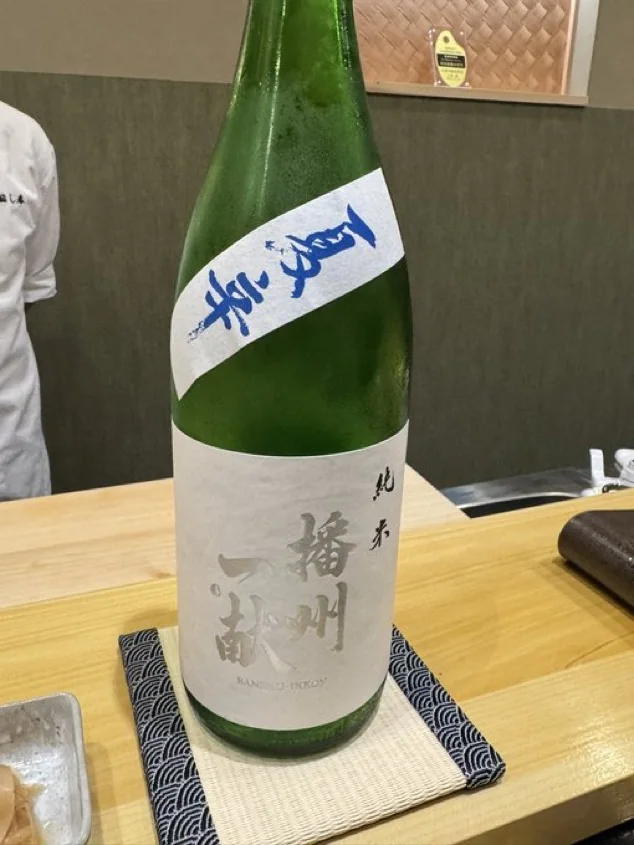
Japanese sake labels become easier when you separate two questions. First, was brewer’s alcohol added? Second, was the sake made to meet a ginjo-style polishing and production standard? The words can be combined, which is why Junmai Ginjo and Junmai Daiginjo exist.
What Junmai Actually Tells You
Junmai sake is made from rice, rice koji, and water, without added jozo alcohol. Non-Junmai premium categories such as Ginjo, Daiginjo, and Honjozo may contain a restricted amount of neutral brewer’s alcohol. In Japan’s specially designated sake categories, that addition is limited to less than 10 percent of the polished rice weight. It is a controlled brewing choice, not evidence that the bottle is cheap or adulterated.
Added brewer’s alcohol can help lift aroma and produce a lighter, cleaner finish. Junmai can feel rounder or more savory, but the word alone does not promise richness. Yeast, rice, water, acidity, fermentation, maturation, and serving temperature can move two Junmai bottles in very different directions.
What Ginjo and Daiginjo Tell You
Ginjo and Daiginjo refer to more than rice polishing. They also require ginjo-style brewing that develops a characteristic aroma and flavor. For Ginjo or Junmai Ginjo, the polishing ratio must be 60 percent or lower. For Daiginjo or Junmai Daiginjo, it must be 50 percent or lower.
A polishing ratio of 50 percent means that 50 percent of the original grain remains; it does not mean the rice was polished by only 50 percent. Lower numbers usually require more rice and more work, which helps explain the price. They do not create a universal quality score.
One correction matters for anyone learning from older charts: ordinary Junmai currently has no minimum polishing-ratio requirement. A chart that assigns every Junmai a 60-to-70-percent range is describing a common style, not the legal definition.
Highly polished sake often trends toward a lighter, smoother profile, while ginjo brewing can produce aromas reminiscent of apple, pear, banana, melon, or other fruit. “Can” is the important word. The designation narrows the production method; it does not tell you the exact aroma intensity or whether the bottle will suit your hirame.
“Dry” Is a Different Question
Karakuchi means dry, and chokarakuchi means very or exceptionally dry. These words describe a taste direction, not a separate legal tier above Junmai or Ginjo. A bottle can therefore be both Junmai and Chokarakuchi.
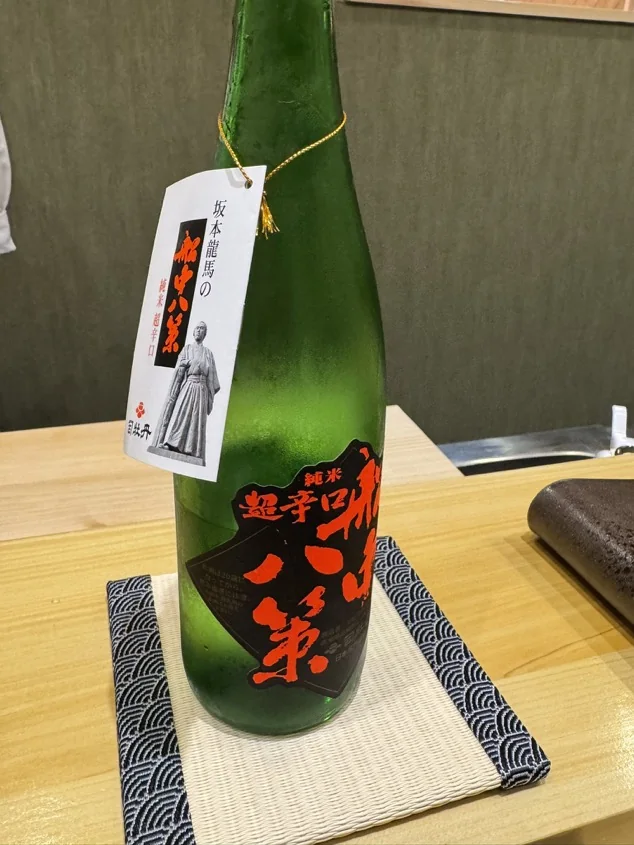
If a label gives a nihonshu-do, or Sake Meter Value, a higher positive number generally points toward a drier impression and a negative number toward a sweeter one. It remains only one clue. Acidity can make sweetness feel tighter, amino acids can add fullness, and chilling can suppress some sweetness and aroma.
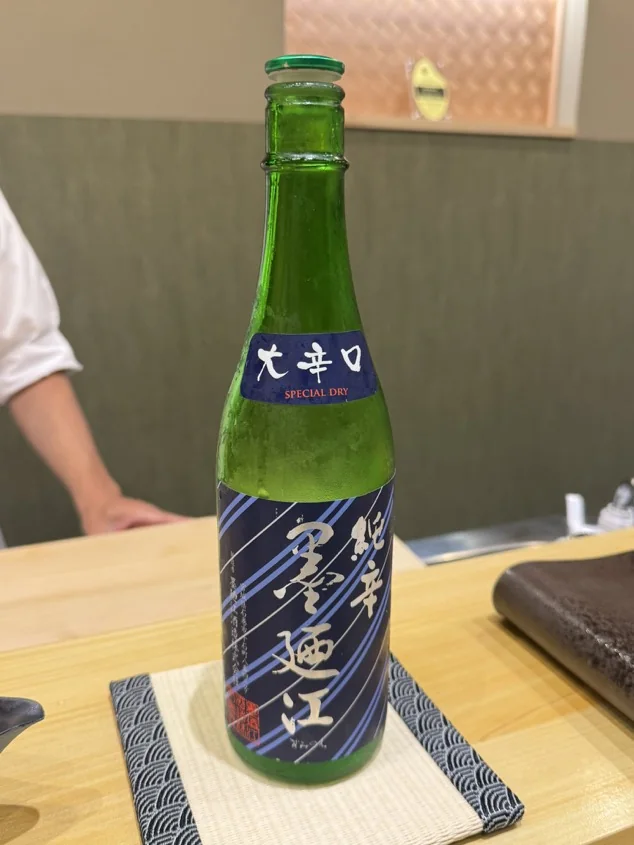
This is why “Give me the driest sake” is less useful than it sounds. At a sushi counter, a better request also mentions the food: restrained aroma for delicate fish, enough acidity for a soy-seasoned piece, or fuller umami for a richer course.
Start with the Sushi, Then Choose the Sake
The most reliable starting point is flavor intensity. The Japan Sake and Shochu Makers Association gives the same broad principle: pair delicate food with lighter sake and richer food with fuller sake. At a sushi counter, you can make that principle more precise by considering aroma, seasoning, fat, and temperature.
Delicate White Fish, Squid, and Shellfish
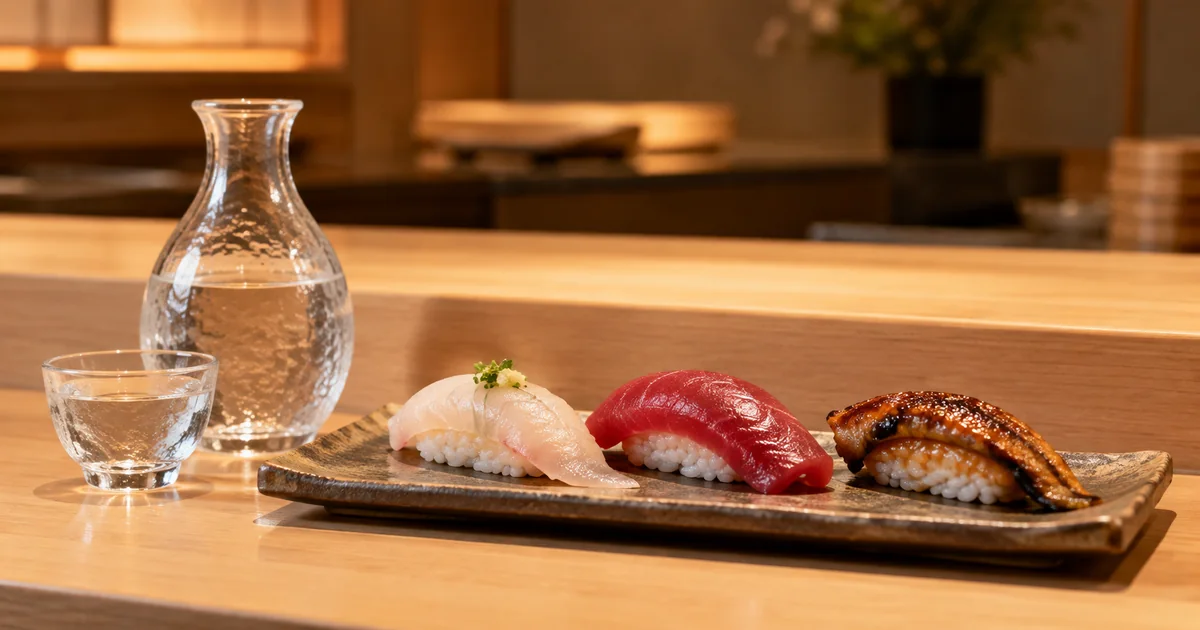
Tai, hirame, aori-ika, and lightly seasoned shellfish can disappear behind a very perfumed sake. Begin with a light-bodied bottle whose aroma is restrained and whose finish is clean. That might be a subtle Junmai, a light Honjozo, or a quiet Ginjo; the category alone cannot decide it.
With a piece such as tai sushi, take a small sip before the sushi and another after it. If fruit aroma remains louder than the fish’s sweetness, the sake is leading rather than supporting. If the finish clears gently and the fish becomes easier to notice, the balance is working.
Akami, Kohada, and Soy-Seasoned Pieces
Lean tuna, vinegar-cured silver-skinned fish, and pieces brushed with nikiri soy sauce can accept more aroma and acidity. A medium-bodied Junmai Ginjo may work, but so can a crisp Ginjo or a balanced Junmai. Look for enough structure to meet the seasoning without leaving a heavy finish.
The word “tuna” is still too broad. Akami is lean and iron-rich; chutoro and otoro carry progressively more fat. Our guide to maguro cuts explains why one bottle does not have to serve every part of the fish equally well.
Fatty Fish and Sweet, Glazed Sushi
Otoro, salmon, and warm anago with sweet tsume usually tolerate a fuller sake than plain white fish. A rounded Junmai, structured Kimoto or Yamahai style, or gently warmed sake can meet the richness. Junmai Daiginjo can also work when its aroma and sweetness fit the piece—but its name does not make it the automatic answer.
Temperature changes the pairing. Around 40°C (104°F), the range called nuru-kan, sweetness and umami can feel more pronounced and the texture can seem lighter. That may complement a warm, savory piece such as simmered anago. It does not literally melt fish fat, and it can make an aromatic sake feel broader or more alcoholic. Try the temperature because it suits the bottle, not because warm is inherently more sophisticated.
Three Useful Ways to Order at a Sushi Counter
You do not need to pronounce a brewery name perfectly or prove that you understand sake. A practical description gives the chef or service staff something useful to work with.
- Kaori wa hikaeme de, shiromi ni au sake wa arimasu ka?
“Do you have a less aromatic sake that goes with white fish?” - Kono sushi ni au sake wa dore desu ka?
“Which sake goes well with this sushi?” - Aji no tsuyoi neta ni au sake o, omakase de onegaishimasu.
“Please choose a sake for the stronger-flavored pieces.”
If the restaurant offers several pours, ask for a small serving before committing to a bottle. In an omakase course, the sequence may move from quiet white fish to cured, fatty, or cooked pieces. Changing sake—or simply changing its temperature—can make more sense than forcing one prestigious bottle through the entire meal.
Choosing a Bottle for Takeout Sushi
Brand names are less reliable than style information because a single brewery may produce several very different bottles. Instead of buying by reputation alone, describe the sushi to the shop and ask for one of these profiles:
- For mostly white fish, squid, and shellfish: light body, restrained fruit aroma, and a clean finish.
- For tuna, cured fish, and soy-seasoned pieces: medium body, moderate acidity, and enough flavor to meet the seasoning.
- For fatty fish, grilled toppings, or sweet anago: fuller umami, firmer acidity, or a sake that also performs well gently warmed.
Check whether the bottle is namazake, which is unpasteurized and generally requires refrigeration. Buy a smaller format when possible, serve modest pours, and compare the same sake slightly chilled and closer to room temperature. The change may teach you more than moving immediately to a more expensive bottle.
Sake is alcoholic. Drink only if you are of legal drinking age, alternate with water, and do not drive after drinking.
The Better Question Is Not “What Is the Best Sake?”
I still remember the combination that silenced the hirame. It cured me of treating price and polishing ratio as shortcuts. The mistake was not choosing a bad sake; it was failing to listen to the sushi before choosing the glass.
At your next counter, notice what is in front of you. Is the fish delicate or oily? Is it raw, cured, brushed with soy, or glazed with a sweet sauce? Is the sake floral, quiet, crisp, savory, chilled, or warm? Once you can answer those questions, the kanji on the list becomes less intimidating—and Junmai Daiginjo becomes one option rather than the default.
If this counter-side guide made sake labels and sushi pairing easier to navigate, you can support Japan Food Compass on Ko-fi and help us continue sharing carefully researched guides and original dining experiences.
 Support me on Ko-fi
Sources for Classification, Labels, and Service
- National Tax Agency: Components and Special Designations of Japanese Sake
- Japan Sake and Shochu Makers Association: How to Read Sake Bottle Labels
- Japan Sake and Shochu Makers Association: Basic Sake Food Pairing
- Japan Sake and Shochu Makers Association: Why Sake Pairs Well with Seafood
- Japan Sake and Shochu Makers Association: How Temperature Changes Sake