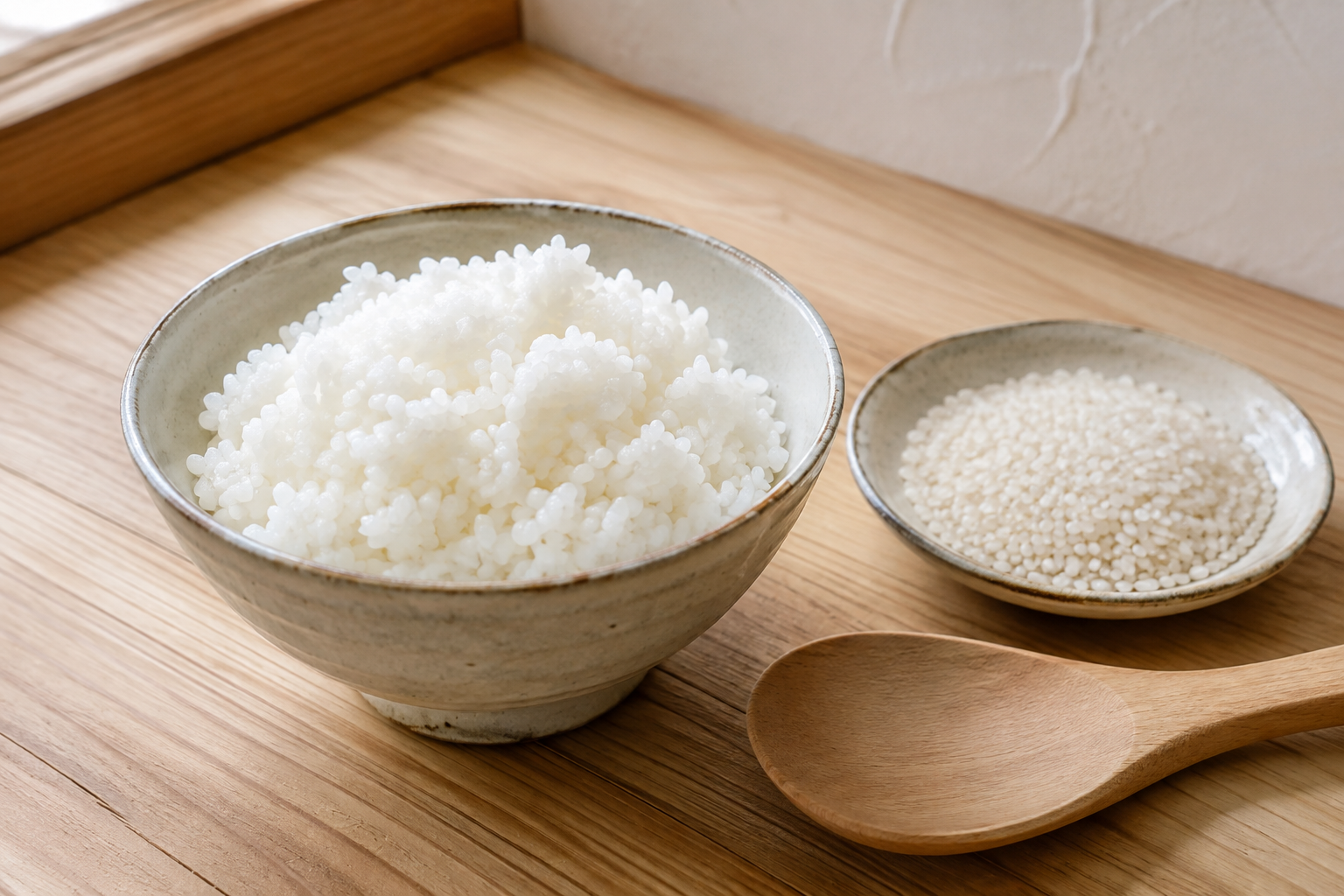
Japanese rice usually refers to short-grain varieties of Japonica rice used in everyday Japanese cooking. When properly cooked, the grains are plump, tender, slightly glossy, and cohesive enough to pick up with chopsticks.
It is served plain with meals and also forms the base of sushi, onigiri, donburi, rice bowls, and many regional dishes. However, ordinary Japanese rice, sushi rice, and glutinous rice are not interchangeable terms. Our rice cooker, gas cooker, and hagama comparison explains how the cooking method also changes control and convenience.
This guide explains the main types of Japanese rice, what gives them their characteristic texture, and how to choose the right rice outside Japan. It also follows sushi rice from selection and washing through soaking, cooking, vinegar mixing, and service, using the practical judgments made at a sushi counter.
Japanese Rice: The Basics
Most rice eaten with everyday meals in Japan is uruchimai, the non-glutinous rice used for plain steamed rice. It generally belongs to the Japonica group and has shorter, rounder grains than long-grain varieties such as basmati or jasmine rice.
After cooking, Japanese short-grain rice holds together without becoming a single paste. This texture makes it suitable for eating with chopsticks and shaping into foods such as onigiri. Its flavor is mild, so it can accompany grilled fish, vegetables, pickles, soup, curry, and strongly seasoned dishes without dominating them.
Rice is also central to the structure of a traditional Japanese meal. In a typical washoku meal, rice is the staple served alongside soup and several dishes rather than simply being treated as a side.
What Does Japanese Rice Taste Like?
Plain Japanese rice has a gentle sweetness and a clean, subtle aroma. Freshly cooked grains should feel tender and moist, with a light chew and a surface that is cohesive rather than wet or mushy.
Texture and flavor vary with the cultivar, growing region, harvest, storage, polishing, and cooking method. Some varieties are firmer and more distinct, while others are softer, sweeter, or more adhesive. For beginners, correct preparation often makes a greater difference than buying the most expensive brand.
The Main Types of Japanese Rice
Uruchimai: Everyday Japanese Rice
Uruchimai is the standard non-glutinous rice used for plain steamed rice, rice bowls, onigiri, curry rice, and many other everyday dishes. It is also the usual starting point for sushi rice.
Outside Japan, packages may use labels such as “Japanese short-grain rice,” “short-grain Japonica rice,” or “sushi rice.” The last label can be confusing because uncooked rice sold for sushi is not yet sushi rice in the culinary sense.
Mochigome: Glutinous Rice
Mochigome is Japanese glutinous rice. Once steamed, it becomes much stickier and more elastic than ordinary uruchimai. It is used to make mochi and dishes such as sekihan, in which glutinous rice is cooked with red beans.
Despite the English name, glutinous rice does not refer to gluten. It describes the rice’s glue-like texture. Mochigome is not the standard choice for plain meals or ordinary sushi.
Hakumai and Genmai: White and Brown Rice
Hakumai is polished white rice with the bran and germ removed. It cooks relatively quickly and has the soft, clean texture most commonly associated with Japanese steamed rice.
Genmai is brown rice with the bran layer retained. It has a firmer bite and a nuttier flavor and normally requires more water and a longer soaking or cooking program. Follow the instructions for the specific rice and cooker rather than using the same settings as white rice.
Is Japanese Rice the Same as Sushi Rice?
Not exactly. Japanese short-grain rice refers to the grain itself. Sushi rice is cooked Japanese-style short-grain rice seasoned with vinegar, salt, and often sugar.
In Japanese sushi restaurants, the seasoned rice is commonly called shari. Its acidity, sweetness, salt level, temperature, and firmness are adjusted to balance the topping. The rice—not raw fish—is the defining element of sushi.
A bag labeled “sushi rice” may simply contain uncooked short-grain or medium-grain rice considered suitable for sushi. You still need to cook and season it before it becomes sushi rice.
How Sushi Chefs Choose Rice
Rice for everyday meals is often praised for sweetness, softness, and a chewy texture. Sushi rice has a different job. It must absorb seasoned vinegar, retain the outline of each grain, hold together under the topping, and then loosen in the mouth at approximately the same moment as the fish.
Moderate Stickiness and Clear Grains
Very sticky, strongly sweet rice can become dense after vinegar is added. Chefs may therefore choose relatively clean, less adhesive varieties such as Sasanishiki or Hatsushimo, or a purpose-developed sushi variety such as Emi no Kizuna. Japan’s National Agriculture and Food Research Organization describes Emi no Kizuna as absorbing vinegar well, mixing easily, holding together when shaped, and loosening smoothly when eaten.
Variety alone does not determine the result. Growing region, crop year, storage, polishing, cooker, and the restaurant’s vinegar blend all matter. Many shops create a house blend rather than depending on one famous name.
Why Some Chefs Blend New and Previous-Crop Rice
Freshly harvested rice often contains more moisture and can cook softer with the same amount of water. Properly stored rice from the previous crop may absorb seasoned vinegar more predictably and help the grains remain distinct. Some chefs use it deliberately or blend crop years for consistency. This does not mean old rice is automatically better: age, oxidation, storage, and condition must all be judged before cooking.
Washing, Soaking, and Draining for Sushi Rice
Treat the First Water Quickly
Dry polished rice begins taking up water immediately. The first rinse should therefore be clean and quick so that loose bran and stale aromas do not remain around the grains. If local tap water has an unpleasant taste or odor, use suitable filtered or bottled water for the first rinse and cooking. Expensive mineral water is not automatically better; mineral content can also change the result.
Modern polished rice generally needs gentle washing rather than aggressive grinding. Stir with the fingers, drain, and repeat without crushing the grains. Damaged surfaces release more starch and can create excessive stickiness.
Soaking Time Changes with Season and Rice
Soaking helps water reach the center of the grain. Warm summer water speeds absorption, while cold winter water slows it. Rough working ranges might be 30–45 minutes in warmer conditions and 60–90 minutes in colder conditions, but the correct time depends on the rice, water temperature, crop condition, and cooking equipment. The manufacturer’s instructions and an actual test batch are more reliable than a fixed seasonal rule.
Drain and Measure, Do Not Guess
After soaking, some professional methods drain the rice before adding a precisely measured amount of cooking water. A 15–30 minute draining period is a common workflow, but it should not be copied blindly. Kitchens that need repeatability often work by weight and record the rice, absorbed water, added water, room temperature, and final texture.
Cooking and Mixing the Shari
Cook Firmer, but Adjust to the Rice
Because seasoned vinegar adds moisture after cooking, sushi rice is commonly cooked firmer than plain table rice. Reducing the water by around ten percent can be a test starting point for some rice and equipment, not a universal formula. New rice, previous-crop rice, small batches, gas pots, pressure cookers, and electric rice cookers all require different adjustments.
After cooking, allow the rice to finish steaming according to the equipment and method. Resting lets heat and moisture become more even, but automatically adding another 10–15 minutes can overcook rice in a machine whose programmed cycle already includes this stage.
Move to a Handai and Add the Vinegar
Hot rice may be transferred to a lightly moistened wooden handai, also called a sushi tub. Wood helps manage surface moisture, but it should not be soaking wet or completely dry. Seasoned vinegar—rice vinegar, red vinegar, salt, sugar, or a house blend—is distributed promptly while the rice is hot enough to absorb it.
Cut and Fold without Crushing
The rice paddle is moved with cutting and folding motions rather than used to mash or stir. Large clumps are separated while the grains are coated evenly. Airflow from a fan can remove excess steam and help produce a glossy surface, but excessive fanning can cool and dry the outside before the vinegar is distributed. Timing and coordination matter more than speed alone.
Sushi Rice and Plain Rice Aim for Different Results
| Point | Plain Table Rice | Sushi Rice | Chef’s Intention |
|---|---|---|---|
| Texture | Soft, plump, and pleasantly cohesive | Clearly defined grains with controlled looseness | The rice and topping should release together |
| Cooking | Adjusted for enjoyment as plain rice | Often firmer to leave room for seasoned vinegar | Prevent a wet or heavy finished shari |
| Serving temperature | Often served hot | Served warm or near the restaurant’s chosen counter temperature | Support aroma, rice texture, and the behavior of fish fat |
| Seasoning | Usually cooked with water and eaten with accompanying dishes | Seasoned with vinegar, salt, and sometimes sugar | Create balance with the topping and the progression of the meal |
There is no universal requirement that shari remain exactly 36–37°C. A chef watches the room, the rice batch, the topping, and the pace of service. The practical target is warm, aromatic rice that does not make the fish feel refrigerator-cold or turn its fat waxy.
How Is Japanese Rice Used?
Japanese rice appears in both simple daily meals and carefully prepared dishes:
- Gohan: plain steamed rice served with a meal
- Onigiri: shaped rice balls, often filled or seasoned
- Donburi: a bowl of rice topped with meat, fish, egg, or vegetables
- Sushi: vinegared rice combined with seafood, vegetables, egg, or other ingredients
- Takikomi gohan: rice cooked with stock, seasonings, and other ingredients
- Okayu: soft rice porridge made with a higher proportion of water
- Mochi: rice cakes traditionally made from steamed glutinous rice
Many seasoned rice dishes also rely on dashi to add depth without overpowering the rice.
How to Choose Japanese Rice Outside Japan
For everyday Japanese meals, look for “Japanese short-grain rice” or “short-grain Japonica rice.” A good medium-grain Japonica-style rice can also work when genuine short-grain rice is difficult to find.
Check the package carefully:
- Choose non-glutinous rice for steamed rice, donburi, onigiri, and sushi.
- Choose glutinous rice only when making mochi or a recipe that specifically requires it.
- Do not substitute jasmine or basmati if you want the cohesive texture of Japanese rice.
- Use the water ratio and cooking instructions provided for that particular product.
The place of cultivation does not by itself determine whether a rice will work. Japonica varieties grown outside Japan can still produce an appropriate texture for Japanese cooking.
Basic Preparation for Everyday Rice
For plain Japanese rice, measure the rice and water accurately, rinse gently, and follow the product and cooker instructions for soaking and water quantity. After cooking, rest only as required by the equipment, then loosen the rice with a cutting and folding motion so excess steam escapes without crushing the grains.
The professional sushi method above is a different target rather than a universal upgrade. Plain rice should be enjoyable with the meal; shari must also accept vinegar and perform beneath a topping.
Buying, Cooking, and Storing Japanese Rice
Is Japanese rice always short-grain?
Short-grain Japonica rice is the standard for many Japanese meals, but medium-grain rice is also grown and used. Outside Japan, medium-grain Japonica-style rice is often sold as a practical substitute.
Why is Japanese rice sticky?
Its starch composition and cooking method give the grains a cohesive texture. Ordinary Japanese rice sticks together enough for chopsticks or onigiri but is less elastic than glutinous mochigome.
Can I use Japanese rice for dishes other than sushi?
Yes. Sushi is only one use. The same type of non-glutinous short-grain rice can be served plain or used for rice bowls, curry rice, onigiri, and many cooked rice dishes.
Choose Japanese Rice by the Meal You Want to Cook
Japanese rice is usually short-grain Japonica rice valued for its plump grains, mild sweetness, and cohesive texture. Everyday uruchimai is different from glutinous mochigome, while sushi rice is a preparation made by seasoning cooked rice rather than a completely separate grain.
For most Japanese home cooking, choose non-glutinous Japanese short-grain rice, follow the package’s water and soaking guidance, and handle the cooked grains gently. Understanding these basics makes sushi, onigiri, donburi, and the everyday Japanese table much easier to appreciate.
See Japanese Rice in Finished Dishes
- Why sushi rice temperature changes with the fish
- Japanese sweet potato rice and other seasonal dishes
If this guide gave you a clearer understanding of a Japanese ingredient, you can support Japan Food Compass on Ko-fi and help us continue sharing carefully researched guides and original kitchen stories.