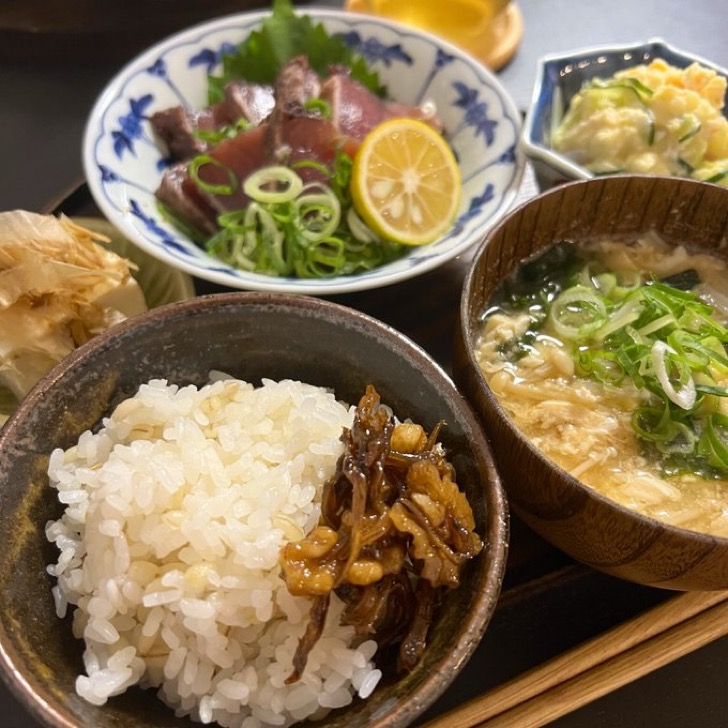
A teishoku often arrives without ceremony. Rice, soup, a main dish, pickles, and perhaps one or two small bowls appear together on a tray. The price may be modest and the room may be busy. Yet from a cook’s point of view, this everyday format is one of the clearest tests of a Japanese kitchen.
The challenge is not simply to prepare several acceptable dishes. The rice must finish properly, the soup should retain its aroma, the fried or grilled main needs to reach the tray at its best, and cold or room-temperature accompaniments must be ready without delaying the hot food. A good teishoku is a small act of coordination: separate dishes arriving as one meal.
Teishoku Describes a Format, Not One Recipe
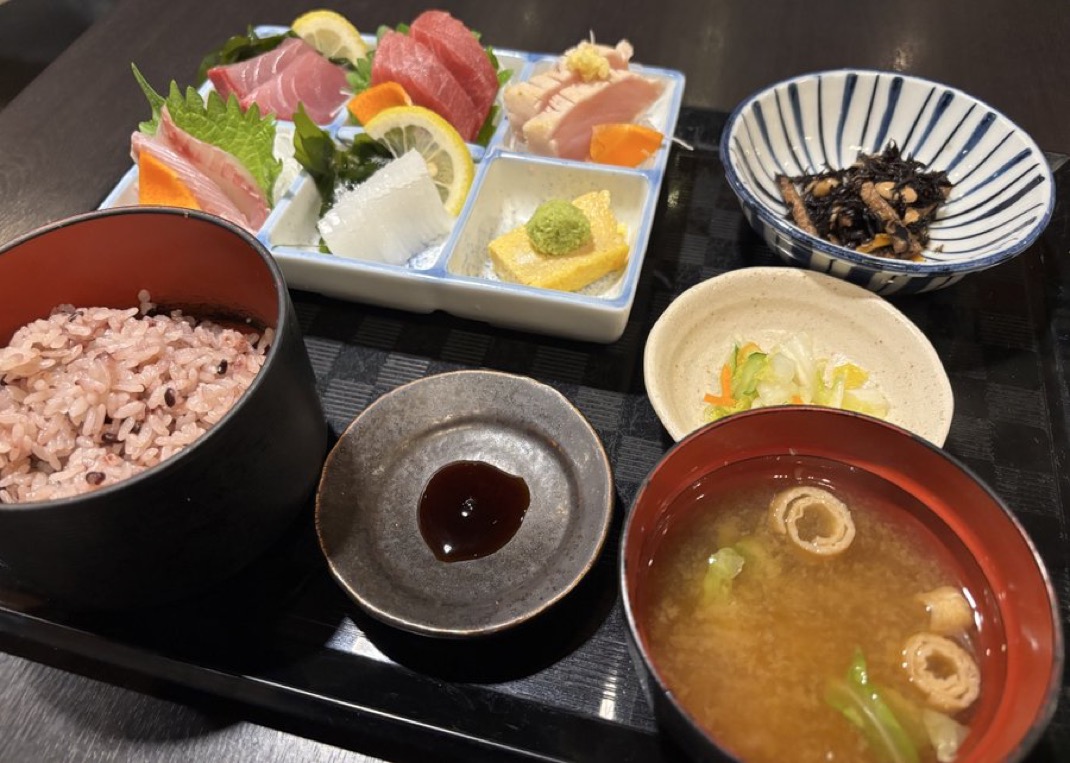
Teishoku (定食) means a predetermined meal set. In its familiar Japanese form, a customer chooses a main dish and receives it with rice, soup, pickles, and one or more accompaniments. The main might be grilled fish, sashimi, tonkatsu, karaage, ginger pork, tofu, or a Japanese-style hamburger steak. The supporting dishes depend on the restaurant.
This is why teishoku is better understood as a relationship between dishes than as a recipe. Rice provides the center of gravity. Soup changes the pace and refreshes the mouth. The main supplies the strongest flavor or texture, while pickles and small dishes provide acidity, bitterness, vegetables, or a quieter taste between richer bites.
The format often draws on the logic of ichiju sansai—one soup and three dishes served with rice and pickles—but a commercial teishoku does not promise that exact count. A simple set may contain only rice, soup, a main, and pickles. Another may include several small bowls. Ichiju sansai describes a traditional meal structure; teishoku tells the customer that the listed components are sold together as one set.
Read the Whole Tray Before Judging the Main Dish
When a tray reaches the table, the first few seconds reveal useful clues. They do not prove that a restaurant is “authentic,” and one imperfect bowl does not condemn an entire kitchen. They show whether the components appear to have been considered together.
Rice: look for separation, moisture, and warmth
For many Japanese cooks, rice is not a neutral filler. It is the element the other dishes are designed to accompany. Properly cooked short-grain rice should hold recognizable grains while remaining cohesive enough to lift with chopsticks. A gentle gloss suggests surface moisture; a crushed, gummy mass at the bottom of the bowl may indicate rough holding or serving.
Do not reduce quality to whether each grain literally “stands up.” Rice variety, polishing, water, cooker, holding time, and the restaurant’s intended texture all matter. The more useful question is whether the rice tastes fresh, warm, and suited to the food around it.
Soup: aroma matters more than maximum heat
Miso soup is often at its most expressive when dashi and miso aromas rise with the steam. Prolonged hard boiling can dull those aromas and make the suspension seem coarse, but a single bubble does not turn the soup into worthless water. Pork-rich tonjiru, shellfish soup, and other styles may be handled differently from a delicate clear miso soup.
A covered bowl may concentrate aroma, but many everyday restaurants use uncovered bowls. Judge what is in front of you: a clear relationship between dashi, miso, and ingredients, served at a comfortable drinking temperature.
Small dishes: look for purpose, not proof of where they were made
Kinpira gobo, simmered hijiki, dressed greens, chilled tofu, or pickles should create contrast rather than repeat the main dish’s sweetness and salt. A lightly seasoned vegetable can reset the palate after fried food; an acidic pickle can make the next bite of rice feel sweeter.
You cannot reliably determine from appearance alone whether a side dish was made entirely in-house or purchased from a supplier. Prepared food is not automatically poor, and house-made food is not automatically good. What the diner can judge is whether the portion tastes intentional and supports the rest of the tray.
The Kitchen Is Synchronizing Different Temperatures, Not Making Everything Hot
The phrase “serve everything hot” misses the real skill. Sashimi should remain cool. Pickles and dressed vegetables may be cool or near room temperature. Rice should be pleasantly hot, miso soup aromatic and drinkable, and a fried cutlet crisp from the fryer rather than steaming under a cover.
The kitchen is therefore coordinating different ideal temperatures. The rice-and-soup station watches the progress of the grill and fryer. The main-dish cook signals when only a short time remains. Small dishes are placed early enough to avoid delay but not so early that they sit neglected. The tray is released when its components reach their intended states together.
That synchronization is one reason teishoku can be more technically revealing than its price suggests. A chef may execute an excellent piece of fish, but the meal still feels disjointed if the rice waited too long or the soup arrived after the diner had begun eating.
Three Kitchen Failures That Changed How I See a Tray
Opening the rice before its required rest
During training, our rice supply ran out in the middle of the lunch rush. I hurried the next batch and opened the cooker as soon as its alarm sounded, skipping the resting stage required by that rice and equipment. The surface was wet while parts of the center remained unpleasantly firm. A customer immediately noticed and asked whether the rice was undercooked.
The lesson was not that every batch everywhere requires exactly 15 minutes. Some modern rice cookers include steaming in their programmed cycle; other pots and rice varieties need a separate rest. The lesson was that service pressure does not change the physical process. A cook must understand the method being used and build that time into the production schedule.
Letting delicate miso soup boil unattended
As a new cook, I once left a prepared pot of miso soup over high heat while working on another task. By the time I returned, large bubbles were rolling through the center. The aroma had flattened and the texture no longer resembled the soup we had intended to serve. My chef made me prepare the batch again.
That mistake taught me to watch for niebana: the point at which the soup is thoroughly hot and beginning to move near the edge, before prolonged boiling drives away its most delicate aromas. It is a quality principle for that style of soup, not a claim that every regional soup must be heated identically.
Finishing the cutlet before the rest of the tray
On another busy service, the fryer station completed a tonkatsu before the rice-and-soup station was ready. The cutlet waited for roughly two minutes. That sounds minor, but steam moved into the crust while it sat, taking away the dry crackle we had worked to create. The food was still edible; it was simply no longer at its peak.
Since then, I have thought of a teishoku ticket as a shared finish line. The stations do not need theatrical split-second precision, but they do need communication, realistic lead times, and the discipline not to complete one fragile component far ahead of the others.
How to Order Without Turning the Meal Into a Questionnaire
Start by choosing the main dish according to the meal you want. Tonkatsu, karaage, or ginger pork suits a substantial meal with plenty of rice. Grilled mackerel or salmon emphasizes salt, smoke, and fish fat. Sashimi offers a cooler, lighter main, while simmered fish highlights seasoning and dashi.
Then check the small print or menu photograph for what is included. Rice size, refills, soup changes, and side-dish substitutions vary by restaurant. Gohan ōmori means a large serving of rice; gohan sukuname de onegaishimasu asks for less. A sign reading ご飯おかわり無料 indicates free rice refills, but never assume this applies without checking.
Tabletop condiments are options, not instructions to season everything immediately. Taste first. Tonkatsu sauce belongs with the cutlet rather than the rice; soy sauce for sashimi should be used lightly enough that the fish remains identifiable. Dressings and furikake vary by restaurant.
A raw egg may be offered as an add-on or included in a particular set. It can be mixed with soy sauce and spooned over warm rice as tamago kake gohan (TKG), but it is not a mandatory or especially “expert” way to eat teishoku. Use only an egg the restaurant intends for raw consumption and eat it promptly. People at higher risk from foodborne illness should follow medical and public-health advice regarding raw egg.
Is a Seafood Bowl a Teishoku?
A bowl dish and a set-meal format can overlap, but they are not synonyms. Donburi describes food served over rice in one bowl. Teishoku describes several predetermined components sold together as a meal.
A seafood bowl served by itself is kaisendon, a type of donburi. If the restaurant serves that bowl with miso soup, pickles, and small dishes as one listed set, it can reasonably be called a kaisendon teishoku or a kaisendon set. The main remains a rice bowl, while the way it is sold and accompanied is teishoku-like.
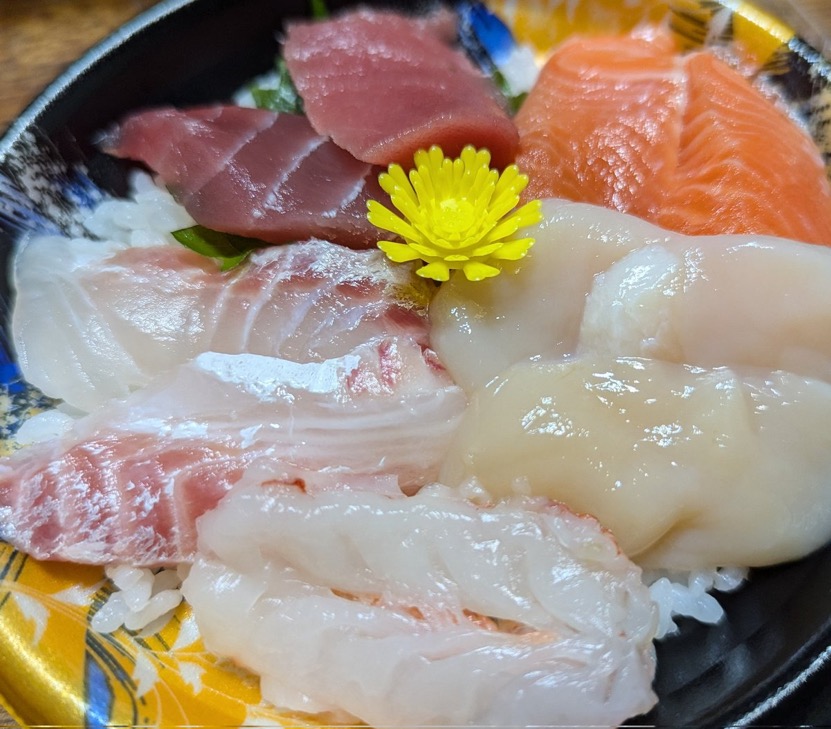
This distinction also explains why the same food can appear in two formats. Sashimi served on a separate plate with rice and soup is a sashimi teishoku. The same fish placed directly over rice becomes kaisendon; add soup and sides, and the menu may present it as a donburi set.
Allergies and Dietary Restrictions Need Direct Questions
A tray makes ingredients visible, but it does not reveal dashi, marinades, shared fryers, or cross-contact. Fish stock may appear in miso soup and vegetable dishes. Sauces can contain soy and wheat. Ginger pork contains pork by definition, while mirin or sake may be used in fish, meat, and simmered dishes. Fried items may share oil with seafood, meat, wheat, or egg.
Ask before ordering rather than expecting the kitchen to rebuild a set after it is served:
- Arerugī ga arimasu. — I have an allergy.
- Kore ni butaniku wa haitte imasu ka? — Does this contain pork?
- Sake ya mirin o tsukatte imasu ka? — Is sake or mirin used?
- Onaji abura de agete imasu ka? — Is it fried in the same oil?
Some restaurants can replace a small dish or adjust an uncomplicated seasoning; others cannot do so safely during service. A severe allergy should never depend on an assumption that substitution eliminates cross-contact. Japan’s Consumer Affairs Agency advises diners and businesses to communicate specifically about allergen information and unintended mixing.
You Do Not Have to Follow a Prescribed Eating Order
Alternating rice, a main dish, and soup is sometimes described as sankaku-tabe, or triangular eating. It can be a useful way to experience the meal: salty grilled fish changes the next bite of plain rice, soup clears the palate, and a pickle restores contrast.
It is not compulsory restaurant etiquette, and diners do not need to trace a rigid triangle with every three bites. The practical idea is simply not to forget that the dishes were designed to interact. Eating all of a highly seasoned main first can leave only plain rice at the end, while alternating allows the rice to moderate stronger flavors.
Lift the rice bowl or soup bowl when eating, use chopsticks for solid ingredients, and drink soup directly from the bowl unless the restaurant provides another utensil. Beyond ordinary table manners, there is no examination to pass. Follow the pace that lets you enjoy the temperature and balance of the tray.
What a Well-Composed Teishoku Leaves Behind
A good teishoku does not require expensive ingredients or a mathematically perfect one-soup-three-dish arrangement. It needs each component to have a reason for being there. Rice should invite another bite of the main. Soup should add aroma and moisture without overwhelming the food. Small dishes should create contrast, and the kitchen should release the tray before its most fragile component loses its character.
That is why this everyday set meal deserves more attention than its modest appearance suggests. It compresses the logic of washoku, the coordination of a restaurant line, and the rhythm of the Japanese table into one tray. For a traveler who wants to understand how ordinary dishes work together, teishoku is not merely a convenient lunch. It is one of the most legible meals in Japan.
Its format also differs from a bento, which is packed for portability and may be eaten later, and from kaiseki, where courses generally unfold over time. Teishoku’s identity lies in simultaneity: the whole meal is present, and every choice can be tasted in relation to the others.
Sources Used for Meal Structure and Dining Safety
- Ministry of Agriculture, Forestry and Fisheries: Washoku and the One-Soup, Three-Dish Structure
- Ministry of Agriculture, Forestry and Fisheries: Characteristics of Washoku Menu Structure
- Japan National Tourism Organization: Dining in Japan and Teishoku
- Consumer Affairs Agency: Food Allergies When Eating Out
- Ministry of Health, Labour and Welfare: Hygiene Measures for Eggs and Egg Products