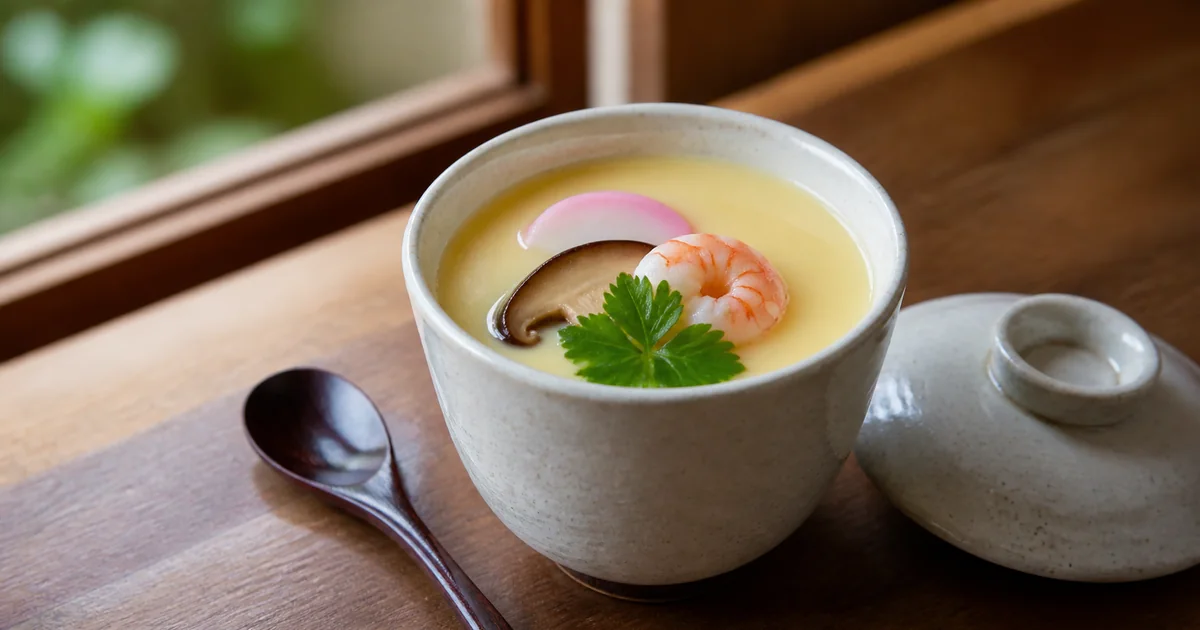
Chawanmushi is a savory Japanese steamed egg custard made by gently cooking eggs with dashi in a small cup. Its name combines chawan, meaning a tea bowl or rice bowl, and mushi, meaning steamed. Unlike a sweet dessert custard, it is lightly seasoned and usually contains small pieces of chicken, shrimp, mushrooms, fish cake, or seasonal vegetables.
The dish can surprise first-time visitors. It looks soft and creamy like custard, but arrives warm and tastes of broth rather than vanilla or sugar. Once that expectation changes, chawanmushi becomes easier to appreciate as a delicate soup-and-egg dish with ingredients hidden beneath its smooth surface.
From a professional kitchen perspective, chawanmushi is an exercise in temperature control. The egg-to-dashi ratio determines how delicate the custard can be, while the size of the cup, temperature of the mixture, amount of filling, and strength of the steam decide whether it sets smoothly or develops a coarse, hole-filled texture.
What Does Chawanmushi Taste Like?
Chawanmushi has a gentle savory flavor led by dashi. Egg gives the custard mild richness, while soy sauce, salt, and sometimes mirin add restrained seasoning. The result should not taste aggressively salty or strongly eggy. Good chawanmushi lets the aroma of the stock and the individual fillings remain clear.
The stock explains much of its character. Traditional versions often use kombu and katsuobushi, although recipes vary. Our guide to what dashi is covers the main fish-based and plant-based styles.
Its texture is silky, tender, and barely firm enough to hold together on a spoon. It is softer than many Western baked custards and should not be rubbery. Small holes or a spongy texture usually indicate that the egg mixture became too hot or cooked too quickly.
Why Is Chawanmushi Not Sweet?
English speakers often associate the word custard with pudding, flan, pastry cream, or other desserts. Custard, however, describes a mixture thickened by egg; it does not have to contain sugar. Chawanmushi belongs to the savory side of that broad family.
| Feature | Chawanmushi | Sweet custard or flan |
|---|---|---|
| Main liquid | Dashi | Milk or cream |
| Seasoning | Soy sauce, salt, sometimes mirin | Sugar and often vanilla |
| Fillings | Chicken, shrimp, mushrooms, fish cake | Usually none, or caramel and fruit |
| Role in a meal | Appetizer or small savory dish | Dessert |
Thinking of it as a softly set dashi soup is often more useful than expecting dessert. The unfamiliar combination of warm temperature, delicate egg, and seafood-scented stock is also why some newcomers need more than one taste to enjoy it.
Common Chawanmushi Ingredients
There is no single required set of fillings. Restaurants and households adjust the dish to the season, region, occasion, and ingredients available. Common additions include:
- Chicken: small seasoned pieces add richness and a firm bite.
- Shrimp: contributes sweetness and is easy to recognize near the surface.
- Shiitake: adds an earthy aroma and extra umami.
- Kamaboko: sliced steamed fish cake provides color and a springy texture.
- Ginkgo nut: a traditional addition with a firm texture and mild bitterness.
- Mitsuba: Japanese parsley used as a fresh aromatic garnish.
Autumn versions may feature matsutake mushrooms, while seafood restaurants may use crab, scallop, or other local ingredients. The fillings are placed in the cup before the strained egg-and-dashi mixture is poured over them.
The Egg-to-Dashi Ratio
The useful way to calculate chawanmushi is by weighing the egg without its shell and comparing it with the seasoned dashi. Egg size labels are only a starting point because the actual edible weight varies.
- About 1 part egg to 3 parts dashi: a dependable starting point that sets firmly enough for home preparation and handling. For example, 50 g of egg can be combined with about 150 ml of seasoned dashi.
- About 1 part egg to 3.5–4 parts dashi: a more delicate restaurant-style range that can produce a softer, almost melting custard. It leaves less margin for variations in egg strength, salt, fillings, cup size, and steam.
These ratios are working ranges rather than universal “golden” numbers. Salt and other dissolved ingredients affect how egg proteins set, and watery fillings can change the effective ratio. A chef tests the full mixture, not the egg and dashi in isolation.
Dashi and Seasoning
Clear kombu-and-katsuobushi ichiban dashi is a classic base. A sushi restaurant may add a restrained amount of sea bream or other fish-bone stock, clam broth, or seasonal seafood liquid, but the added flavor should remain clean enough for the egg and fillings to be recognizable. Light soy sauce, salt, mirin, and sake are used carefully to preserve the pale color and aroma.
The seasoned dashi must cool before it is mixed with the egg. It does not need to be refrigerator-cold, but it should be cool enough that it cannot begin coagulating the egg before the custard enters the steamer.
How Chefs Create a Silky Custard
Mix Gently, Strain, and Remove Bubbles
The egg is loosened without whipping in unnecessary air, then mixed with cooled dashi and passed through a fine strainer. Straining removes chalazae and unmixed white that would interrupt the texture. After pouring, surface bubbles can be lifted with a spoon or touched with a skewer. Some professional kitchens pass a flame very briefly over the surface, but this requires appropriate equipment and care; a spoon is the safer home method.
Controlled Heat, Not One Fixed Time
One professional approach begins with strong steam for roughly one or two minutes, then reduces the heat so the custard cooks gently. A small cup might need around another 10–12 minutes, but depth, material, filling temperature, batch size, and steamer performance can change that substantially.
The problem called su occurs when excessive heat makes the egg network contract rapidly while steam and liquid form holes. Rather than treating 80–85°C as a guaranteed setting, control the steam so the mixture heats gradually without boiling. A skewer inserted near the center should release clear liquid rather than raw, cloudy egg.
Manage the Steamer Lid
Covering each cup or wrapping the steamer lid can prevent condensation from marking the surface. Any cloth must be secured well away from the flame or heating element. Leaving a chopstick-sized gap under the lid is another traditional way to vent excess steam and moderate the chamber.
Why Chawanmushi Fails
| Symptom | Likely Cause | Professional Response |
|---|---|---|
| Coarse texture or many holes | Steam was too strong, the mixture heated too quickly, or it cooked too long | Vent the lid, reduce the heat after the initial stage, and test the actual cup and batch size |
| Custard remains liquid | Too much dashi, insufficient heat, cold or watery fillings, or proteolytic ingredients | Measure by weight, preheat or drain fillings appropriately, and continue gentle cooking until the center is set |
| Uneven or separated texture | Dashi was too hot when mixed, the egg was not distributed evenly, or the cup heated unevenly | Cool the dashi, mix and strain carefully, and space the cups so steam circulates |
| Pitted or wavy surface | Condensation fell from the lid or bubbles remained on the surface | Cover the cups, secure a lid cloth safely, and remove bubbles before steaming |
The Raw Maitake Problem
Raw maitake contains proteolytic enzymes that can interfere with the egg protein network and prevent the custard from setting. Cook or blanch it before adding it. Other fillings should also be considered for the water they release and the cooking time they require; seafood and poultry must reach a safe degree of doneness.
Its Role in a Sushi Omakase Course
At a sushi counter, chawanmushi changes the temperature and rhythm of the meal. It may appear after several cool appetizers, in the middle of the course, or before nigiri. The warm dashi provides a pause between raw or chilled preparations without requiring a strongly flavored dish.
The fillings can also express the season: bamboo shoot in spring, seafood and vegetables in summer, matsutake in autumn, and crab, shirako, or other rich ingredients in winter. Uni may be added as a topping or filling when its sweetness suits the stock. These are examples rather than a fixed calendar.
How to Eat Chawanmushi at the Counter
- Begin while it is warm: Chawanmushi is prepared around aroma and temperature. You do not need to rush, but leaving it untouched for a long time changes the intended texture and fragrance.
- Use the spoon to combine custard and fillings: Scoop gently so some dashi, egg, and a lower filling can be tasted together. There is no need to turn the custard out of its cup.
- Hold only a manageable cup: A small cup may be held, but leave a hot or heavy vessel on the counter and use the spoon safely.
- Replace the lid normally: When finished, return the lid in its original orientation. Placing it upside down can mark or damage lacquered and decorated surfaces.
Is Chawanmushi Vegetarian?
Usually not. Even when the visible fillings are vegetables, the dashi may contain katsuobushi or another fish ingredient. Standard versions may also include chicken, shrimp, or fish cake.
A vegetarian version can be made with kombu and shiitake dashi and vegetable fillings, but diners should ask rather than assume. Vegan chawanmushi requires an egg substitute as well as plant-based stock, so it is a modern adaptation rather than the standard dish.
Allergens and Dietary Considerations
Egg is unavoidable in traditional chawanmushi. Fish, shellfish, chicken, soy, and wheat may also be present through the stock, fillings, fish cake, or soy sauce. Recipes differ, and small ingredients may be hidden below the custard.
If you have an allergy, ask about both the dashi and every filling. A plain-looking surface does not confirm that the dish is free from seafood or gluten. People who need alcohol-free food may also wish to ask whether sake or mirin was used in the seasoning.
Troubleshooting Texture and Doneness
Is chawanmushi the same as egg drop soup?
No. Egg drop soup contains ribbons or pieces of egg suspended in liquid. Chawanmushi combines egg and stock before steaming, producing one soft, uniform custard around the fillings.
Is chawanmushi the same as tamago tofu?
They are related steamed egg preparations, but not identical. Tamago tofu is usually a smooth, unfilled egg custard that is chilled, unmolded, and served with sauce. Chawanmushi is normally served in its cup and contains fillings.
Can you eat the ginkgo nut inside?
Yes. A cooked ginkgo nut is an intentional traditional filling. It has a firm, slightly chewy texture and may taste mildly bitter. It should not be confused with decorative garnish.
Why is my chawanmushi watery?
Possible causes include an unsuitable egg-to-stock ratio, insufficient cooking, or liquid released by ingredients. Use a tested recipe, measure accurately, and confirm that poultry and seafood are fully cooked.
Silky Texture Depends on Gentle Heat
Chawanmushi is best understood as a warm, savory dashi custard rather than a Japanese version of sweet pudding. Its pleasure comes from the contrast between silky egg, aromatic broth, and small pieces of seasonal food discovered with each spoonful.
First-time diners should expect subtle flavor and a very soft texture. Try it slowly with some of the fillings rather than judging the plain surface alone. It is a compact introduction to the Japanese preference for dashi, seasonality, careful heat control, and understated presentation.