Umami is often introduced as “the fifth basic taste.” That definition is correct, but it does not tell you why a cook stands over a stockpot watching steam, color, movement, and aroma as carefully as the clock. Nor does it explain why kombu stock and bonito stock can each seem quiet on their own, then become strikingly fuller when they meet.
From the kitchen, umami is easiest to understand through dashi and comparison. Taste kombu dashi, katsuobushi dashi, and awase dashi made from both. The chemistry explains why the third can taste stronger; the craft explains whether that strength becomes a clear, elegant stock or a cloudy, fishy one.
Umami Is a Taste; Good Dashi Is a Larger Sensory Experience
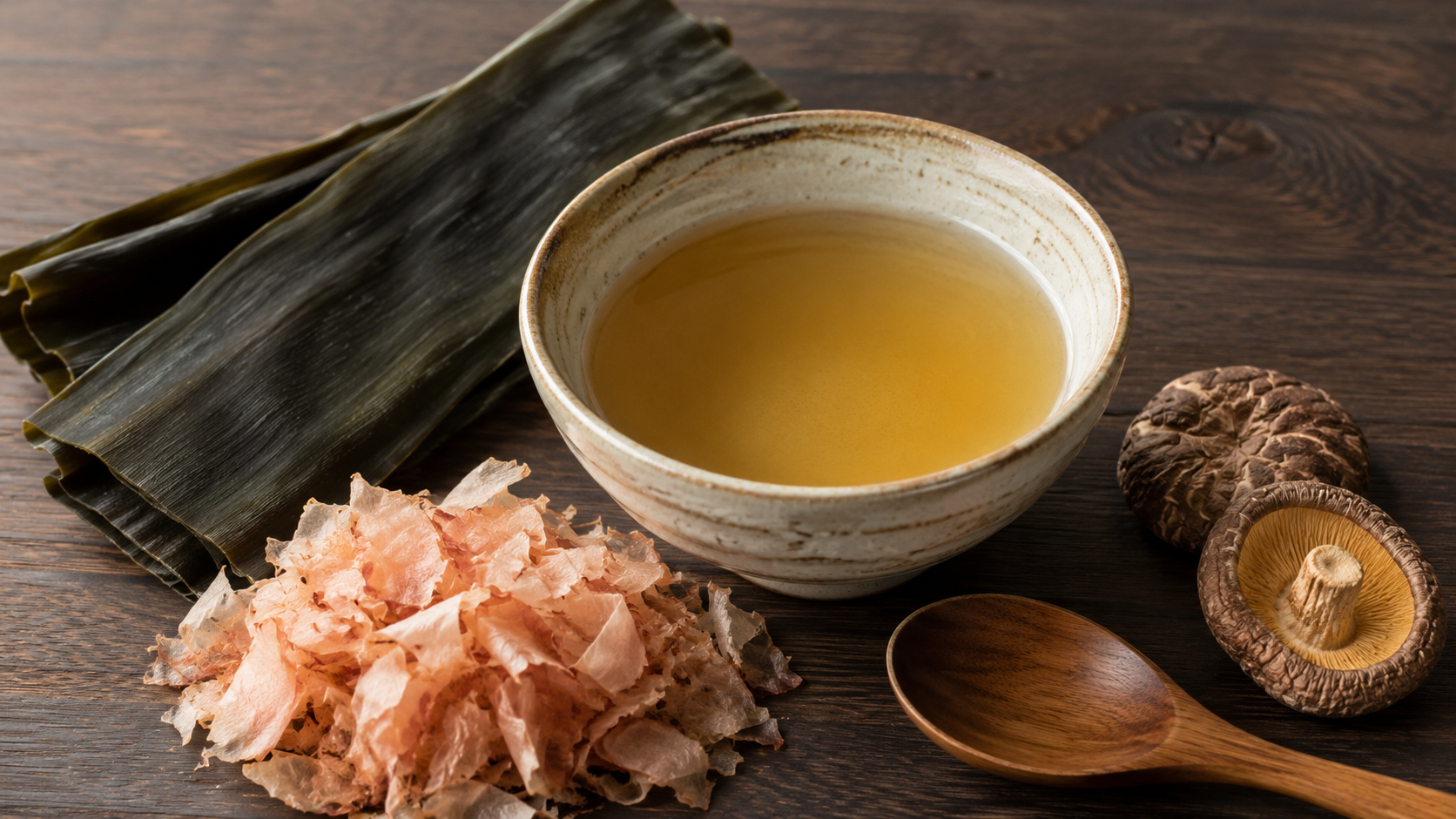
Umami is one of the basic tastes, alongside sweet, sour, salty, and bitter. It is produced chiefly by free glutamate and is intensified by certain 5′-nucleotides, especially inosinate and guanylate. Kombu is a notable source of glutamate, katsuobushi supplies inosinate, and dried shiitake is associated with guanylate.
That definition needs one important boundary. Aroma is not umami. Golden color is not umami. Fat, smoke, heat, texture, and saltiness are not umami either. They can all contribute to flavor—the total eating experience—while umami remains one taste component within it.
This distinction does not diminish a cook’s judgment. It makes the judgment more precise. When I assess first dashi, I am evaluating umami together with volatile bonito aroma, visual clarity, bitterness, astringency, temperature, and the way the stock finishes after swallowing. A bowl may contain plenty of glutamate and still be a poor first dashi.
What I Watch While Drawing First Dashi
A timer and thermometer are useful. Professional judgment begins with repeatable control, not with pretending that numbers do not matter. But identical numbers can still produce different results when kombu thickness, shaving size, water, and ingredient age change. The cook therefore reads several signals at once.
Aroma: the moment smoke and fish become rounded
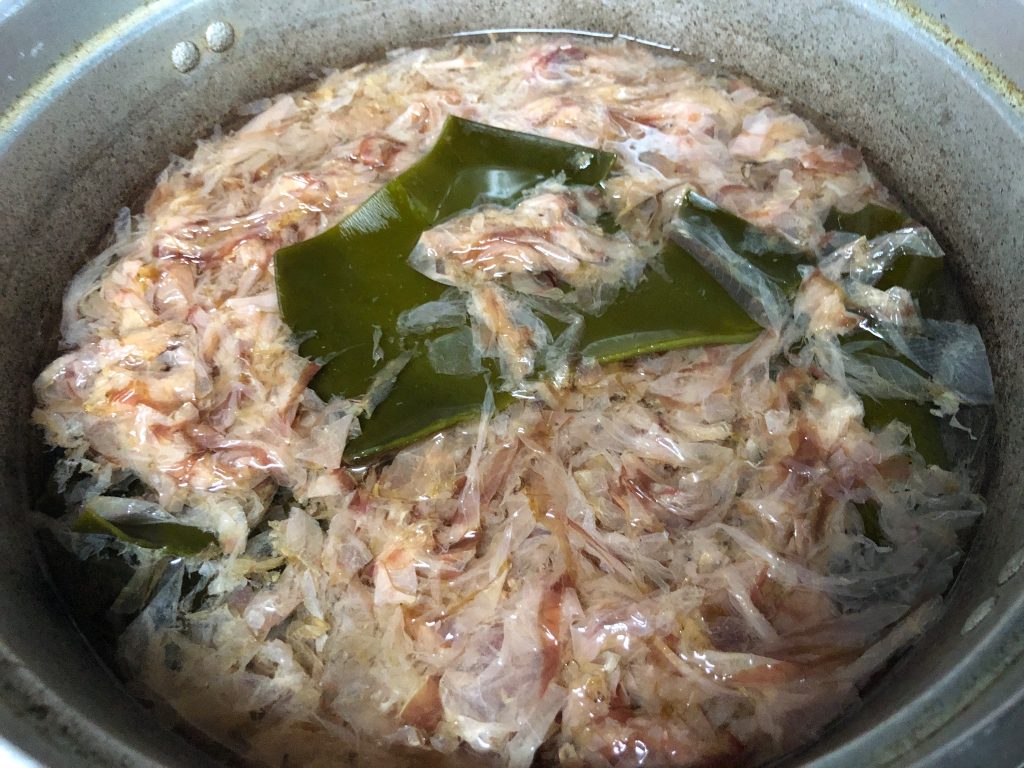
Katsuobushi should give a clear cured-fish aroma with smoke and gentle sweetness, not an aggressive boiled-fish smell. Some methods add the flakes after bringing the kombu stock to a boil and switching off the heat; others use different temperatures and contact times. There is no universal rule that every professional extracts bonito at exactly 80°C.
I look for the point at which the rising steam smells full but still clean. Continued agitation or prolonged high heat can flatten delicate top notes and pull the stock toward a heavier profile. That may be useful for another dish, but it is not the first dashi I want for a clear soup.
Clarity: a target for clear first dashi, not a definition of quality everywhere
For a refined ichiban dashi intended for suimono, a luminous pale-gold appearance matters. Fine particles, vigorous agitation, or forceful pressing can make the stock cloudy. I lift a ladle and check whether light passes through cleanly.
Cloudiness is not universal proof of bad cooking. Miso soup is naturally opaque, chicken paitan is intentionally emulsified, and some robust broths are designed to be cloudy. The meaningful question is whether the appearance matches the style being made.
Aftertaste: persistence without a dirty finish
Umami is often recognized by how it spreads and lingers rather than by an immediate sharp impact. With good first dashi, the savory impression remains after swallowing while the finish stays clean. A long aftertaste is not automatically desirable if it consists of bitterness, excessive smoke, oxidation, or fishiness.
Salt: a partner, not the source of umami
Unsalted dashi can seem quiet because it is being tasted outside the finished dish. A little salt can sharpen the overall perception, and salt interacts with other tastes. Yet 0.8–1.0% salt is not a universal “trace amount” for evaluating stock; it is closer to the seasoning range of some completed soups and varies with the dish, ingredients, and diner.
For comparison, add the same small measured amount to each sample rather than salting by intuition. Umami can also help lower-sodium food remain satisfying: a randomized blinded soup study found that adding glutamate improved palatability at lower salt concentrations. The practical lesson is balance, not permission to keep adding salt until the stock tastes powerful.
Three Cups Explain More Than a Definition
The clearest kitchen lesson is to prepare three simple samples under controlled conditions.
- Kombu dashi: restrained aroma, gentle marine sweetness, and glutamate-led savory depth that tends to build quietly.
- Katsuobushi dashi: a more immediate smoky and cured-fish aroma, with inosinate contributing to umami perception.
- Awase dashi: kombu and katsuobushi together, creating stronger perceived umami through the interaction of glutamate and inosinate.
These are tendencies, not fixed tasting notes. Kombu variety, bonito species and curing, shaving thickness, water, temperature, and concentration all change the result. Color also depends on technique and material; not every excellent kombu stock is almost colorless, and no responsible cook promises that an aftertaste must last several minutes.
To compare fairly, keep the water, ingredient quantities, temperature, extraction time, vessel, and serving temperature consistent. Taste unsalted first, then repeat with an equal measured amount of salt. This separates the ingredient comparison from the seasoning effect.
Water should also remain constant because mineral and ionic composition can change the result. The separate guide to Japanese tap water and dashi explains why hardness alone does not tell the whole story.
Why Kombu and Katsuobushi Become More Than Their Sum
Glutamate activates umami-sensitive pathways that include the T1R1/T1R3 taste receptor. Inosinate does not simply add another independent savory flavor. It can bind at a nearby site and enhance the receptor’s response to glutamate. This is the molecular basis of the synergy cooks discovered long before receptors were identified.
A scientific review has described the human response to a glutamate-and-inosinate mixture as approximately eight times the response to glutamate alone under the cited experimental conditions. That is the origin of the memorable “eight times” figure. It is not a recipe guarantee that every bowl of combined dashi will taste exactly eight times stronger.
Perceived intensity depends on concentration, ratio, temperature, salt, water composition, and the rest of the food matrix. Other umami-sensitive pathways may also contribute. The accurate culinary statement is that glutamate and inosinate can create powerful synergy; the exact multiplier belongs to the conditions under which it was measured.
The same logic travels well beyond Japan. Tomato and meat, aged cheese and tomato sauce, mushrooms and meat, or kombu and dried shiitake combine glutamate with nucleotide-rich ingredients in different ways. Umami has a Japanese name, but it is not confined to Japanese food.
The Day I Squeezed First Dashi Too Far
As a trainee, I once looked at the expensive bonito flakes left in the straining cloth and thought I was throwing flavor away. I pressed them repeatedly with the back of a ladle, determined to recover every final drop.
The stock became cloudier, and the finish turned coarse, fishy, and bitter. My chef tasted it once and immediately asked whether I had squeezed the flakes. The entire batch had to be redone.
At the time, I imagined that I had crushed cell membranes and released iron and oxidized fat. I cannot establish that mechanism from what happened in the pot. The safer explanation is practical: forceful pressing pushed fine particles and more strongly flavored liquid through the cloth, changing clarity, aroma, and the balance of bitter or astringent notes.
The rule I retained is specific: for a clear, delicate first dashi, let the flakes drain under their own weight rather than wringing them dry. The remaining ingredients are not useless. They can contribute to niban dashi, a second stock suited to strongly seasoned soups, simmered dishes, and other preparations where delicacy is not the only goal. They may also be repurposed in suitable cooked dishes.
Restraint does not mean that true umami exists only in the first transparent drop. It means choosing which qualities belong in the stock you are making and stopping before extraction changes its purpose.
How to Taste Umami at a Restaurant Without Inventing Rules
When a lidded clear soup arrives, opening the lid near the nose allows the first trapped aroma to rise toward you. Pause briefly and smell before sipping. There is no required three-second countdown; the useful habit is simply to notice aroma before heat and repeated sipping make it less distinct.
Then separate what you sense:
- Is the aroma smoky, marine, mushroom-like, fermented, or vegetal?
- Is the liquid salty, sweet, sour, bitter, or distinctly savory?
- Does the savoriness expand and persist after swallowing?
- Does the finish remain clean, or do smoke, fishiness, bitterness, or salt dominate?
For a clear suimono, luminosity and the absence of floating scum can indicate careful straining. But never use slight cloudiness alone to declare a cook incompetent. Ingredients, starch, fat, miso, emulsification, and the intended regional style all affect appearance.
The goal is not to perform expertise at the table. It is to become aware that a light-looking bowl can carry several layers at once: glutamate-led depth, nucleotide synergy, cured-fish aroma, seasoning, and the temperature chosen for service.
Umami Is Not the Same Thing as MSG—or Deliciousness
MSG is monosodium glutamate, the sodium salt of glutamic acid. When dissolved, it supplies glutamate that can contribute umami. The free glutamate naturally present in kombu, tomato, cheese, or fermented food contributes the same basic taste signal.
That does not make a spoonful of MSG and a bowl of kombu dashi identical. Whole foods and stocks also contain aromas, other tastes, color, texture, and many additional compounds. Umami describes a taste; it does not certify that a food is natural, artificial, healthy, unhealthy, refined, or delicious.
The U.S. Food and Drug Administration considers added MSG generally recognized as safe and notes that naturally occurring and added glutamate are chemically related in the same way. Ingredient labeling and individual dietary needs should still be respected, but a savory taste alone does not prove that added MSG is present.
The Cook’s Real Task Is Not Maximum Umami
The strongest stock is not automatically the best stock. Dashi for a delicate clear soup, a noodle broth, miso soup, and a simmered dish may require different concentration, aroma, and finish. The purpose of umami is often to support the central ingredient without making the diner think only about the stock.
That is why the cook watches more than the receptor chemistry. Aroma must remain appropriate to the dish. Clarity must suit the intended style. Salt must reveal rather than dominate. Extraction must stop before desirable depth becomes heaviness.
Umami is scientifically a basic taste. In the kitchen, understanding it becomes an exercise in restraint: combine ingredients intelligently, measure what can be measured, use the senses to catch what numbers miss, and leave enough space for the food itself.
Research and Culinary References
- Ministry of Agriculture, Forestry and Fisheries: Dashi and Umami
- Umami, the Fifth Basic Taste: Receptor Mechanisms and Food Flavor
- Molecular Mechanism for Umami Taste Synergism
- Randomized Blinded Study of Umami and Preferred Salt Concentration in Soup
- Ministry of Agriculture, Forestry and Fisheries: First and Second Dashi and Why Bonito Flakes Are Not Squeezed
- U.S. Food and Drug Administration: Questions and Answers on MSG
If this article deepened your understanding of Japanese food culture, you can support Japan Food Compass on Ko-fi and help us continue sharing carefully researched guides and original kitchen stories.