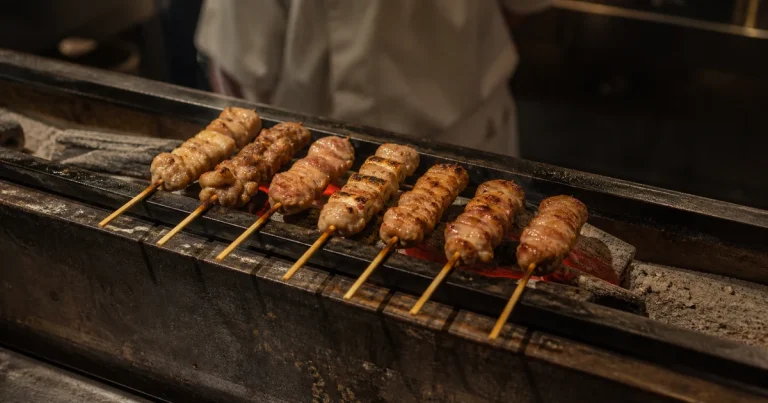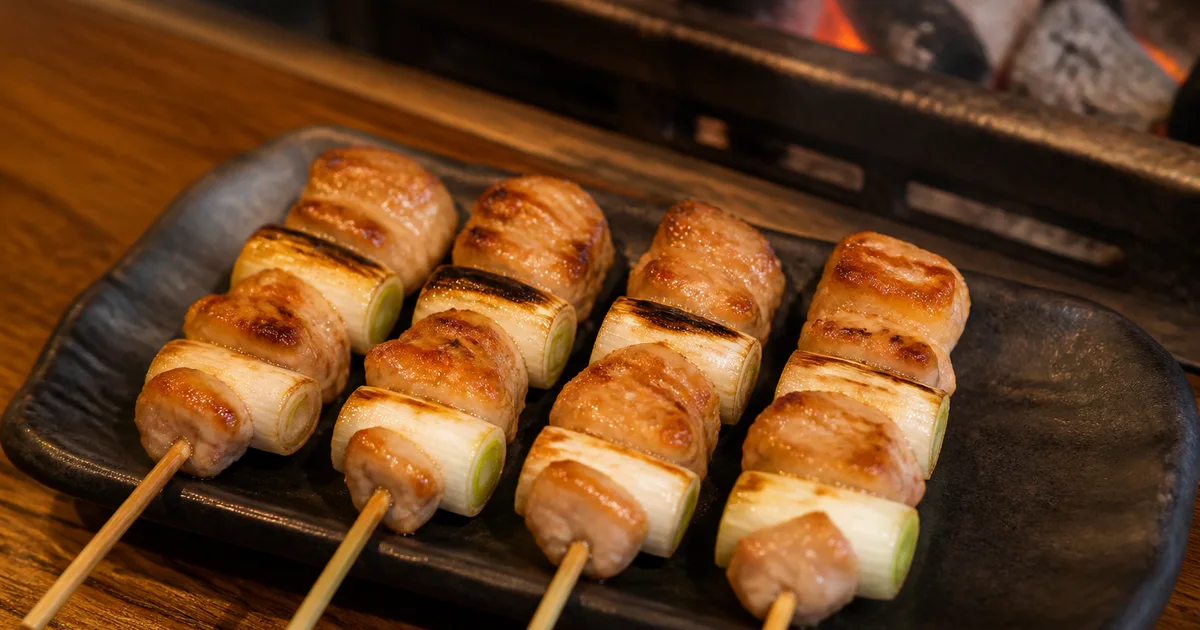
Negima puts two ingredients with different needs on the same stick. Chicken must cook safely without drying out; negi needs time to lose its raw sharpness and become sweet before its outer layers burn. A good skewer solves both problems at once.
Negima yakitori alternates bite-size chicken with sections of Japanese long onion and grills them together. It is beginner-friendly, but it is also a useful test of cutting and timing because the vegetable is not merely a spacer.
Choose the Onion Before Deciding the Cut Size
The negi in negima is often thick naganegi. English menus may call it scallion, green onion, spring onion, Welsh onion, or leek, but none of those translations guarantees the exact same plant or thickness outside Japan.
For grilling, the useful portion has enough layered white flesh to soften and sweeten while still holding on the skewer. Very thin green onion can scorch or collapse before a thick piece of chicken is done. A broad Western leek may take longer to soften and has a different ratio of layers to moisture.
The chicken is not fixed to one anatomical cut. Thigh is common because its fat and moisture tolerate direct heat, while breast produces a leaner result. Negima therefore names an arrangement, not a single yakitori cut.
Chicken and Negi Need Compatible Dimensions
The cook sizes the chicken and onion so their centers approach readiness together. A large onion section beside a thin meat piece leaves the onion harsh or the chicken dry. A tiny onion segment can blacken, split, or slide from the skewer while the chicken is still cooking.
Spacing matters too. The ingredients should support one another without being crushed into a solid mass. Contact lets rendered chicken fat and seasoning reach the neighboring negi, but completely hidden surfaces brown poorly. The skewer must also remain stable when turned.
As heat enters the negi, its layers soften and its sharp aroma becomes sweeter. The outer edge may blister while the center stays moist. Chicken contributes savoriness and fat; onion breaks up that richness with moisture and mild pungency. That alternating rhythm is the point of the dish.
The Grill Gives Each Ingredient a Different Signal
Chicken signals progress through surface opacity, tightening, glistening fat, and browning. Negi shows translucent layers, softened edges, blistering, and color at the cut faces. The cook watches both rather than turning on a fixed timer.
Dripping chicken fat can intensify the heat below. Brief flare-ups add color quickly but can make the onion bitter and blacken the meat before the center is safe. Moving the skewer, adjusting distance, and turning sooner are more useful than allowing a large flame to become part of the spectacle.
With tare, timing becomes more delicate because sugar-rich sauce can burn. Light applications late enough in the cooking process build a glaze without forcing the cook to choose between raw chicken and scorched sauce. With shio, the browning and sweetness of the negi remain more exposed.
Shio and Tare Answer Different Questions
| If you want to notice… | Start with | Reason |
|---|---|---|
| The onion’s sweetness and the chicken’s own flavor | Shio | Salt keeps the finish dry and direct. |
| Caramelization and a fuller savory-sweet coating | Tare | The sauce connects meat and onion with one glaze. |
| The shop’s intended balance | Its default | Some restaurants size and grill the skewer for one preparation. |
Tare may contain soy, wheat, mirin, sake, sugar, or other ingredients. Serious dietary restrictions require confirmation; the word tare does not identify one universal recipe. See the separate shio and tare guide for a cut-by-cut comparison.
The Name Predates the Chicken Skewer
Modern yakitori negima normally contains chicken, yet the name is commonly traced to negima-nabe, an Edo-period preparation of negi and maguro (tuna). The word can be written 葱鮪 with characters for onion and tuna.
MAFF’s account of negima-nabe describes fatty tuna cooked with Japanese long onion and soy-based seasoning. The Agriculture and Livestock Industries Corporation also connects the familiar name to the tuna-and-negi dish.
That history explains why translating negima only as “chicken and scallion” describes today’s yakitori but not the whole word. On a yakitori menu, however, chicken and negi remain the practical expectation unless the menu says otherwise.
What a Diner Can Check Without Knowing the Recipe
- The chicken pieces should be similar enough in thickness to share a doneness.
- The negi should be tender and sweet inside, not simply black outside and raw at the center.
- Neither ingredient should spin loosely or fall away when the skewer is lifted.
- Tare should form a glaze rather than a burnt, sticky shell.
- The vegetable should still be recognizable; it is part of the flavor design, not filler.
Order with negima o kudasai, adding shio de or tare de when the choice is offered. Compare it with plain momo if you want to see what the onion contributes. The yakitori ordering guide explains quantities and pacing.
Safety and Menu Variations
The chicken should be fully cooked. A browned onion and dark tare do not prove that the thickest meat piece is safe. At home, the USDA recommends 165°F (73.9°C) for poultry, measured with a food thermometer; product and local guidance take priority.
Restaurants may use thigh, breast, a branded bird, or a house-specific cut. They may also list vegetable skewers separately as kushiyaki. The visible chicken-and-negi pattern is more reliable than assuming every menu uses the same category language. Our yakitori and kushiyaki comparison explains that boundary.