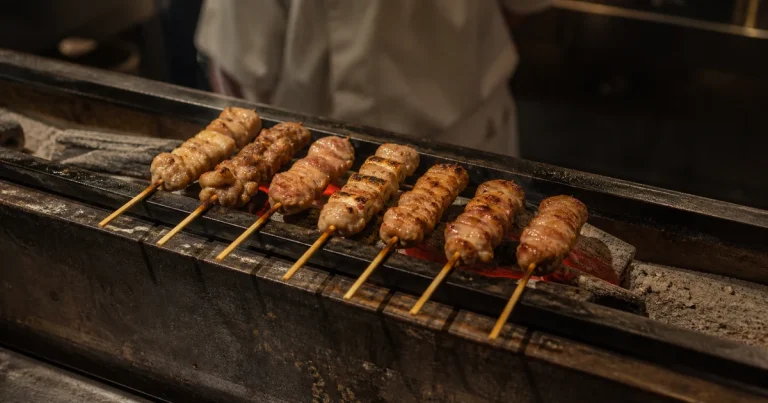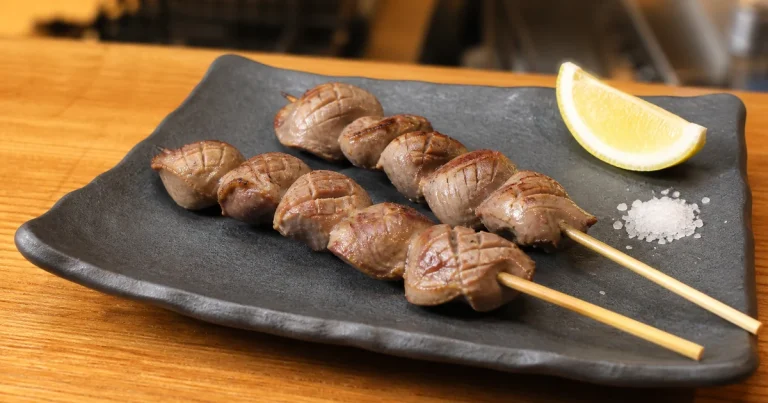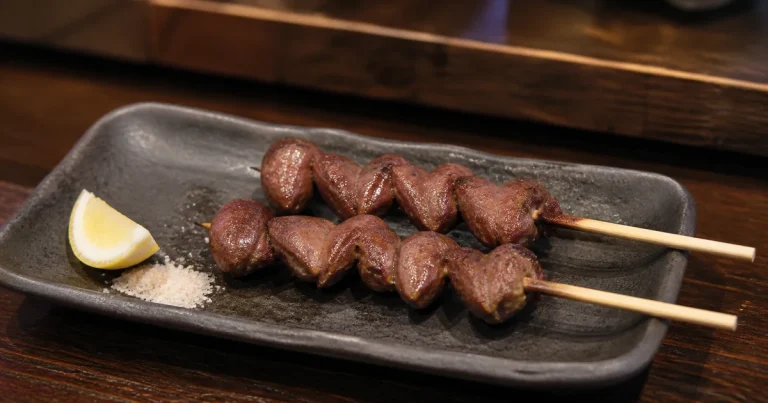
Kawa is inexpensive, familiar, and easy to underestimate. On the grill, however, chicken skin exposes almost every weakness in the preparation. Loosely built folds spin on the supports. Thick hidden sections heat slowly. Fat dripping onto charcoal produces sudden flames. Tare can turn from glossy to bitter while the inside is still heavy and greasy.
Handled carefully, the same ingredient produces one of yakitori’s most satisfying contrasts: crisp, browned edges around soft, springy folds. That “crisp outside, chewy within” texture is not simply a result of buying good skin. It is designed through trimming, preliminary cooking, folding, skewer balance, controlled rendering, and the timing of the final browning.
The Desired Texture Determines the Preparation
Kawa yakitori is chicken skin folded, rolled, or threaded onto a skewer and grilled. There is no single correct texture. Some shops render the skin until much of the skewer crackles; others preserve a tender, gelatinous quality inside browned folds. A third style deliberately combines the two.
The part of the chicken matters as well. Neck skin, body skin, thickness, attached fat, and connective tissue do not behave identically. So do the amount of trimming, the density of the skewer, and whether the skin is parboiled before grilling. A useful method starts by deciding what the final bite should be, rather than forcing every piece through the same fixed time.
In the preparation shown here, raw skin is parboiled before it is folded and skewered. This firms the slippery material enough to handle, removes some surface residue, and begins releasing fat. It does not by itself make the finished skewer safe or crisp; the folds still require controlled cooking afterward.
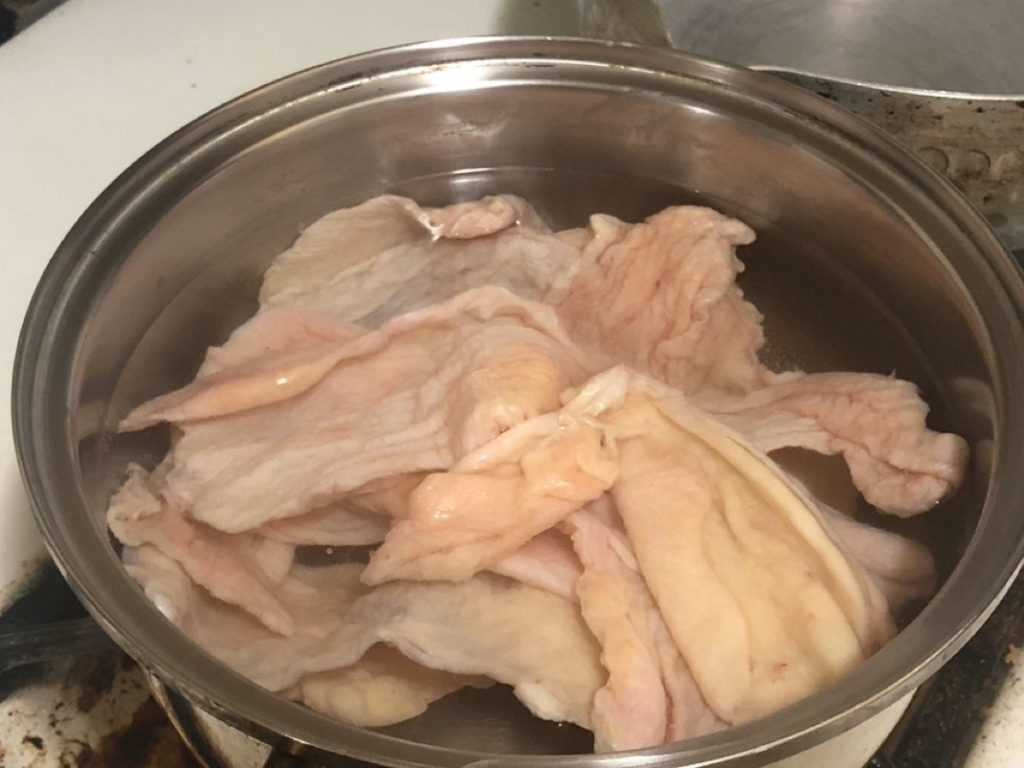
Parboiling Changes the Skin Before It Meets the Skewer
As the water heats, the skin loses its raw translucency, tightens, and becomes easier to cut and fold. Some fat moves into the water, but the process does not strip the skin completely lean. Kawa remains a rich cut, and that remaining fat is central to both its flavor and its behavior over charcoal.
The degree of preliminary cooking changes the final texture. A longer, controlled parboil can release more fat and produce a firmer starting material for a drier style. A shorter treatment can preserve more softness and richness. Neither choice guarantees success: skin that is later packed too tightly may still remain heavy inside, while thin skin can be dried out through an unnecessarily long grill.
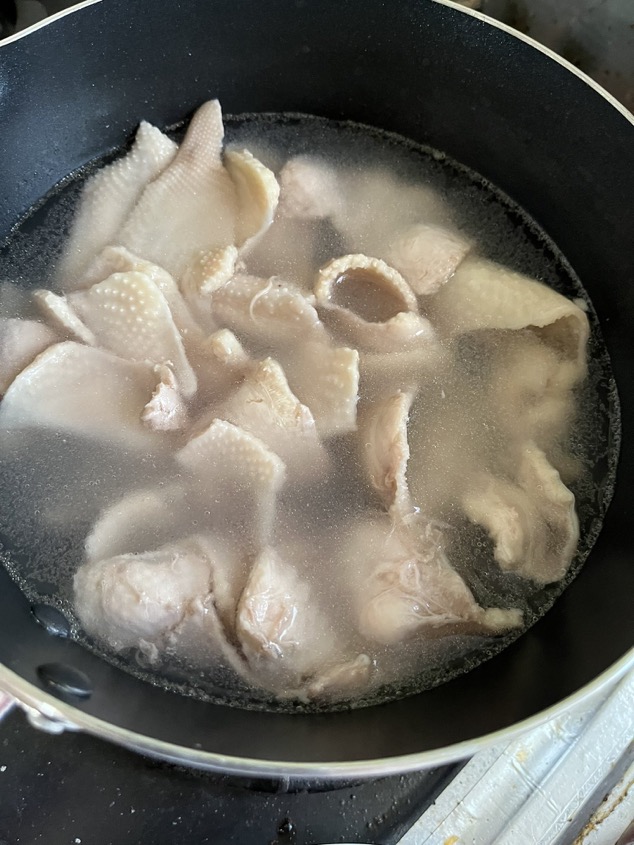
After parboiling, the skin must be drained and handled under the kitchen’s food-safety procedure. If it will not be skewered and cooked immediately, it should not be left cooling slowly at room temperature. Commercial kitchens need a controlled cooling and refrigerated-storage process appropriate to their operation; home cooks should keep batches small and follow current local food-safety guidance.
Two Ways to Build Texture: Folding and Rolling
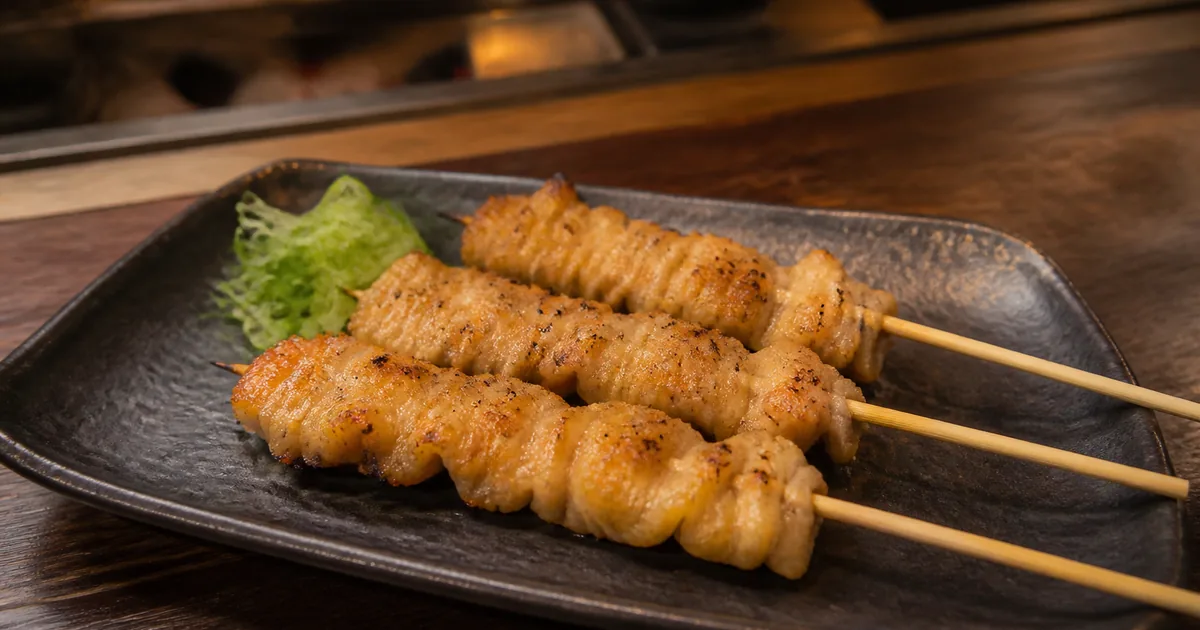
For a folded or accordion-style skewer, the skin is arranged into repeated peaks and valleys. The exposed edges meet stronger heat and can become crisp and aromatic. The protected inner surfaces retain more moisture and softness. When the density is correct, a single bite moves from a dry, browned edge into a springy fold instead of delivering one uniform rubbery mass.
The folds need to touch closely enough to stay stable but not become an impenetrable block. If the bundle is compressed too tightly, the outer layer can look finished while fat and moisture remain trapped deep inside. If it is too loose, the edges flap, scorch, and move independently whenever the skewer is turned.
Fukuoka is also known for guruguru torikawa, in which long strips of chicken skin are wrapped repeatedly around a skewer. Some specialist shops repeatedly grill, rest, and season the skewers over several days, gradually removing fat and building a crisp exterior. That schedule belongs to the individual shop rather than to every Fukuoka skewer. The common visual idea is the tight spiral; the precise number of cycles, resting time, and sauce method are part of each restaurant’s craft.
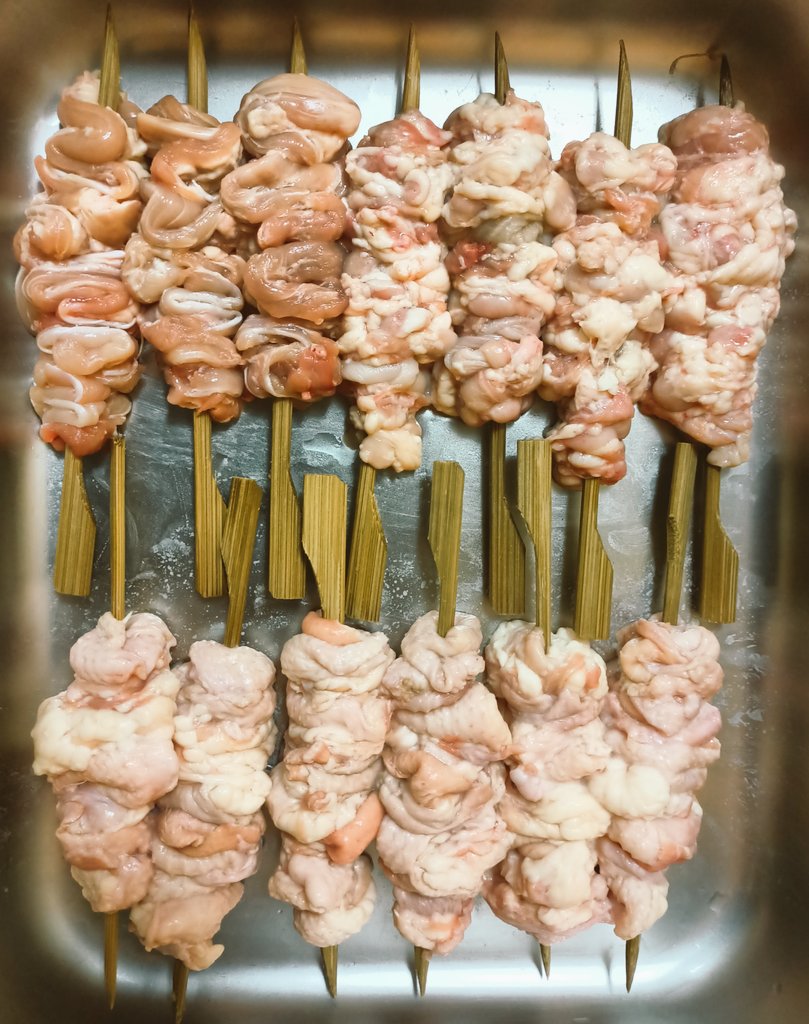
The Skewer Must Hold a Slippery Ingredient Still
Chicken skin carries enough fat to slide and rotate if the skewer is inserted carelessly. On a yakitori grill, that imbalance appears as the skewer “nodding” or rolling back toward its heavy side. The cook turns it, but the same face falls toward the charcoal again, leaving one surface dark and another pale.
A broad, flat bamboo skewer can help because it grips the folds across a wider surface than a round stick. It is useful rather than mandatory; skilled cooks also build stable kawa on other skewers. In the method pictured above, the skewer passes through the firm center of each fold in a consistent line, and the material is secured without being crushed into a solid mass.
The finished construction should present several controllable faces to the fire. Stability matters more than visual perfection. If the folds stay where the cook places them, heat can be distributed deliberately instead of whichever side gravity chooses.
Render First, Then Build the Surface
Rendering and browning are related but separate jobs. Rendering means gradually melting and releasing some of the fat held in and around the skin. Browning develops roasted aroma and a firmer exterior. Aggressive heat can color the outside before the dense folds have rendered; gentle heat alone can leave the surface pale and soft.
A practical charcoal setup therefore has more than one heat zone. The skewers can begin where the heat is moderate or the distance is greater, allowing fat to warm and drip without immediately scorching the ridges. As the folds become lighter and the surface loses its raw, slick appearance, the cook can move the skewer briefly toward stronger heat to set the exterior.
This is not a mechanical two-step formula. Thin neck skin, thick body skin, tightly wound spirals, and looser accordion folds progress at different rates. The cook watches fat bubbling at the folds, changes in surface gloss, the sound of the sizzle, and how the bundle feels when lifted. A shift from a wet sizzle toward a drier crackle can indicate that exposed surfaces are losing moisture, but none of these cues alone confirms that the inner folds are safely cooked.
A Flare-Up Can Ruin the Entire Batch
Kawa releases more dripping fat than most lean skewers. When that fat hits hot charcoal, flames can rise in an instant. A small amount of smoke may contribute aroma; direct flame held against the skin deposits soot, burns sauce, and replaces roasted flavor with harsh bitterness.
During my training, I panicked when chicken-skin fat produced a large flare-up and sprayed water directly onto the charcoal. Steam and ash surged upward, covering every skin skewer on the grill. What should have been crisp kawa became black, bitter, rubbery pieces. My chef made me discard the batch and pay for it. I never forgot the lesson: control begins by moving the food and managing the fire before panic takes over.
In that kitchen, the response was to move the skewers immediately to a gentler zone and use an uchiwa fan with care to redirect or suppress the flame without soaking the fuel. Fan technique is not as simple as blowing as hard as possible; added airflow can also intensify combustion if it is aimed badly. Grill design, charcoal arrangement, ventilation, and house procedure determine the correct response.
Spraying water directly onto charcoal is therefore presented here as the mistake in this specific working method, not an absolute rule for every professional system. The broader principle is universal: do not leave fatty skin in direct flame, and do not improvise a reaction that spreads ash or destabilizes the heat.
Tare Belongs Near the End of the Fire
For glazed kawa, the skin is commonly allowed to render and develop some surface firmness before tare is applied. Putting a sugar-rich sauce onto wet, heavily fatty skin too early makes the surface harder to manage: drips feed the fire, while the sugars can blacken before the folds are ready.
In the working method described here, the first dip comes only after most of the unwanted heaviness has cooked away. A second light application builds flavor and gloss without burying the texture. “Two dips” is a house rhythm, not a law. Sauce concentration, sugar content, skewer density, and fire strength all affect how many applications are useful.
Near the finish, small bubbles appear as the tare heats and concentrates. The surface moves toward a glossy amber-brown and its aroma changes from plainly sweet to roasted. That is the useful boundary. Large dark patches, acrid smoke, and a bitter smell indicate carbonization rather than additional umami.
Shio offers a different expression. Without a glaze, the cook can push for a drier surface and let rendered fat and charcoal aroma remain more obvious. The guide to tare and shio explains how that choice changes other yakitori cuts as well.
The Best Texture Has a Short Life at the Counter
Kawa should be eaten soon after it leaves the grill. As rendered fat cools, tender sections can feel waxier and crisp edges begin absorbing moisture from the inner folds and from tare. This is not a rule against taking a photograph, but it is a reason not to spend several minutes arranging one while the skewer waits.
A carefully made folded skewer should show intention throughout the bite: crisp ridges without bitter soot, inner layers that are soft or springy rather than raw-feeling, and enough rendered richness to taste like chicken skin without leaving the mouth coated in grease. A fully crisp Fukuoka-style spiral is a different target, not evidence that one style is superior.
Menus may show 皮, かわ, カワ, or torikawa. To order, say “Kawa, ippon onegaishimasu.” If both seasonings are offered, add “shio de” or “tare de.” The yakitori ordering guide covers quantities, set menus, and counter etiquette.
For a useful comparison, order kawa beside momo. Both contain skin and fat, but momo balances them against juicy thigh meat while kawa makes the skin itself the entire subject. The main yakitori cuts guide places it alongside lean meat, organs, and cartilage.
Cooking Safety for Folded Chicken Skin
Raw chicken skin can carry the same food-safety hazards as other raw poultry. Preliminary boiling does not permit careless handling afterward, and a browned exterior does not prove that tightly packed folds received sufficient heat. Keep raw and partially cooked skin separate from ready-to-eat food, clean utensils and work surfaces, and control cooling and refrigeration between stages.
Japan’s Ministry of Health, Labour and Welfare advises heating meat to at least 75°C at the center for one minute, or applying an equivalent validated treatment, to prevent campylobacter food poisoning. The USDA Food Safety and Inspection Service lists 165°F (73.9°C) as the safe minimum internal temperature for poultry. At home, check a representative thick central fold with an appropriate food thermometer and follow the current guidance and product instructions for your location.
Sources on Kawa Styles and Poultry Safety
- Ministry of Agriculture, Forestry and Fisheries: Japan Chicken Cuts and Characteristics
- Official Fukuoka Tourism Information: Fukuoka Food and Spiral-Wrapped Torikawa
- Official Fukuoka Tourism Information: One Specialist Shop’s Three-Day Torikawa Method
- Ministry of Health, Labour and Welfare: Campylobacter Food Poisoning Prevention Q&A
- USDA Food Safety and Inspection Service: Safe Minimum Internal Temperature Chart