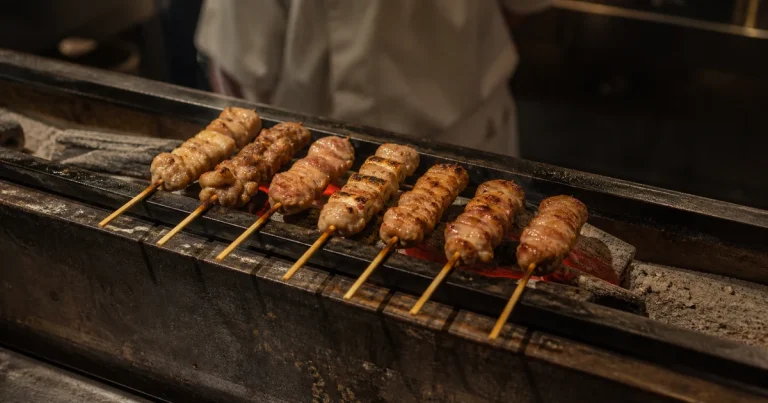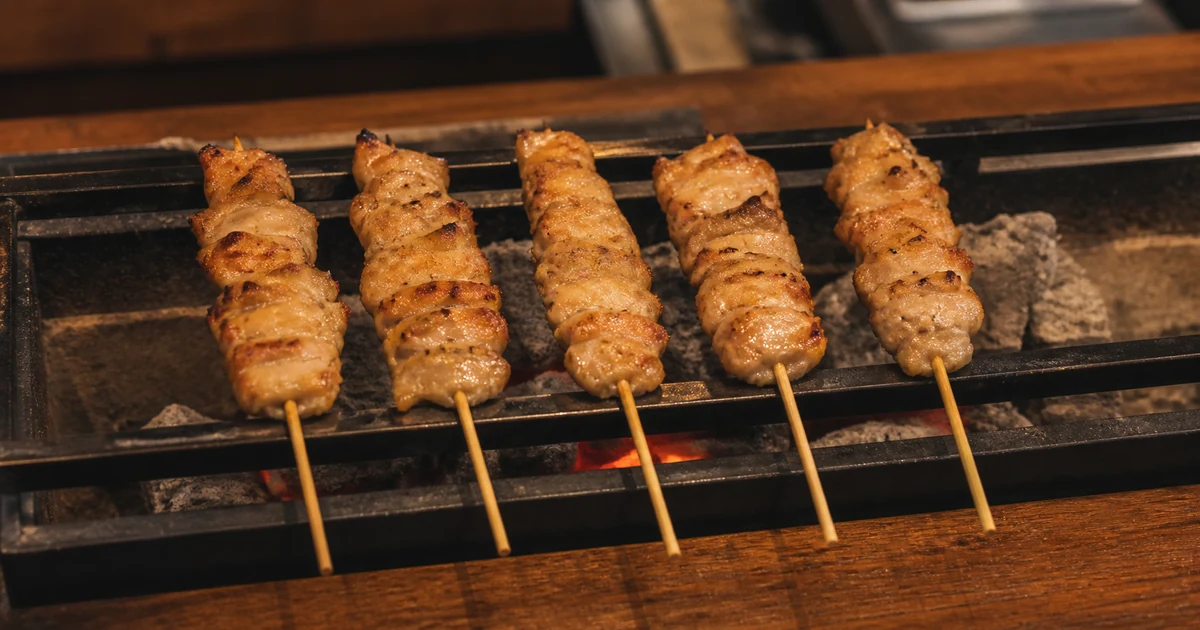
Momo is one of the most familiar skewers on a yakitori menu. That familiarity makes it easy to underestimate.
From the grill cook’s side, chicken thigh is unforgiving. If the pieces differ in thickness, the thin ones lose moisture before the thick ones are safely cooked. If the skewer misses the center of gravity, the meat turns on the supports and exposes the wrong surface to the heat. If dripping fat creates an uncontrolled flame, a skewer can move from fragrant browning to bitter soot in seconds.
I worked in yakitori restaurants for years, and momo taught me that a standard item leaves nowhere for careless preparation to hide. The goal is not simply to cook chicken on a stick. It is to make every piece on that stick finish together, with browned edges, rendered skin, a moist center, and a clean bite. Here is the work behind that result—and what a diner can notice when the skewer arrives.
Why Momo Is a Test of Basic Yakitori Skill
Momo (もも or モモ) means chicken thigh in this menu context. It is darker, richer meat than chicken breast, with enough fat and connective tissue to remain succulent under strong heat when it is handled well. Japan’s Ministry of Agriculture, Forestry and Fisheries describes thigh as a full-flavored cut whose fat contributes to its richness.
This makes momo approachable for a first yakitori order, but it does not make the skewer automatic. Thigh is irregular. One area may be thick and meaty, another thin, fatty, or covered with skin. The cook has to turn that uneven raw material into several pieces that behave as one unit over the grill.
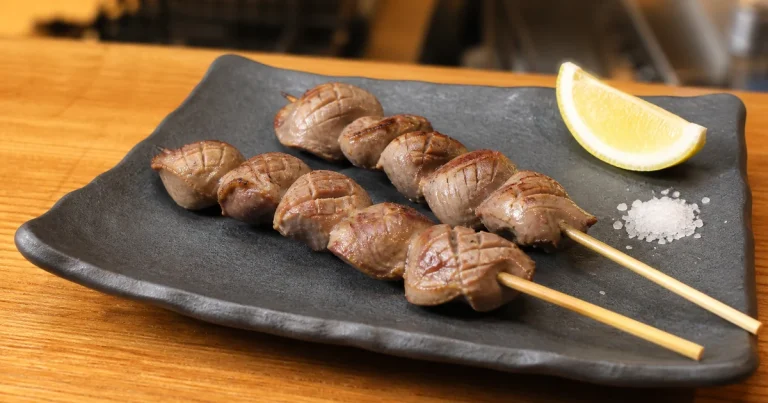
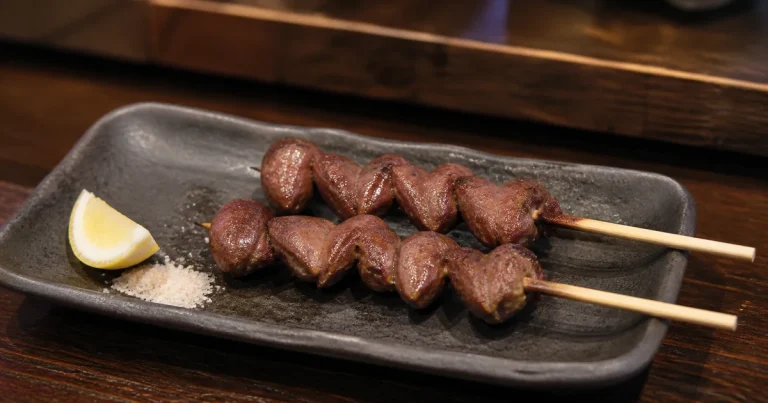
A broader guide to yakitori cuts shows how thigh differs from breast, skin, heart, liver, gizzard, and cartilage. Momo’s particular challenge is balance: it should taste clearly of chicken while keeping enough skin and fat to carry heat, aroma, and moisture.
Thickness Matters More Than Matching Weight
Equal weight does not guarantee equal cooking. Two pieces can weigh the same while one is broad and thin and the other is compact and thick. Over charcoal, those shapes do not finish at the same time.
I therefore pay close attention to thickness before I think about the finished weight of the skewer. Thin edges are either trimmed, folded into a useful shape, or positioned where they will not dry out first. Thick sections are opened or divided so heat does not have to travel through a much deeper center than the neighboring pieces.
Muscle direction matters too. I look at the grain and cut so the diner is not left pulling through unnecessarily long fibers. The aim is not to make thigh meat unnaturally soft. Momo should retain a gentle spring. The cut simply prevents its natural structure from becoming an obstacle to an easy bite.
When thickness is consistent, the cook can manage the skewer as a whole. Browning, fat rendering, and heat moving from the surface toward the center progress at comparable rates. That is what allows the first piece and the last piece to feel as though they belong to the same skewer.
Skin and Fat Are Part of the Heat Management
Removing every trace of skin and fat may sound like a cleaner or lighter approach, but it also removes two tools the grill cook can use.
In my preparation, I leave an appropriate amount of skin and attached fat rather than stripping the thigh completely bare. “Appropriate” depends on the chicken and the intended style. A thick flap of fat can become greasy before the meat is ready; removing everything can leave an exposed surface that dries quickly.
Positioned carefully, the skin protects part of the meat from the most aggressive surface heat. As it renders, its fat coats the exterior, supports browning, and carries roasted aroma. It does not create an airtight seal or magically lock in every drop of juice. Its practical value is that it changes how quickly the surface dries and how the skewer meets the fire.
The final bite should show that contrast: lightly crisp or taut skin outside, moist thigh beneath it, and enough rendered fat to taste rich without leaving the mouth coated in grease.
A Skewer Needs a Center of Gravity
Skewering is not just a way to keep several pieces together. The bamboo must carry their weight in a stable line.
I guide the skewer through the substantial center of each piece, arranging the meat so its weight sits as close as practical to the skewer’s axis. Skin is kept controlled rather than left hanging where it can burn. The pieces are held securely, but they are not crushed into one solid block with no room around their edges.
When the center of gravity is wrong, the problem appears at the grill. A heavy side pulls downward and the skewer rolls on the metal supports. In kitchen language, we may describe the skewer as bowing or “nodding.” The cook turns it, but the same heavy face falls back toward the charcoal. One side receives too much heat while the surface that actually needs color remains out of position.
A well-balanced skewer stays where I place it. That small piece of control determines whether I can brown the skin, protect the leaner meat, and move several skewers through different heat zones without continually fighting their weight.
Dripping Fat Changes the Fire
As momo cooks, skin and fat release droplets toward the charcoal. A short burst of fragrant smoke can add aroma. An uncontrolled flame touching the meat can deposit soot, scorch the surface, and produce harsh bitterness.
This is why a useful yakitori fire is not one uniform bed of maximum heat. I need hotter and gentler areas. When fat causes a flare-up, I can move the skewer away from that point, change its height or position, and manage the flow of flame and smoke with an uchiwa fan. The response has to be immediate; watching a flame for several seconds is enough to lose the clean flavor I want.
At my grill, I do not routinely pour water onto the charcoal every time a flame appears. Doing so can disturb the heat and ash. That is a working method from my own experience, not a universal rule for every restaurant or grill design. The equipment, charcoal arrangement, ventilation, and house procedure all affect how a cook responds.
The detailed yakitori grill guide explains why a narrow grill, skewer supports, and separate heat zones matter. Premium charcoal can make heat stable, but it cannot correct an unbalanced skewer or a cook who reacts too slowly.
For Shio Momo, Salt Has Its Own Timing
For the salt-seasoned momo I cook, I apply salt immediately before the skewer goes over the heat or just after it reaches the grill. Small pieces have a high proportion of exposed surface, so seasoning them well in advance can draw visible moisture to the outside before cooking begins.
I sprinkle from enough height to distribute the grains across the irregular surface instead of leaving one salty patch and one bland patch. Distance alone does not create accuracy—the grain size, hand movement, and amount still matter—but it helps spread the seasoning beyond the highest points of the meat.
This is a house technique, not proof that every earlier salting method is wrong. Other cooks may deliberately rest seasoned chicken as part of a tested preparation. What matters is understanding what the chosen timing does to the surface before the skewer meets the heat.
Momo also carries tare well. Its meat and fat can support a savory-sweet glaze, but sugary sauce darkens quickly and may require repeated light applications rather than one heavy coat. The separate tare and shio guide explains how the same chicken changes under the two seasonings.
Sound, Bubbles, Color, and Springiness Guide the Cook
A timer cannot make the final decision for me. Chicken size, starting temperature, fat content, charcoal condition, distance from the fire, and the number of skewers on the grill all change the cooking rhythm.
I read several signals together:
- Sound: moisture and fat begin quietly, then produce a more active sizzle as the surface heats and renders.
- Bubbles: juices appearing at the surface change in size and pace as heat moves through the meat.
- Color: the skin takes on an even roasted tone; isolated black areas can mean a flare-up or sauce burning rather than useful browning.
- Movement: the pieces tighten around the skewer and feel more unified when it is lifted and turned.
- Spring: gentle pressure meets resistance and the meat returns rather than remaining loose or becoming rigid.
During training, one tactile comparison helped communicate that progression. Raw meat can feel loose like the base of the thumb with the hand relaxed. Overcooked meat can feel tense like the same area beneath a tightly closed fist. The texture I seek is closer to the resilient pad at the base of the thumb when the hand makes a relaxed “OK” sign: a clean, quick push back without hard tension.
That comparison is a sensory reference, not a safety test. It helps a cook describe texture, but it cannot detect harmful bacteria or prove that the center received sufficient heat.
Professional Sensory Judgment and Food Safety Are Different Questions
Chicken may carry Campylobacter and other pathogens even when it is fresh. Japan’s Ministry of Health, Labour and Welfare identifies raw and undercooked chicken as a major cause of campylobacter food poisoning and advises heating meat to at least 75°C at the center for one minute, or applying an equivalent validated treatment.
For readers cooking in the United States, the USDA lists 165°F (73.9°C), measured with a food thermometer, as the safe minimum internal temperature for poultry. Guidance varies in how time and temperature are expressed, so home cooks should follow the current authority and product directions that apply where they live.
A thin skewer can be awkward to measure from above. Insert an appropriate instant-read probe from the side into the thickest central piece so the sensing area reaches the center. At a restaurant, temperature checks, equipment controls, sanitation, and other procedures belong to the business’s food-safety plan. Color, clear juices, charcoal marks, or finger pressure alone do not validate safety.
What a Diner Can Notice in a Well-Grilled Momo Skewer
You do not need to inspect a skewer like a critic. Eat it while it is hot and pay attention to whether the choices feel connected.
- The pieces should be similar enough in thickness that one is not dry while another feels undercooked.
- The skewer should show intentional browning rather than a surface covered in bitter black soot.
- Skin should contribute aroma and texture without remaining as a thick, rubbery flap.
- The meat should feel moist and gently springy, not mushy or tightly fibrous.
- Salt or tare should support the chicken rather than become the only flavor you remember.
Momo normally means thigh without onion. Chicken thigh alternating with Japanese long onion is generally called negima. If a restaurant offers both shio and tare, either can suit momo; if the grill cook has a house preference, following that recommendation can reveal more about the restaurant’s style.
To order, say “Momo o onegaishimasu.” If asked about seasoning, answer “shio de” for salt or “tare de” for sauce. The practical guide to ordering yakitori in Japan covers quantities, set menus, useful phrases, and etiquette.
A Familiar Skewer with Nowhere to Hide
Momo does not rely on the novelty of an organ or the dramatic richness of pure skin. Its appeal comes from precise fundamentals repeated without visible effort: thickness matched before service, skin and fat trimmed with purpose, weight centered on the bamboo, fire controlled as fat begins to fall, and the skewer removed while the meat still has life in its texture.
That is why I do not regard momo as merely the safe beginner’s choice. It is one of the clearest ways to read a yakitori cook’s work. The next time you order it, notice whether every piece finishes together—and whether the familiar taste of chicken thigh has been made more complete through the cut, the skewer, and the fire.
Sources for Chicken Cuts and Food Safety
- Ministry of Agriculture, Forestry and Fisheries: Japanese Chicken Cuts and Characteristics
- Ministry of Agriculture, Forestry and Fisheries: Yakitori and Uniform Preparation
- Ministry of Health, Labour and Welfare: Campylobacter Food Poisoning Prevention Q&A
- USDA Food Safety and Inspection Service: Safe Minimum Internal Temperature Chart