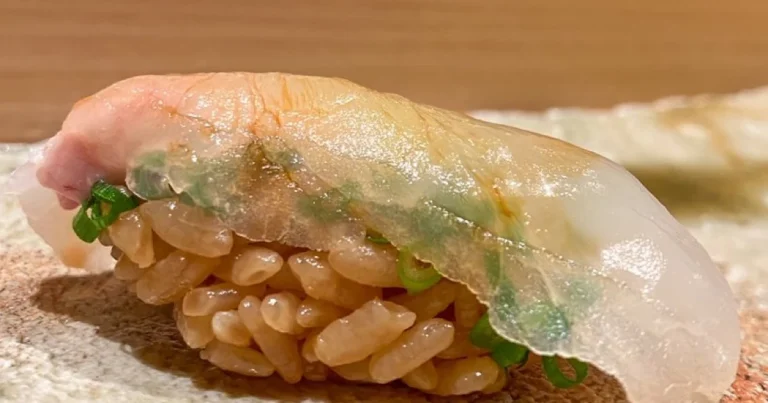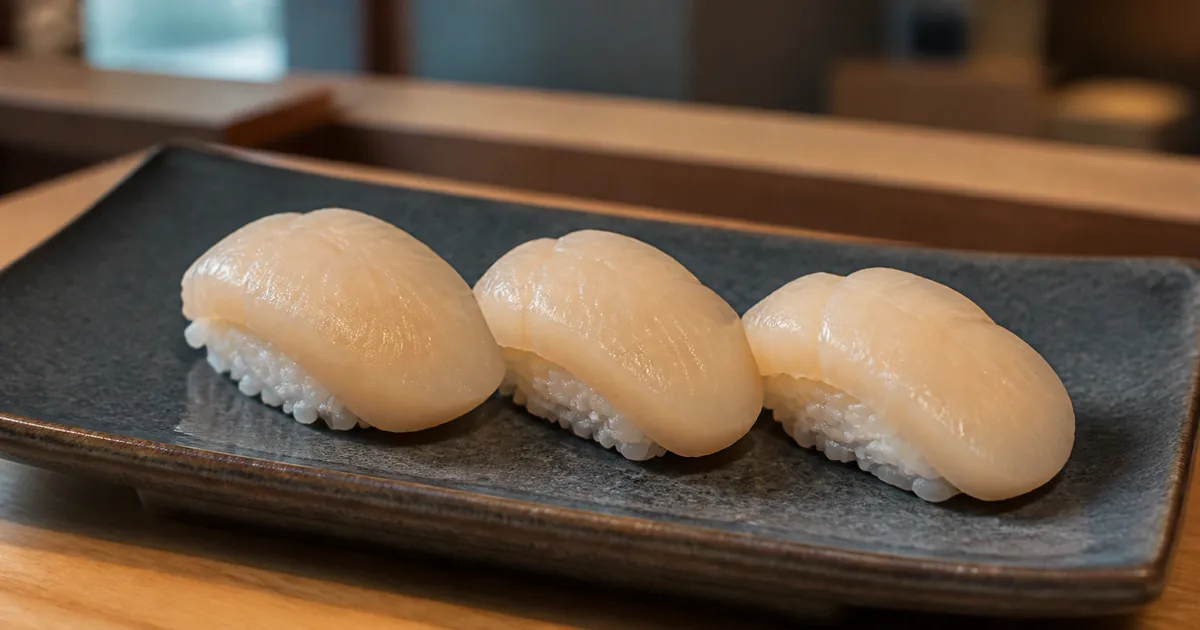
Hotate sushi is built around the adductor muscle of a scallop, prized for gentle sweetness and a texture that changes dramatically with cutting and heat. A useful way to understand it is to follow the ingredient from shell to sushi counter rather than treating it as another generic “taste and types” entry.
Raw hotate can feel cool, supple, and almost creamy; a light sear firms the surface and makes its sweetness more aromatic. That range is why the same scallop may appear as nigiri, sashimi, aburi, or gunkan during one meal.
Start With the Part You Are Actually Eating
Hotate means scallop. The thick white portion commonly served as sushi is the adductor muscle, which opens and closes the shell. Menus may also use kaibashira, a broader term for the adductor muscle of shellfish. In a sushi context, the white, round piece is usually the scallop’s adductor muscle rather than the entire animal.
This distinction explains the clean flavor and layered grain. The muscle can be split horizontally, cut vertically, or opened like a book. Each choice changes how quickly it warms in the mouth and how much resistance the fibers provide.
Texture Changes More Than Flavor
Good hotate has a restrained ocean aroma and a clear natural sweetness. Texture is the stronger variable. A thick raw piece can feel plump and softly elastic; thin slices feel more delicate; scoring creates extra surface area and a quicker melt.
Brief searing tightens the exterior while leaving the center tender. Full cooking makes the muscle firmer and more fibrous. Freezing can also alter drip loss and firmness, although high-quality frozen scallops handled correctly may be excellent. “Fresh” is not automatically superior if transport and temperature control are poor.
Why Hokkaido Appears So Often Beside Hotate
Hokkaido is one of Japan’s best-known scallop-producing regions, with fisheries using both seabed culture and suspended cultivation depending on the area. Cold waters and substantial production make Hokkaido hotate common in seafood markets, restaurants, and regional gifts.
Origin can be meaningful, but it is not a complete quality grade. Species, harvest area, size, handling, freezing method, thawing, and the chef’s cut all influence the final bite. At the counter, the appearance and preparation in front of you matter more than a famous place name alone.
Live, Seabed-Grown, and Individually Frozen Hotate
At the counter, “fresh versus frozen” is not a sufficient quality test. The form in which a scallop reaches the kitchen determines what the chef must protect or correct.
- Live scallop in the shell: a healthy animal closes strongly when disturbed. Immediately after shucking, the adductor muscle can feel taut, clean, and springy. That firmness is useful when the chef wants a crisp, lively bite.
- Seabed-grown scallop: in some northern Japanese fisheries, juvenile scallops are released and later harvested from the seabed. Growth conditions, current, density, and harvest area influence size and firmness; the production method alone is not a guarantee of quality.
- Individually quick-frozen adductor muscle: products often called tamarei in the trade are frozen soon after processing so individual muscles remain separate. Freezing equipment varies, so “tunnel frozen” should not be assumed for every product. Careful freezing and thawing can produce excellent sushi with a soft, concentrated sweetness.
A poorly handled live scallop may be inferior to a well-processed frozen one. Time since harvest, temperature control, glaze, freezer burn, and thawing practice all matter. I judge the piece that arrives at the cutting board, not the marketing word printed on the box.
When Is Hotate in Season?
There is no single nationwide scallop season because species, farming method, and production area differ. For the large Yesso scallops strongly associated with Hokkaido and northern Honshu, the adductor muscle is often especially substantial in summer, while the gonad develops toward the winter-to-spring spawning period. Local harvest schedules can shift this pattern.
- Summer: the adductor muscle may be large and rich in glycogen, making it particularly attractive for nigiri and sashimi.
- Winter to spring: roe and milt can become more prominent. Where regulations and sourcing permit, these parts may be cooked for a deeper, more mineral flavor.
For diners, “in season” should therefore be read together with origin and preparation. A chef may choose frozen summer-harvest muscle in another season because its condition is better than that of a tired fresh product.
How a Chef Judges Scallop Quality
Visual inspection cannot prove microbiological safety, but it helps a chef detect poor handling and decide how a scallop should be cut.
- Defined edges: the rim should retain shape rather than collapsing into a soft, rounded mass.
- Color and translucency: good muscle is commonly creamy white with a slight translucency. Color varies naturally, so whiteness alone is not a grade.
- Minimal drip: excessive cloudy liquid can indicate cell damage or poor thawing. It also carries away soluble flavor and leaves the surface difficult to season evenly.
- Clean aroma and resilience: the piece should smell mild and marine, not sharply fishy, sour, or ammonia-like. Gentle pressure should meet some resistance rather than leaving a mushy surface.
At service, I also watch what happens after the cut. A slice that quickly releases water may need blotting, a different cut, or a change of plan from nigiri to a cooked preparation.
Thawing Hotate Without Sacrificing Texture
Freezing creates ice crystals that can damage cells; careless thawing then encourages drip loss. Room-temperature thawing is fast but difficult to control, and placing bare scallops under running fresh water can waterlog the surface and wash away flavor.
The most broadly reliable method is gradual thawing in the refrigerator on a rack or absorbent paper, following the processor’s directions. For faster thawing, keep the scallops sealed in a food-safe bag and place the bag in cold water, then use or cook them promptly. U.S. food-safety guidance likewise recommends refrigerator thawing or cold-water thawing in a sealed bag rather than leaving seafood on the counter.
Some sushi kitchens use a cold salted-water method for specific products, sometimes near seawater salinity. It can firm the surface, but it is not a universal three-percent formula: concentration, exposure time, glaze, scallop size, and the producer’s processing method change the result. If direct brine contact is used, it must be brief, cold, and followed by thorough drying. The objective is controlled thawing and low drip—not “aging” the scallop in warm water.
Knife Work Changes Sweetness and Resistance
The adductor muscle is built from visible fibers. A chef can make the same scallop feel crisp, creamy, or almost melting by changing the direction and depth of the cut.
- Cutting with the fiber: preserves more of the muscle’s structure and produces a springier, more substantial bite. It can suit sashimi or a very fresh, firm scallop.
- Cutting across the fiber: shortens the fibers and creates a softer mouthfeel. A large muscle may be sliced horizontally and opened like a book so it covers the shari without becoming too thick.
- Scoring: shallow crosscuts increase surface area, hold nikiri or citrus, and help the piece loosen in the mouth. Cuts that are too deep make the scallop ragged and encourage liquid loss.
The choice is not cosmetic. For nigiri, I consider the firmness of the day’s shari, the temperature of the scallop, and how quickly both should break apart. A thick unscored piece can remain in the mouth after the rice has already dispersed; an overworked piece can lose the plump texture that made hotate attractive in the first place.
Beyond the Adductor Muscle: Mantle, Roe, and Viscera
A whole scallop contains edible parts beyond the white muscle, but they are not interchangeable and should only be used from an approved, traceable source.
- Mantle or “frill” (himo): the ruffled tissue around the shell has a firm, curling bite. It is cleaned repeatedly to remove grit and slime, then may be blanched, grilled, simmered, dressed, or used in gunkan.
- Gonad: the orange-red roe and pale milt can be rich and creamy when cooked. Availability and permitted use depend on harvest area, monitoring, processing, and local rules.
- Dark digestive gland: commonly called the uro in a Japanese kitchen, this part is removed and discarded. Marine biotoxins and contaminants can concentrate in viscera. Do not treat a whole raw scallop as though every internal organ were edible.
This distinction is important because adductor-only scallop and whole or roe-on scallop do not present the same toxin-control questions. FDA seafood inspection guidance, for example, distinguishes adductor-only products from roe-on and whole scallops when considering natural-toxin testing. Diners should rely on regulated commercial supply and professional processing rather than gathering or preparing whole scallops from an unknown harvest area.
Five Ways a Sushi Chef Can Present One Scallop
Nigiri: the balance with shari
For nigiri, the chef shapes hotate over vinegared rice. A large muscle may be butterflied or divided to cover the shari without becoming bulky. The rice adds acidity and warmth, so the sweetness reads differently than it does in sashimi. If the role of rice is unfamiliar, our guide to what defines sushi explains why the topping alone is not the whole dish.
Sashimi: the clearest view of the cut
Without rice, the diner notices thickness, grain, and temperature more directly. This is also a good illustration of the practical difference between sushi and sashimi: the same ingredient becomes a different dish when vinegared rice is removed.
Aburi: aroma from surface heat
A torch or hot surface lightly browns the outside. The sear increases aroma and firms the first bite, while the center may remain raw or barely warmed. Citrus, salt, or a small amount of sauce often replaces a heavy dip in soy sauce.
Gunkan: chopped texture and seasoning
Chopped hotate can be held by a strip of nori in gunkan form. The pieces may be mixed with another ingredient or sauce, creating a softer, more blended texture than a single slice of nigiri.
Cooked scallop: firmer and more aromatic
Fully cooked hotate loses some translucent softness but gains a firmer chew and pronounced roasted aroma. It can be a comfortable choice for diners who do not want raw shellfish, but preparation varies, so ask rather than assuming that every seared item is cooked through.
Place Hotate in a Tasting Sequence
Hotate works well after a lean white fish and before strongly flavored or fatty pieces. Its sweetness is easy to overwhelm, so tasting it before eel sauce, very fatty tuna, or heavily seasoned gunkan usually makes the differences clearer.
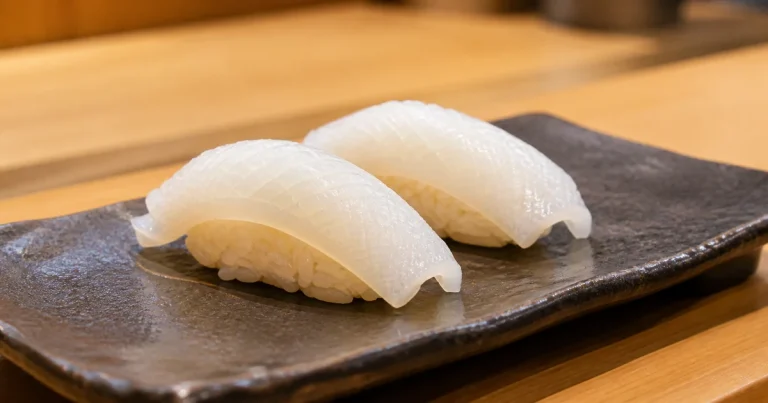
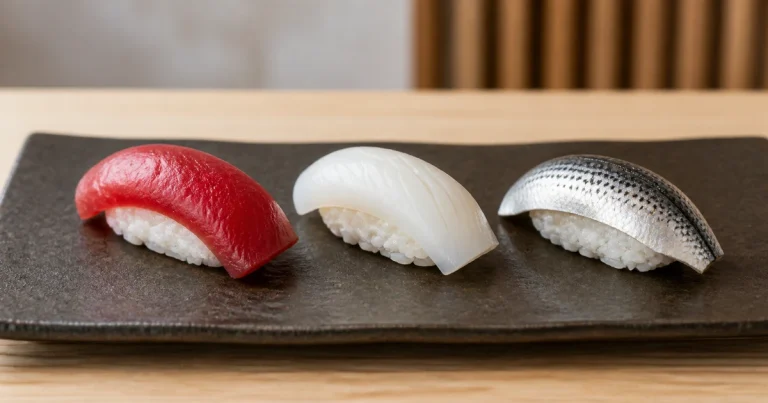
For a texture comparison, place it beside ika sushi: scallop is softer and sweeter, while squid is generally firmer and more dependent on scoring. For a shellfish comparison, ebi sushi brings a more obvious cooked snap and shrimp aroma.
Seasoning Should Support, Not Hide, the Scallop
Salt, sudachi or yuzu, nikiri soy sauce, and a small amount of wasabi are common partners. Their purpose is to sharpen sweetness or add aroma. Fresh wasabi can be subtle and fragrant, but the chef may omit it when another seasoning already defines the piece.
If the nigiri arrives brushed with sauce or topped with salt, taste it before adding soy sauce. Dip only when needed and avoid soaking the rice. The broader guide to eating sushi in Japan covers hands, chopsticks, ginger, and counter manners without turning the meal into a rule test.
Ordering Language and Menu Clues
You can say “Hotate, hitotsu kudasai” for one order. Nama indicates raw; aburi indicates seared. A menu that says Hokkaido-san hotate identifies Hokkaido origin, while kaibashira emphasizes the shellfish muscle.
Ask whether a seared preparation remains raw in the center if that matters to you. English labels such as “scallop roll” may describe chopped or mixed fillings rather than the simple hotate nigiri shown on a Japanese menu.
Shellfish Allergy and Raw-Seafood Safety
Scallops are molluscan shellfish. Anyone with a shellfish allergy should not rely on the visual simplicity of nigiri: shared knives, boards, hands, sauces, and serving surfaces can create cross-contact. Explain the allergy clearly to the restaurant before ordering.
Raw seafood always requires reliable sourcing and cold-chain control. People who are pregnant, elderly, immunocompromised, or otherwise at higher risk should follow current medical and public-health advice about raw or undercooked shellfish. A light sear is not necessarily full cooking.
A Practical First Hotate Order
Begin with one piece of raw nigiri to understand the scallop-rice balance. If you enjoy it, follow with aburi hotate to feel how surface heat changes aroma and firmness. Then compare it with ika or ebi. That short sequence teaches more than a list of abstract adjectives and shows why hotate is a favorite at many sushi counters.
Editorial Sources
- Ministry of Agriculture, Forestry and Fisheries: Fisheries and Aquaculture Statistics
- U.S. Food and Drug Administration: Advice About Eating Fish
- U.S. Food and Drug Administration: Food Allergies
- FoodSafety.gov: Safe Selection and Handling of Fish and Shellfish
- FDA Seafood Processor and Product Inspection Program