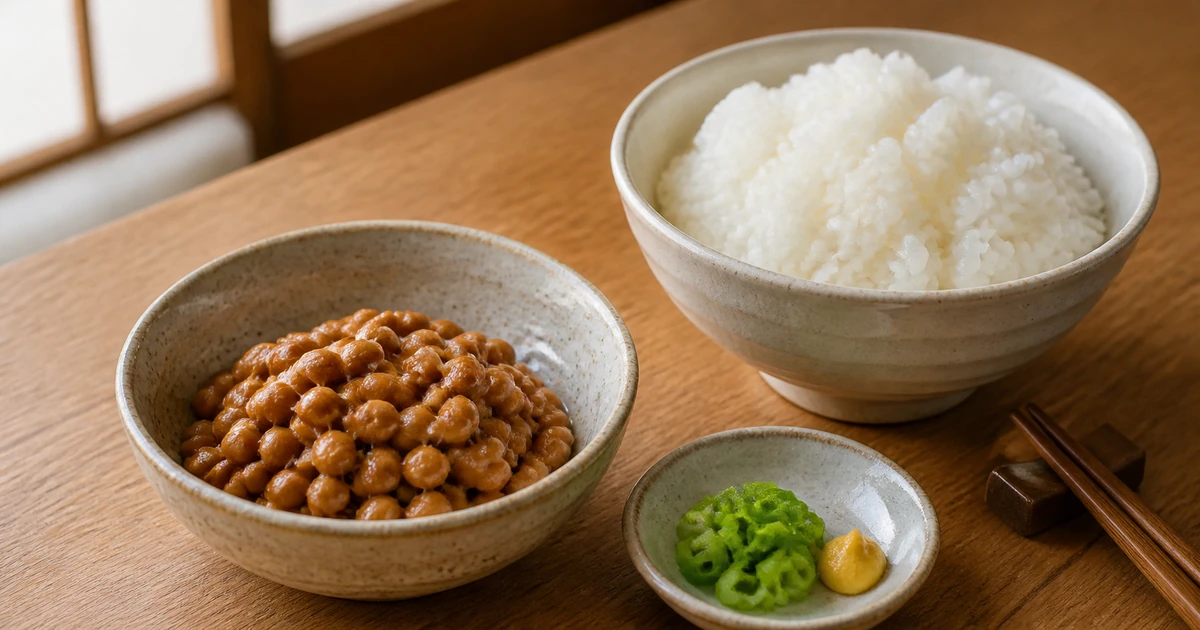
What is natto? Natto is a Japanese food made by fermenting cooked soybeans with Bacillus subtilis var. natto. The familiar version has whole or split beans, a pronounced fermented aroma, and sticky threads that become more visible when the beans are stirred.
In Japan, natto is not treated only as a traditional specialty or a health product. It is a familiar refrigerated food sold in small packs and commonly eaten with hot rice. Some people enjoy its savory depth and soft beans, while others dislike the smell or slippery texture.
Why Natto Feels Ordinary in Japan but Unusual Abroad
A standard Japanese breakfast may place natto beside rice, soup, grilled fish, pickles, and other small dishes. The diner opens the pack, removes the film, stirs the beans, adds seasoning, and pours or lifts the mixture over rice. It is inexpensive, quick, and requires no further cooking.
For a visitor, the same food can seem challenging before the first bite. Its threads stretch from bowl to chopsticks, and its aroma does not resemble an ordinary cooked bean. The key is to expect fermentation rather than freshness: natto tastes savory, bean-like, lightly bitter, and sometimes nutty, with a scent that can seem yeasty, earthy, or sharp.
The neutral warmth and gentle sweetness of Japanese rice soften these qualities. This is why eating a large spoonful alone is not always the best introduction.
What Fermentation Changes Inside the Pack
Commercial stringy natto begins with soybeans that are soaked and cooked. A natto culture is added, and the beans ferment under controlled temperature and humidity before being cooled and matured. Japan’s Ministry of Agriculture, Forestry and Fisheries identifies temperature and humidity control as central to the finished flavor and texture.
This process differs from the production of miso, which generally combines soybeans with salt and koji and matures as a paste. Ordinary stringy natto is not simply young miso or Japanese tempeh.
The pale coating and threads around the beans are characteristic results of natto fermentation. They should not be confused with a sweet sauce added by the manufacturer. The small seasoning packet is separate and may contain soy sauce, sweeteners, dashi, or other ingredients.
Whole Beans, Hikiwari, and Straw-Wrapped Natto
| Type | What changes | Eating experience | Useful starting point |
|---|---|---|---|
| Small-bean natto | Made with small whole soybeans | Easy to combine evenly with rice | A practical first pack |
| Medium or large-bean natto | Larger whole soybeans | More noticeable bean texture and flavor | For people who enjoy cooked soybeans |
| Hikiwari natto | Soybeans are split into small pieces | Softer, finer, and easy to mix into other foods | Useful in rolls, sauces, and rice |
| Warazuto natto | Traditionally associated with bundles of rice straw | Presentation and aroma differ by producer | A regional or souvenir experience |
Mito in Ibaraki Prefecture is especially associated with small-bean natto. MAFF explains that smaller early-maturing soybeans became suited to natto production and later gained attention as a railway souvenir. Modern supermarkets carry many regional and producer-specific variations, so bean size alone does not determine quality.
How to Prepare One Pack Without Making It a Ritual
- Keep the natto chilled and follow the storage directions on its label.
- Open the container and carefully lift away the inner film.
- Stir with chopsticks until the beans separate and fine threads develop.
- Add some or all of the included tare and karashi, then stir again if desired.
- Taste it with a small amount of warm rice before adding more seasoning.
There is no national rule for the correct number of stirs or whether tare must go in before or after mixing. Those claims often turn a simple breakfast food into a performance. Stirring changes aeration and texture, but personal preference matters more than reaching a magic number.
Common additions include sliced green onion, nori, grated daikon, okra, shiso, or a raw egg. Not every topping is needed at once. One mild aromatic ingredient and a restrained amount of sauce let a beginner understand the beans instead of hiding them.
Natto Does Not Have to Stay on Top of Rice
Rice is the standard partner, but natto also appears in noodles, omelets, toast, fried rice, soups, and mixed dishes. Regional natto-jiru mashes natto into a warming soup, while soboro natto from Ibaraki combines it with dried daikon. These uses show that natto can function as both a topping and an ingredient.
Maguro Natto: Tuna Changes the Balance
Maguro natto combines pieces of tuna sashimi with stirred natto, often with soy-based seasoning and a garnish such as green onion or aonori. The clean, dense texture of raw tuna contrasts with the soft beans and sticky coating. It remains a dish that divides opinion, but it is a recognizable Japanese combination rather than a novelty invented for foreign diners.
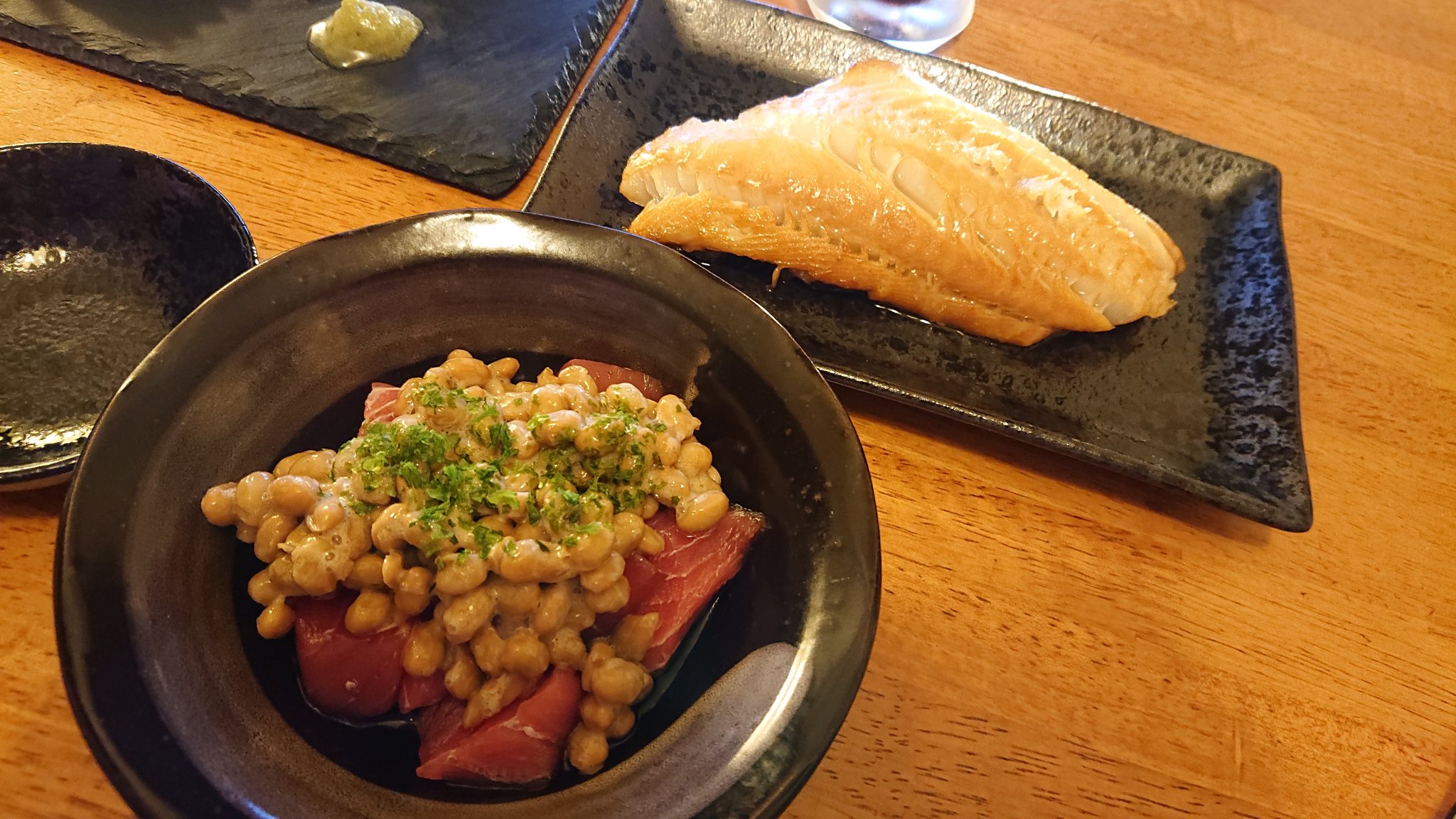
Because this version contains raw fish, it should be prepared only with tuna intended for raw consumption and handled under appropriate refrigeration and food-safety guidance. Natto fermentation does not make unsafe raw fish safe.
Natto Hosomaki: A Compact Sushi Filling
For natto hosomaki, seasoned natto is rolled with sushi rice inside nori. Hikiwari natto is especially convenient because the small pieces spread through the narrow center of the roll. Green onion may be added for freshness and a slight bite.
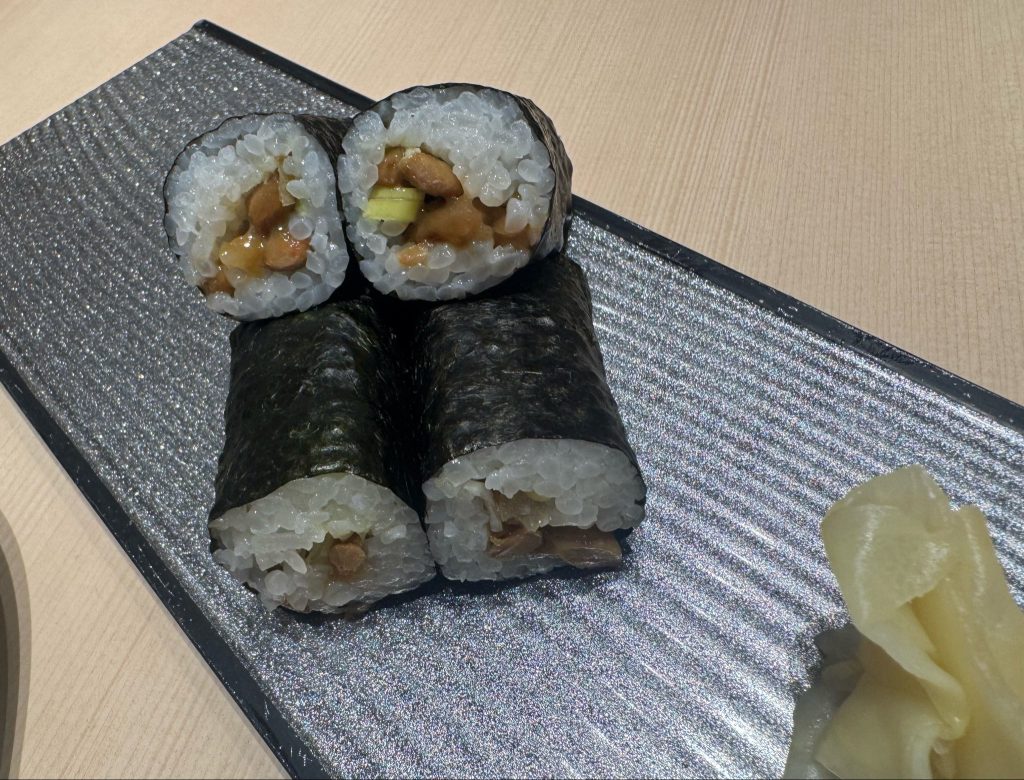
Rice and seaweed soften the aroma, although the sticky texture remains. For someone comfortable with sushi, a small roll can be more approachable than an entire pack.
Beginner Mistakes That Make Natto Harder to Enjoy
- Starting with a large spoonful by itself: begin with rice or a small roll so the flavor has context.
- Using every packet automatically: tare can be sweet and salty; add gradually.
- Expecting all packs to taste identical: bean size, fermentation, seasoning, and producer affect the result.
- Assuming the tare is gluten-free: natto itself is based on soybeans, but an included soy-sauce seasoning may contain wheat.
- Calling every dark fermented soybean “natto”: salted, koji-fermented products such as tera natto are different from ordinary stringy natto.
- Leaving it warm for convenience: follow the package’s refrigeration and date instructions.
What to Check When Buying Natto Outside Japan
Look in the refrigerated or frozen section of a Japanese or broader Asian grocery. Choose small whole beans for a familiar rice topping, hikiwari for finer texture or sushi rolls, and larger beans when soybean flavor matters most. A frozen product should be thawed according to its package rather than improvised.
Soy is a major allergen, and separate tare or mustard packets can introduce wheat, fish, or other ingredients. Read the full label even if the front simply says “natto.” People taking warfarin should also seek advice from their clinician before adding natto or making a major change in intake because it is a vitamin K–rich fermented food.
A fair first taste is a small portion over warm rice, lightly seasoned. If the texture is the main obstacle, try natto hosomaki; if plain beans seem one-dimensional, maguro natto provides contrast. Liking natto is not a requirement for appreciating Japanese food, but trying it in the way it is actually eaten gives the ingredient a much better chance.
Editorial Sources
- Ministry of Agriculture, Forestry and Fisheries: Natto production, Mito history, and regional varieties
- Ministry of Agriculture, Forestry and Fisheries: Introduction to Japanese fermented foods
- Ministry of Agriculture, Forestry and Fisheries: Natto-jiru
- Ministry of Agriculture, Forestry and Fisheries: Soboro natto
- U.S. Food and Drug Administration: Reading labels for major food allergens
- Cambridge University Hospitals NHS Foundation Trust: Warfarin and vitamin K guidance