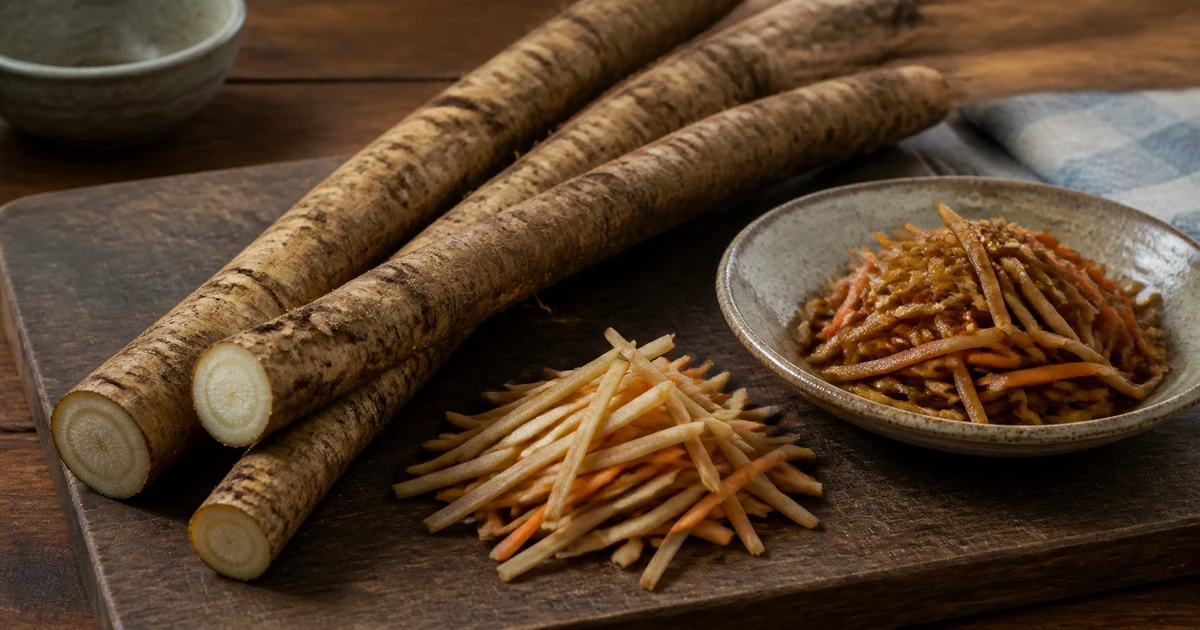
What is gobo? Gobo is the Japanese name for edible burdock root, a long brown root vegetable with pale flesh, an earthy aroma, and a firm, fibrous bite. In Japan, it is cooked in everyday side dishes, soups, rice dishes, salads, tempura, pickles, and even sushi rolls.
To someone seeing it for the first time, gobo can look more like a stick than a vegetable. That unfamiliar appearance helps explain why many visitors overlook it. Burdock is not absent from Western countries—the USDA documents commercial roots from California and Hawaii—but it is far less common as a routine supermarket vegetable in the United States, United Kingdom, and several other English-speaking markets.
Why Does Japan Treat Burdock as a Vegetable?
Japan has developed cultivated varieties, cutting techniques, and dishes that make gobo’s aroma and resilient texture desirable. One important example is Takinogawa Gobo, associated with the former Takinogawa area of Edo, now Tokyo. Japan’s Ministry of Agriculture, Forestry and Fisheries states that more than 90 percent of burdock cultivated in Japan today descends from this improved line.
Gobo also fits the structure of washoku, where a vegetable does not need to become soft or sweet to be valued. Its crunch can contrast with rice, tofu, meat, or tender vegetables, while its earthy character carries soy-based seasoning.
The most familiar example is kinpira gobo: thin burdock and carrot stir-fried, then seasoned with sugar, chili, and Japanese soy sauce. MAFF records it as an everyday Tokyo dish with roots in the Edo period rather than a modern health-food invention.
What Does Gobo Taste Like?
Gobo tastes earthy, mildly sweet, nutty, and sometimes gently bitter or astringent. Its aroma is closer to damp soil, mushrooms, or an unpeeled root vegetable than to the sweetness of carrot or parsnip. Freshness, variety, thickness, and preparation all change the result.
| Vegetable | Typical flavor | Texture after cooking | Can it replace gobo? |
|---|---|---|---|
| Gobo / burdock root | Earthy, aromatic, mildly sweet | Firm and pleasantly fibrous | The reference ingredient |
| Parsnip | Sweeter and more perfumed | Softer and starchier | Not a close substitute |
| Carrot | Clean and distinctly sweet | Tender-crisp to soft | Useful partner, not replacement |
| Salsify | Mild, earthy, sometimes nutty | More tender when cooked | Similar idea, different result |
The cut matters as much as the cooking time. Fine julienne keeps kinpira crisp but easy to chew. Sasagaki—shaving the root as if sharpening a pencil—creates thin, irregular pieces for soup and mixed rice. Thick batons hold their shape for simmering or pickling.
The Prep Mistakes That Changed How I Handle Gobo
Soaking Until the Aroma Disappeared
Early in kitchen training, it is easy to mistake whiteness for quality. I once left a pile of sasagaki gobo in water, changed the water repeatedly, and presented roots that looked clean but tasted exhausted. The lesson was direct: the purpose of rinsing is to control discoloration and harshness for a particular dish, not to wash until every trace of the ingredient has gone.
Polyphenols contribute to browning and can contribute astringency, but calling them the source of gobo’s “umami” is not chemically accurate. The practical loss comes from prolonged contact with water carrying away aroma and water-soluble components while the thin cuts lose character. Depending on the root and dish, I may transfer fresh cuts directly to stock, give them a short rinse, or soak them for several minutes. There is no universal rule that the water must become clear.
Peeling Away the Best Part
Another common mistake is using a peeler aggressively until the root becomes uniformly white. Much of gobo’s distinctive aroma is strongest near the surface. For a fresh, sound root, scrubbing away soil with a vegetable brush or lightly scraping the outside with the back of a knife is often enough. Crumpled aluminum foil is also used in home kitchens, but it should be clean and applied gently.
This does not mean every dark mark must remain. Remove damaged, dried, deeply discolored, or unpleasantly tough areas. The chef’s judgment is selective: preserve the fragrant outer layer where it is good, trim where quality demands it.
“Removing Aku” Does Not Mean Erasing the Flavor
Japanese recipes often describe gobo as having aku. In kitchen language, this is not one specific toxin. It can refer to bitterness, astringency, discoloration, or compounds that cloud the water and make the flavor feel harsh. The desired amount of removal depends on the dish and the root.
MAFF’s recipe for tataki gobo scrapes the surface lightly, soaks cut pieces for five to six minutes, and then boils them. Other preparations use a quick rinse, while some cooks skip soaking when color is unimportant and they want a stronger aroma. Leaving thin gobo in water for a long time can make it blander.
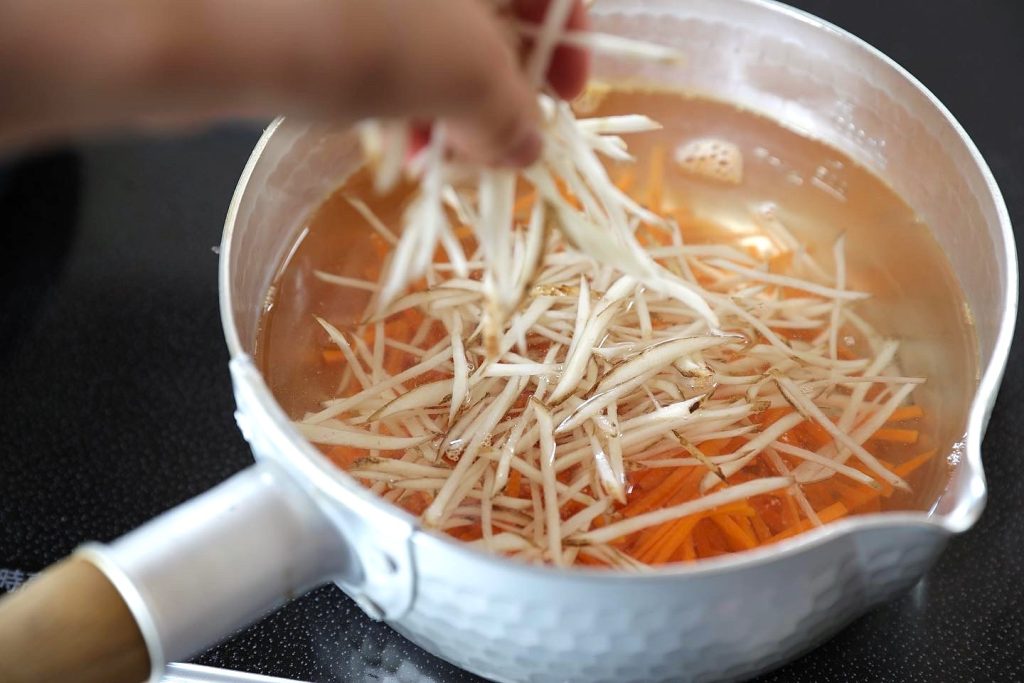
A Practical Preparation Sequence
- Scrub off soil thoroughly under running water.
- Scrape or peel only as much surface as the recipe requires; aroma is concentrated near the outside.
- Cut for the intended texture: julienne, sasagaki, diagonal slices, or batons.
- Rinse or soak briefly when you want to reduce discoloration or strong astringency.
- Drain well, then boil, simmer, stir-fry, pickle, or fry according to the dish.
Do not treat a clock time as universal. A young, mild Japanese variety may need less intervention than an older, thicker root sold overseas.
New Gobo and Mature Gobo Need Different Treatment
Season labels vary by region and farming schedule, but Japanese markets often distinguish tender shin-gobo or new-season burdock from more mature roots available through autumn and winter.
- Spring to early summer new gobo: the skin can be thin, the fibers relatively tender, and the aroma fresh and green. Light scrubbing, fine sasagaki, and shorter cooking suit salads, quick simmering, tempura, and seasonal mixed dishes. Some producing areas ship spring gobo as early as March.
- Autumn and winter mature gobo: a thicker, firmer root can carry longer simmering and more assertive seasoning. Diagonal cuts or rolling cuts expose surface area while retaining enough structure for chikuzen-ni, game-ni, soups, and braised chicken dishes.
Age alone does not determine quality. Variety, storage, diameter, growing soil, and how long the cut root has been exposed all matter. I test the raw resistance with the knife and smell the cut surface before deciding how thinly to cut or how long to cook.
Knife Work and Cooking Method by Dish
| Dish | Cut and preparation | Chef’s objective |
|---|---|---|
| Kinpira gobo | Even julienne or controlled sasagaki | Cut with attention to the fiber, stir-fry decisively, and retain a clear bite; sesame oil and chili finish the aroma |
| Tataki gobo | Short batons, cooked and gently crushed | Open cracks without turning the root to paste so sesame dressing or sanbaizu reaches the interior |
| Simmered-then-fried gobo | Thicker batons first cooked in seasoned dashi | Cool in the liquid, dry, coat, and fry for a crisp shell around a juicy, seasoned center |
| Raw-cut tempura or kakiage | Fine sasagaki or thin strips, thoroughly dried | High-temperature oil drives off moisture quickly and creates light, aromatic edges |
| Chikuzen-ni or game-ni | Diagonal or rolling cuts of similar size | Create surface area for seasoning while preserving structure during longer simmering |
Gobo tempura does not have to be simmered first. Thin raw cuts can fry beautifully and give the clearest earthy aroma. Pre-simmering is a separate restaurant technique for thicker pieces when the desired effect is “crisp outside, dashi-rich inside.” Choosing between the two is part of the dish design.
How Gobo Moves from Salad to Tempura
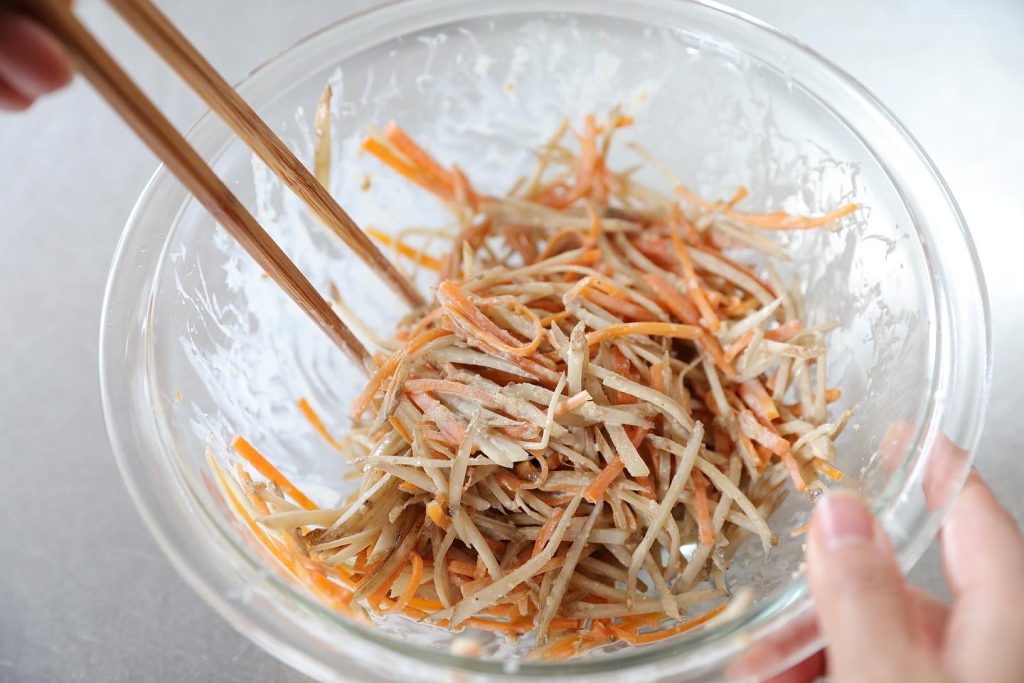
For Japanese-style gobo salad, julienned gobo and carrot are normally cooked until safe and pleasantly crisp, cooled, drained, and mixed with a creamy or sesame-forward dressing. The preparation should soften the fibers without turning both vegetables into paste.
For tempura or kakiage, thin gobo strips create crisp, tangled edges. After any rinsing, drain and dry them well before they approach hot oil; excess surface water increases splattering. A thick piece that remains tough in the center is less successful than a thin, controlled cut.
Other common routes include miso soup, tonjiru, takikomi gohan, chicken-and-gobo simmered dishes, and kinpira. Sweet-savory cooking liquid often combines soy sauce, sugar, sake, and mirin, but the proportions depend on whether the dish is a side, soup, or preserved preparation.
Pickled Gobo Belongs in Sushi Too
Pickling changes gobo from an earthy root into a compact sushi filling with acidity, sweetness, and a clean crunch. A seasoned baton can run through the center of hosomaki, surrounded by sushi rice and nori. The result is simple but not bland: the filling provides both flavor and structure in each slice.
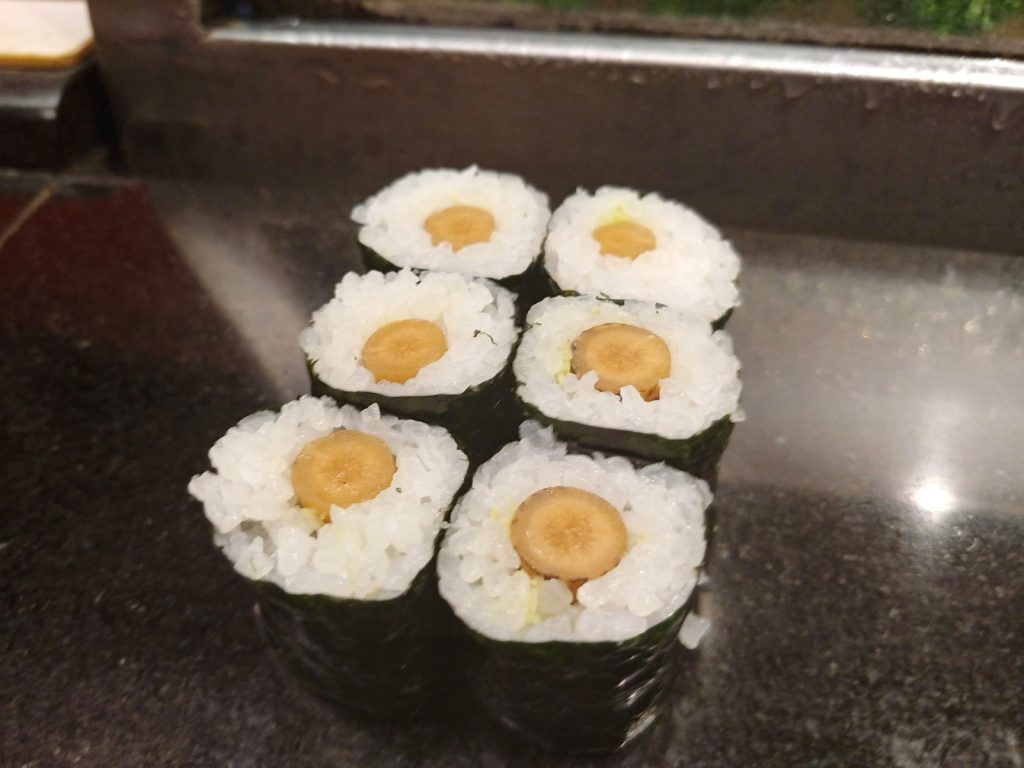
This use is not limited to one modern restaurant. MAFF documents regional sushi in which burdock is simmered with sweet-savory seasoning or combined with sushi rice. The exact roll, pickle, and seasoning vary, so “gobo sushi” does not describe one nationally fixed recipe.
What First-Time Cooks Usually Get Wrong
- Peeling until the root is perfectly white: this removes some of the characteristic aroma near the surface.
- Soaking every cut for a long time: water can reduce harshness, but it can also wash away flavor.
- Cutting thick pieces for a quick dish: gobo stays firm and may seem woody if the cut and cooking time do not match.
- Expecting parsnip sweetness: burdock is earthier and less starchy.
- Using wet strips for tempura: drain thoroughly before frying.
- Foraging unfamiliar burdock: buy cultivated, food-grade roots unless you have qualified identification and safe harvesting knowledge.
How to Find Gobo Outside Japan
Look for labels such as gobo, burdock root, edible burdock, or occasionally great burdock. Japanese, Korean, and broader Asian groceries are more likely to carry fresh roots; refrigerated pickled gobo and frozen or prepared products may be easier to find.
Choose firm roots without soft, spongy areas. A little soil is normal for an unwashed root. Because long gobo is awkward to transport, shops may cut it into shorter lengths. Check prepared products for sugar, salt, color, and allergens rather than assuming every pickle has the same formula.
The best first experience is not a plain boiled chunk. Try kinpira for aroma and crunch, a cooked gobo salad for familiarity, or pickled gobo hosomaki for a clear contrast with rice. These preparations show why Japanese cooks value the root instead of disguising it as another vegetable.
Editorial Sources
- Ministry of Agriculture, Forestry and Fisheries: Kimpira, Takinogawa Gobo, and Edo-Tokyo food culture
- Ministry of Agriculture, Forestry and Fisheries: Tataki gobo preparation
- Ministry of Agriculture, Forestry and Fisheries: Burdock in regional rolled sushi
- Ministry of Agriculture, Forestry and Fisheries: Tsurajima Gobo characteristics
- Ministry of Agriculture, Forestry and Fisheries: Kikuchi Suiden Gobo production and spring harvest
- USDA Agricultural Marketing Service: Burdock root market forms and production
- NC State Extension: Great burdock distribution and food use