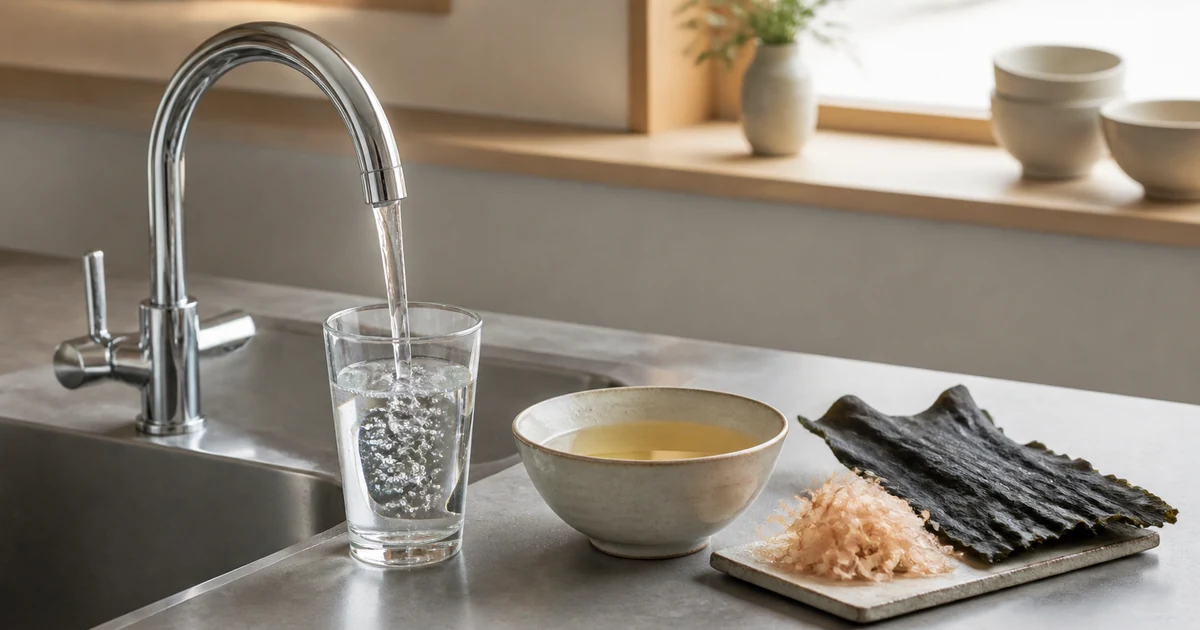
Yes. Tap water supplied by Japan’s public water systems is generally safe to drink. Travelers normally do not need bottled water simply because they are in Japan, and restaurants commonly serve water without charge. The answer changes only when a local advisory, a non-potable label, a private well, or a problem inside a building gives you a reason to stop and check.
For a cook, however, “safe to drink” is only the first question. Water is also an ingredient. It becomes part of rice, tea, miso soup, simmered food, and above all dashi. A glass of water may taste neutral on its own yet behave differently when it extracts aroma and savory compounds from kombu or katsuobushi.
When the Answer Is Yes—and When to Pause
Japan’s public tap water is governed by national quality standards and tested by water suppliers. From April 2026, PFOS and PFOA were added to the mandatory standards, bringing the list to 52 items. The Japan National Tourism Organization gives travelers the same practical answer: Japanese tap water is safe to drink and is commonly served in restaurants.
That national answer does not mean every faucet can be treated without context. Do not drink when:
- a municipal authority, hotel, or building manager has issued a boil-water or do-not-use notice;
- the faucet is marked non-potable;
- the source is an unverified private well;
- the water has unexpected color, particles, or a strong unfamiliar odor; or
- earthquake, flooding, pipe damage, or maintenance has disrupted the local supply.
Buildings with storage tanks add another layer of responsibility. The public utility supplies treated water, but the condition of a building’s tank and internal plumbing can affect what reaches the faucet. If something seems wrong, ask the property manager rather than assuming that boiling or a countertop filter will solve every possible problem.
Boiling can kill susceptible microorganisms when authorities specifically recommend it, but it does not remove every chemical contaminant. A taste filter may reduce chlorine odor, yet it is not a substitute for an official safety instruction. During an advisory, follow the exact local notice.
The Expensive Water That Ruined My Dashi
I learned to separate price from suitability during a short cooking event outside Japan. Wanting to present careful Japanese cooking, I had brought aged Hokkaido makombu and freshly shaved hongarebushi. I distrusted the unfamiliar local tap water and bought one of the most expensive imported mineral waters available, assuming that a premium bottle must produce a premium stock.
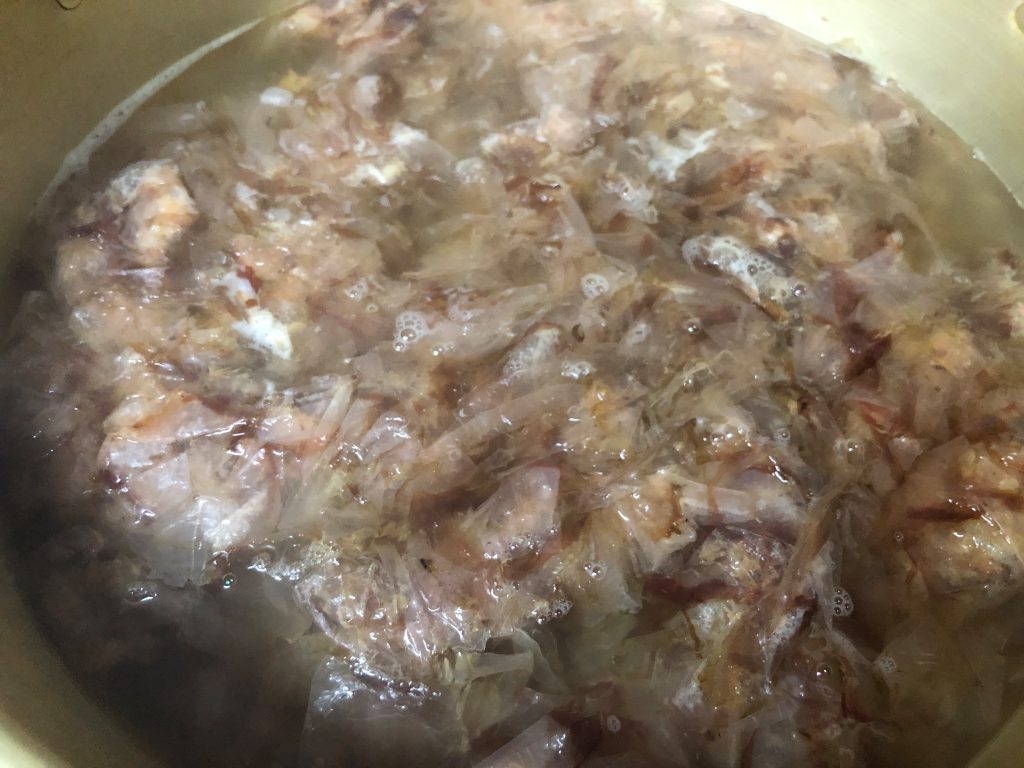
As the water heated, the stock behaved differently from the clear dashi I expected. Grayish foam gathered on the surface and the liquid became noticeably cloudy. When I tasted it, the gentle marine sweetness I wanted was hidden beneath a heavy mineral impression, bitterness, and an earthy quality. The result was unusable for the dish I had planned.
In the moment, I blamed hard water completely. That conclusion was understandable, but too simple. Hardness, individual ions, the kombu itself, temperature, extraction time, the pot, and other conditions can all affect the outcome. A failed batch is powerful kitchen evidence that water matters; it is not laboratory proof that every hard water will destroy every kombu.
The lasting lesson was more useful than the original assumption: never select cooking water by price, prestige, or the word “mineral” alone. Taste it, read its mineral analysis, and test it with the actual ingredient before service.
Japan Is Often Soft-Water Country, but Not One Single Water
Hardness is a measure based mainly on dissolved calcium and magnesium, usually expressed as milligrams per liter of calcium carbonate. Much of Japan’s tap water is relatively soft compared with distinctly hard water found in some other countries, but there is no single national hardness value.
Tokyo, for example, reports that its tap water is generally around 50–100 mg/L depending on season and water system. Other regions may be lower or higher. Water source, geology, rainfall, treatment, and blending all contribute. Calling every Japanese tap “ultra-soft water at 40 mg/L” would turn a useful tendency into an inaccurate rule.
Hardness is not the same as safety, and it does not explain taste by itself. Residual chlorine, temperature, dissolved carbon dioxide, plumbing, and the balance of individual ions can all affect how water tastes. Very low-mineral water is not automatically delicious, just as high-priced mineral water is not automatically appropriate for dashi.
What Water Actually Changes in Dashi
Dashi is unusually sensitive because it depends on extraction rather than long reduction or heavy seasoning. Kombucontributes glutamate and other soluble compounds. Katsuobushi contributes inosinate and volatile aromas. Water carries those compounds into the finished stock and remains most of what the diner tastes.
It is tempting to explain every difference with a dramatic mechanism: calcium and magnesium create an impermeable wall, glutamate becomes trapped, and hard water inevitably produces cloudy, bitter stock. Current evidence does not support that universal story.
A 2024 Japan Society of Cookery Science study compared makombu extraction in mineral waters with hardness levels of roughly 30–300 mg/L. It found no significant effect of hardness alone on the content and balance of extracted components. When the researchers compared waters with similar hardness but different ionic compositions, those compositional differences did affect extraction behavior. In other words, one hardness number cannot describe everything the water is doing.
That does not invalidate a cook’s senses. Hard water can carry a stronger mineral taste, produce scale when heated, or give a stock a different texture and aroma. It means the result should be described honestly: “this water produced this result under these conditions,” rather than “hard water blocks all umami.”
A Kitchen Comparison Is Useful When It Controls the Variables
After the failed event, I compared the same makombu in Japanese tap water and a much harder bottled water, using 10 grams per liter and a 60°C extraction. In my kitchen comparison, the Japanese water produced the clearer, cleaner-tasting stock, while the harder bottled water gave a heavier mineral impression and more visible cloudiness.
Those observations helped me choose water for service, but they were not a peer-reviewed experiment. A fair comparison should keep the kombu batch, amount, vessel, starting temperature, extraction temperature, time, and tasting temperature constant. Ideally, taste the samples blind. Record the bottled water’s calcium, magnesium, bicarbonate, sodium, and total mineral content rather than relying on price or a marketing description.
If the harder sample performs poorly, try another low-mineral still water. If both taste good, there is no culinary prize for choosing the more complicated option. The purpose of testing is to find water that lets the chosen ingredients speak clearly.
What the Glass of Ohiya Can—and Cannot—Tell You
The cold water served at a Japanese restaurant is called ohiya. It can offer a first impression of the water’s temperature, odor, and mineral taste, but it does not reveal the entire kitchen system. A restaurant may serve filtered water, chilled dispenser water, or ordinary tap water. It may also use different water for coffee, tea, ice, or stock.
Still, paying attention is worthwhile. A clean-tasting glass helps explain why delicate soup can remain restrained rather than needing heavy seasoning. When you next taste miso soup, clear broth, or udon stock, notice not only salt and dashi but also the absence or presence of a mineral or chlorine impression.
This should not become a ritual for declaring a restaurant “authentic” from one sip. Water quality at the table is one clue, and the cook’s extraction technique remains decisive.
Choosing Water for Dashi Outside Japan
Start with safe local tap water. If it tastes pleasant and produces a dashi you enjoy, there is no reason to replace it. When it smells strongly of disinfectant or tastes conspicuously mineral, compare it with a still bottled water whose label shows relatively low mineral content.
Do not assume that the most expensive bottle is the best. Sparkling water is unsuitable for an ordinary dashi comparison, and distilled water is not guaranteed to taste better; water with almost no minerals can seem flat.
A properly certified and maintained filter may improve taste, but use it according to the manufacturer’s instructions and change cartridges on schedule. Filtered water has less residual disinfectant protection, so keep equipment clean and do not store the water carelessly.
If chlorine odor is the only issue, local water authorities may recommend airing, chilling, filtering, or boiling for taste improvement. Tokyo Waterworks, for example, recommends boiling with the lid partly open and then continuing at low heat for approximately five to ten minutes when odor is a concern. That is different from claiming that one minute of boiling creates “perfect natural spring water.” Once water is boiled or filtered, cool and store it hygienically and use it promptly.
Most importantly, taste before changing anything. Water is one variable among kombu variety, katsuobushi quality, quantity, shaving thickness, temperature, and time. Correcting an extraction mistake with specialty water is no easier than correcting unsuitable water with expensive kombu.
The Quiet Ingredient Behind the Meal
The practical answer for a visitor remains simple: Japan’s public tap water is generally drinkable, and complimentary restaurant water is normal. Check local instructions during emergencies, respect non-potable labels, and ask about private wells or unusual water rather than guessing.
The culinary answer is more interesting. Japan’s often low-mineral water is compatible with the clear, restrained style associated with many dashi preparations, but it is not magic and it is not identical across the country. Good stock comes from understanding the particular water and adjusting the extraction—not from repeating that soft water is always perfect or that hard water destroys umami.
The next time a bowl of soup seems remarkably clear and aromatic, the water deserves some of the credit. So do the cook who tasted it, tested it, and chose not to let an expensive label make the decision.
Evidence Behind the Safety and Dashi Claims
- Japan National Tourism Organization: Drinking Water in Japan
- Ministry of the Environment: Japan’s Drinking-Water Quality Standards
- Ministry of Land, Infrastructure, Transport and Tourism: Storage-Tank Water Systems and Drinking Wells
- Tokyo Metropolitan Government: Tap-Water Hardness
- Tokyo Metropolitan Government: Unusual Taste, Odor, and Household Treatment
- Japan Society of Cookery Science: Kombu Dashi Extracted with Different Waters