At a sushi counter, it is easy to spend all your attention on the fish: the marbling of tuna, the translucence of squid, or the knife work on sea bream. Yet the first thing that reaches your tongue beneath every topping is the shari—the seasoned rice. If that rice is too sweet, too salty, too cold, or too assertive, even excellent fish can lose its character.
Rice vinegar is therefore more than a background condiment. It sets the pace of a sushi meal. A pale komezu can give the rice a clean, bright finish, while a sake-lees vinegar commonly called akazu can bring amber color and a deeper fermented impression. Neither is automatically superior. The useful question is which vinegar, seasoning, and rice temperature allow a particular topping to taste most complete.
This is how I learned to think about vinegar at the cutting board: not as the star of sushi, but as the link between grain and fish.
“Rice Vinegar” Does Not Describe One Flavor
In English, several different products are often grouped under the phrase “rice vinegar.” Japanese labels make distinctions that matter in the kitchen.
- Komezu (米酢): Under Japan’s JAS standard, this is a grain vinegar made with at least 40 grams of rice per liter, excluding rice black vinegar. Products vary with the rice, water, fermentation, aging, and producer. In sushi work, a pale komezu is often valued for a relatively clean color and straightforward acidity.
- Akazu (赤酢): In sushi usage, this usually refers to an amber or reddish vinegar associated with aged sake lees. The depth of color, aroma, and flavor varies considerably. “Akazu” is not a promise that every bottle follows one fixed aging period or tastes equally mellow.
- Grain vinegar: This can be brewed from more than one grain and is generally economical and versatile. It is not the same product category as komezu simply because both look pale.
- Seasoned rice vinegar or sushi seasoning: This already contains some combination of salt, sugar, or other seasonings. It is convenient, but it gives the cook less control over the final balance.
Distilled white vinegar is a separate product and should not be confused with pale Japanese rice vinegar. Calling komezu “white vinegar” may sound convenient, but it can send an overseas shopper to the wrong bottle.
Rice vinegar also has a life beyond sushi. Its relatively gentle profile works in sunomono, quick pickles, dressings, and sauces. For the distinction between vinegar and another frequently misunderstood seasoning, see the guide to mirin.
Akazu Became Part of Edomae Sushi for Practical Reasons
Sake-lees vinegar spread alongside Edomae sushi in the late Edo period. Japan’s Ministry of Agriculture, Forestry and Fisheries notes that it suited sushi and was less expensive than rice vinegar at the time. Mizkan traces its own sake-lees vinegar to founder Matazaemon Nakano and describes how it became popular among Edo sushi makers.
That history helps explain the association between amber-colored rice and traditional Edomae sushi, but it should not become a purity test. Modern sushi shops may use komezu, akazu, a blend of several vinegars, or different shari for different parts of the menu. The house style matters more than the color alone.
A useful working tendency is that a clean komezu-led blend can leave room for the sweetness of white fish, squid, and shrimp, while a more savory or fermented akazu-led blend can stand comfortably beside tuna, cured toppings, simmered anago, or a brush of nikiri. This is a pairing approach, not a law. A skilled chef can build one balanced shari that works across an entire progression.
The Night My Akazu Shari Defeated the Fish
Early in my career, when dark akazu shari was attracting attention, I became too interested in making the rice announce itself. I prepared an assertive blend with deeply flavored sake-lees vinegar and a firm dose of salt. The color looked dramatic. I believed the shari had presence.
Then I served it beneath excellent hirame and aori-ika.
A regular customer tasted the hirame, paused, and told me that the fish had disappeared behind the vinegar. When I made the same piece for myself, the problem was obvious. The shari’s fermented aroma, acidity, and salt remained after the delicate sweetness of the flounder should have opened. I had not strengthened the sushi; I had made the rice compete with it.
That failure changed how I formulate shari. Vinegar must have enough structure to season the rice and refresh the palate, but its intensity has to be judged against the topping, the size of the rice portion, the serving temperature, and the order of the meal. For delicate white fish and squid, I began testing lighter komezu-led blends. For tuna and simmered toppings, I could use more depth—but never simply because darker rice looked more “authentic.”
The lesson was not that akazu is too strong. It was that no vinegar deserves to dominate merely because it is fashionable.
What Actually Happens During Shari-kiri
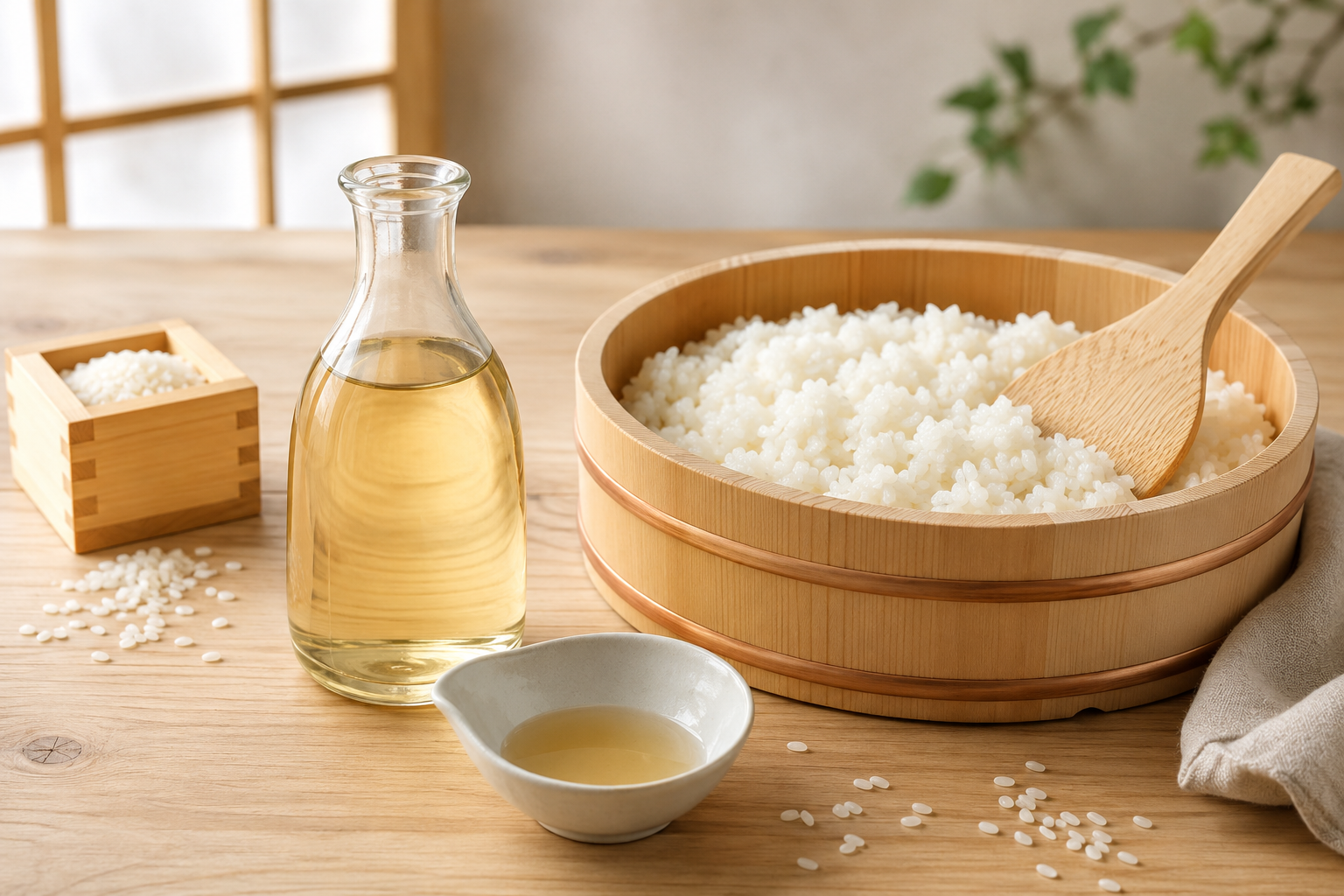
Shari-kiri is the mixing of freshly cooked rice with seasoned vinegar. The familiar image is rice being moved from the cooker into a wooden handai, seasoned, cut and folded with a paddle, then cooled while the grains become glossy.
Freshly cooked rice matters because the seasoning can be distributed while the rice is hot and mobile. There is no universal professional rule that it must be exactly 80–90°C. Rice variety, batch size, cooker, water level, room conditions, vinegar formulation, and the chef’s target texture all change the working window.
The paddle should cut through and turn the rice rather than mash it. The purpose is not to chop grains in half. It is to expose new surfaces, spread the seasoning evenly, and release excess steam without compressing the batch into a paste. A handai can help manage surface moisture, but a broad nonreactive bowl can work at home.
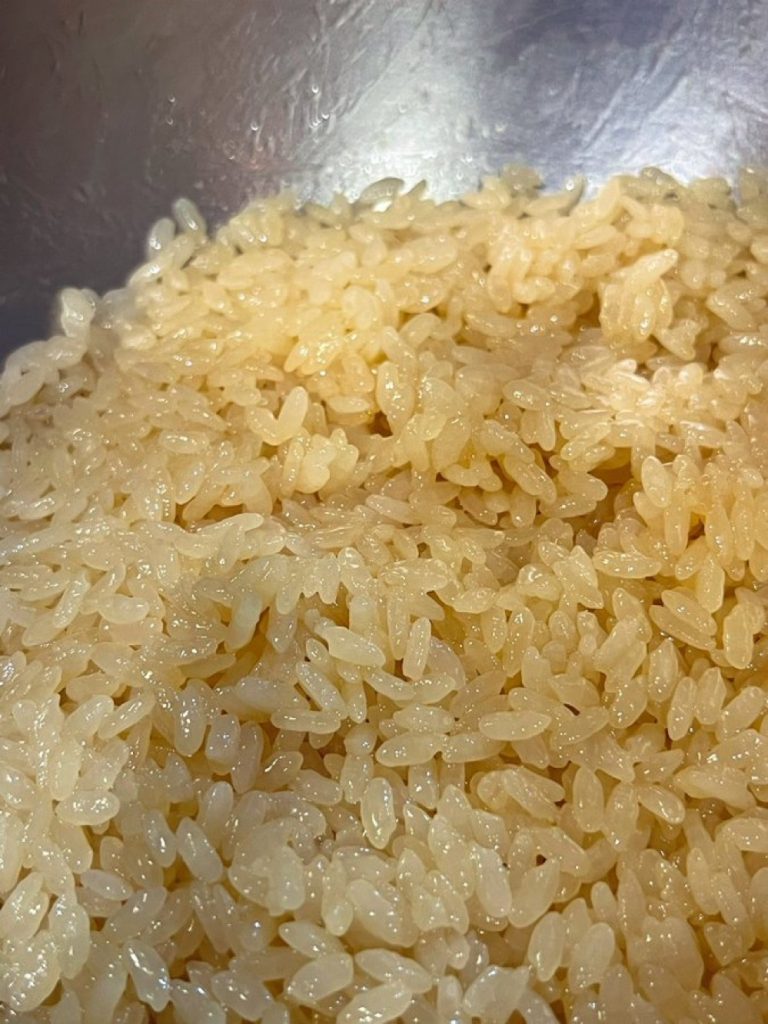
Fanning is also a tool rather than a ritual. Used with restraint, it helps remove steam and set a sheen on the grains. Used too aggressively or for too long, it can dry the surface before the rice is ready to be held and shaped.
Warm rice also releases vinegar aroma more readily than cold rice. Some of the sharpest volatile impression softens as hot rice is mixed and steam escapes, but the goal is not to boil away all the acidity. The cook wants a shari that smells alive when it reaches the diner. Cooling it until it becomes refrigerator-cold flattens aroma and changes the texture of the starch.
For a closer look at service temperature, see why sushi rice temperature changes a piece of nigiri. The broader guide to Japanese rice explains why sushi rice is usually cooked with its later seasoning in mind.
Salt and Sugar Are Structural Decisions, Not a Golden Ratio
Every vinegar blend has to solve three related problems: acidity, salinity, and sweetness. The ideal balance depends on the vinegar’s acidity, the rice, the topping, and the intended style.
Some akazu-led Edomae shari uses little or no added sugar, relying on the vinegar’s fermented character and the natural sweetness of the rice. Other respected shops use sugar. Komezu-based shari often includes sugar to round the acidity, but that does not mean all pale shari should taste sweet.
Too much sugar can make the rice feel heavy beside fatty fish. Too much salt can suppress the sweetness of delicate toppings and leave the mouth tired after several pieces. Too little seasoning can produce rice that tastes detached from the fish. These are sensory outcomes, not moral judgments about “traditional” and “modern” sushi.
For home cooks, a tested recipe is safer than an invented universal ratio. Kikkoman’s basic English-language recipe uses 4 tablespoons of rice vinegar, 2 tablespoons of sugar, and 1 teaspoon of salt for 360 grams of uncooked rice. Treat that as one reliable starting style, not a professional law. Vinegar acidity, spoon size, rice yield, and personal preference vary, so follow the bottle or recipe you are using and adjust only after tasting a small batch.
The previously proposed mixture of 100 milliliters vinegar, 20 grams salt, and 10–15 grams sugar for two Japanese cups of rice is not recommended here. The salt level is unusually high relative to established home recipes and could overwhelm both rice and fish.
Seasoned Rice Vinegar Is Convenient—Its Trade-off Is Control
Seasoned rice vinegar is not an inferior product by definition. It is useful for beginners, quick chirashi, hand rolls, and small batches because the salt and sugar have already been balanced by the manufacturer.
The limitation is that you cannot independently reduce sweetness, increase salt, or change the vinegar blend. Ingredient lists also differ by brand and country. Do not assume that every seasoned product contains high-fructose corn syrup or preservatives; read the actual label. Most importantly, do not add a full recipe’s salt and sugar on top of an already seasoned vinegar.
If you want to study the effect of vinegar itself, buy an unseasoned rice vinegar first. Make two small batches with the same rice and measured seasoning, changing only the vinegar. Comparison teaches more than a ranking.
How to Read Shari at the Sushi Counter
You do not need to identify a proprietary vinegar blend to understand what the chef is trying to do. On the first piece, notice four things together:
- Temperature: Is the shari pleasantly warm, cool, or refrigerator-cold? How does that temperature interact with the fish’s fat?
- Separation: Do the grains hold together long enough to lift, then loosen cleanly in the mouth?
- Seasoning: Does acidity brighten the topping, or does salt, sugar, or fermented aroma remain after the fish has faded?
- Progression: Does the same shari continue to work as the meal moves from white fish to tuna, silver-skinned fish, shellfish, and simmered toppings?
Color is only one clue. Darker rice does not prove greater craftsmanship, stronger acidity, longer aging, or a more traditional restaurant. Pale shari can be forceful; amber shari can be restrained. Taste the relationship between fish and rice rather than awarding points to the shade.
This perspective also changes how you understand sushi as a complete dish. The topping provides species, season, fat, texture, curing, and knife work. The rice provides warmth, grain structure, acidity, salt, and a measured sweetness. Nigiri succeeds when neither half asks to be tasted alone.
References on Rice Vinegar, Akazu, and Sushi Rice
- Ministry of Agriculture, Forestry and Fisheries: Japanese Agricultural Standard for Brewed Vinegar
- Ministry of Agriculture, Forestry and Fisheries: Komezu in Japan’s Traditional Food Culture
- Ministry of Agriculture, Forestry and Fisheries: Vinegar and the Spread of Sake-Lees Vinegar with Edomae Sushi
- Mizkan: Jun Sakekasu-su Mitsukan Yamabuki and the Producer’s Definition of Akazu
- Kikkoman: Basic Sushi Rice Method and Seasoning Ratio
If this guide gave you a clearer understanding of a Japanese ingredient, you can support Japan Food Compass on Ko-fi and help us continue sharing carefully researched guides and original kitchen stories.