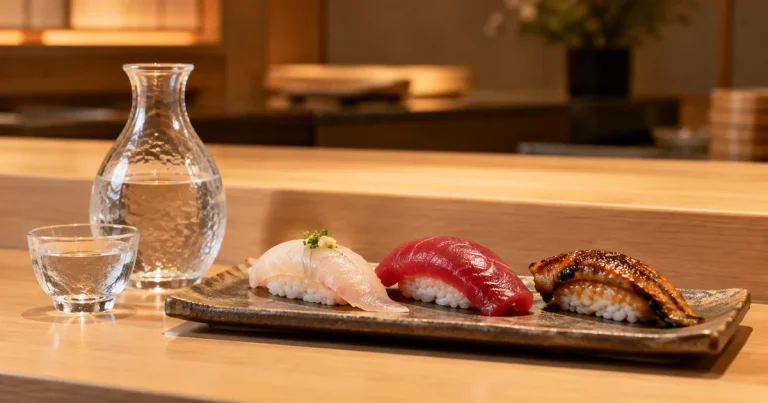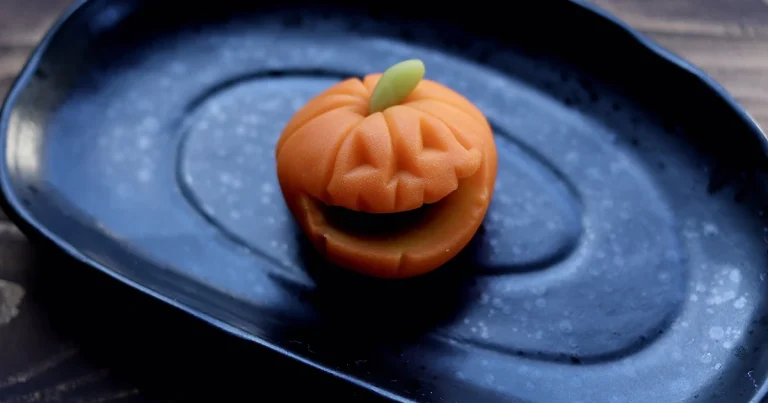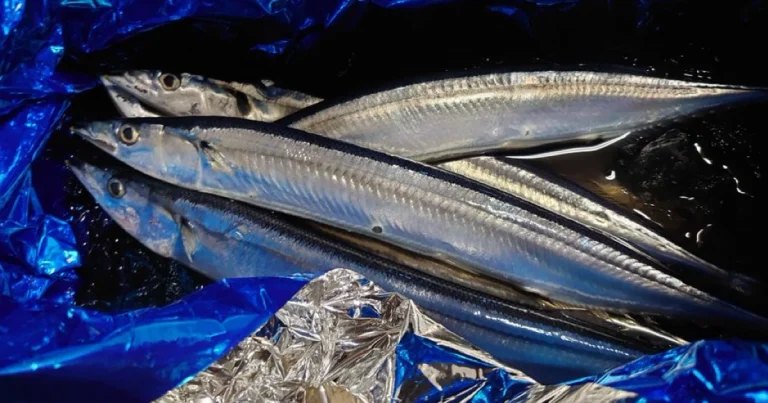
Sushi culture in Japan is not defined by raw fish alone. It grew from preservation, regional ingredients, urban food stalls, specialized craft, and everyday ways of sharing a meal. Modern nigiri is one important expression, but fermented sushi, pressed sushi, rolls, boxed meals, neighborhood shops, and celebratory dishes all belong to the wider story.
Understanding that history changes how a diner sees the plate. The rice is not a neutral base, “fresh” does not always mean untouched, and a chef’s work begins long before a piece is shaped. Sushi becomes easier to appreciate when it is viewed as a living food culture rather than a fixed collection of toppings.
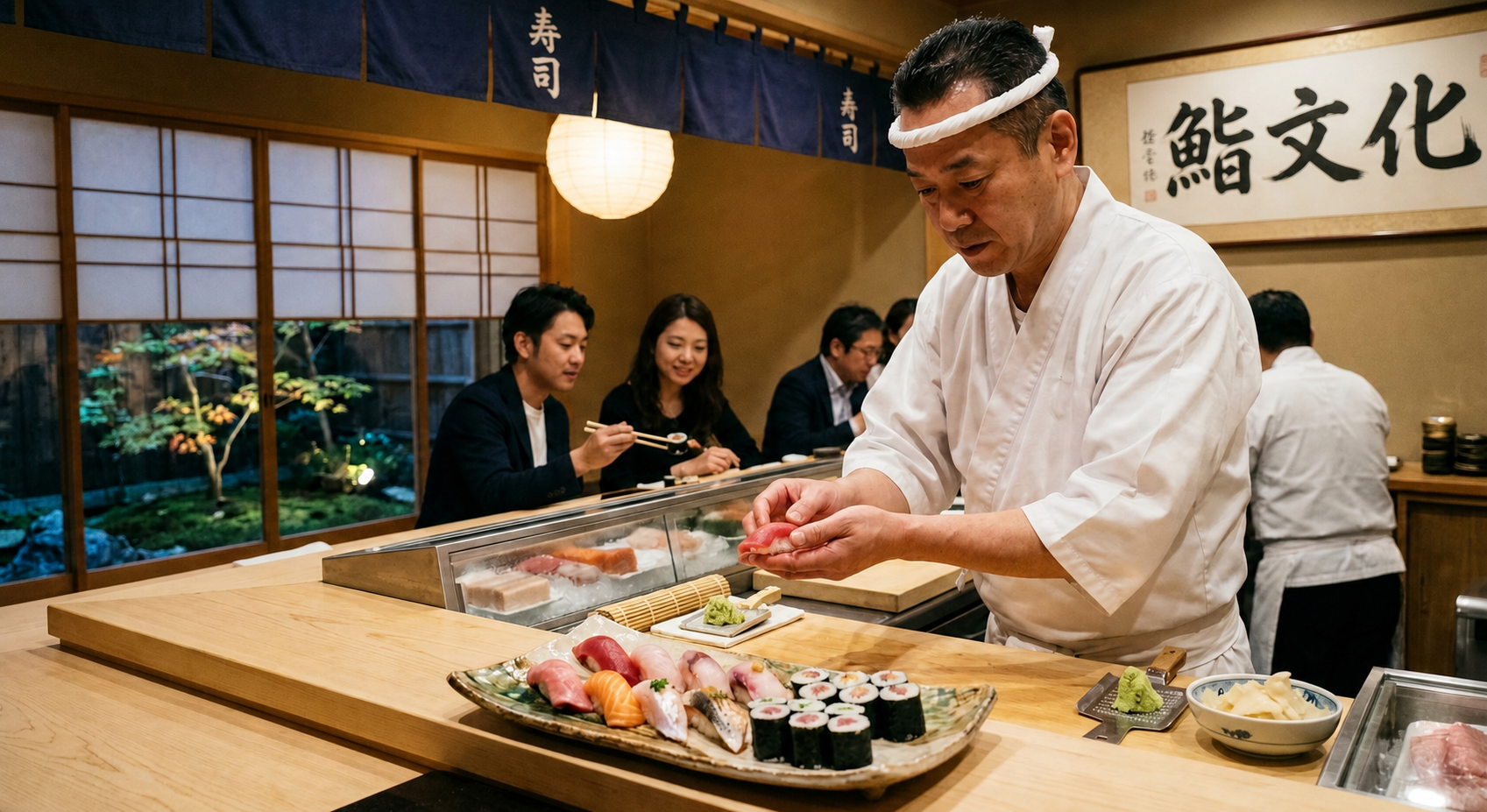
For me as a sushi chef, that culture becomes most visible at the tsukeba, the working side of the counter. The chef and guest create the meal together through timing, observation, conversation, and silence. A piece is shaped by hours of preparation, but its final condition exists only briefly after it is placed in front of the diner.
Sushi Began With Preservation, Not Nigiri
Early forms of sushi used salt and cooked rice to preserve fish through lactic-acid fermentation. In long-fermented narezushi, the rice supported the process and was historically discarded in some forms. Japan’s Ministry of Agriculture, Forestry and Fisheries explains that related preservation knowledge is thought to have reached Japan with rice agriculture from parts of China or Southeast Asia.
The tradition did not disappear when faster sushi developed. Regional narezushi remains part of Japanese food culture, including Shiga Prefecture’s well-known funazushi. Other local forms vary in fish, fermentation time, seasoning, and connection to festivals or shrine offerings. Sushi history is therefore not a simple replacement of “old” by “modern.” Several timelines continue beside one another.
Vinegared Rice Made Sushi Faster
Over time, shorter fermentation allowed people to eat the rice with the fish. Later, hayazushi, or fast sushi, used vinegar to create acidity without waiting for natural fermentation. This change made sushi quicker to prepare and opened the way for several recognizable forms.
MAFF describes two important directions: Kansai-style hako-zushi, in which seasoned rice and toppings are pressed into a block, and Kanto-style nigiri associated with Edo, present-day Tokyo. The distinction matters because the familiar hand-shaped piece is not the original or only form. Nigiri, maki, temaki, gunkan, and chirashi now give diners several different relationships between rice and other ingredients.
Edomae Sushi Turned Preparation Into the Main Craft
Nigiri became popular in Edo as food that could be served quickly at stalls. “Edomae” originally referred to the waters in front of Edo and later came to describe a regional culinary style. Before refrigeration, seafood could not simply be held raw for long periods, so cooks developed preparations suited to each ingredient.
Fish might be salted, cured with vinegar, marinated in soy sauce, simmered, steamed, or placed with kombu. Anago was cooked; shrimp could be steamed; kohada and mackerel were adjusted with salt and vinegar. These methods were not attempts to disguise inferior seafood. They controlled moisture, aroma, texture, and keeping quality while creating a deliberate relationship with the rice.
That logic still shapes serious sushi today. A chef considers the species, cut, fat, temperature, seasoning, and timing of service. Our guide to how Japanese chefs cut squid shows how fine scoring can change texture and help restrained seasoning meet a smooth surface.
Regional Sushi Did Not Vanish
Tokyo-style nigiri became internationally dominant, but Japan retains many regional sushi traditions. Toyama’s masuzushi presses trout and rice into a round container. Kyoto is associated with preserved mackerel sushi. Nara and neighboring areas have leaf-wrapped forms such as kakinoha-zushi, while Gifu has hoba-zushi wrapped in magnolia leaves.
These forms reflect geography as much as taste. Inland communities historically relied on salting, pickling, fermentation, leaves, and transport routes because they did not receive seafood in the same condition as a coastal city. Rice varieties, local fish, festivals, and household practices added further differences. Regional variation is not a deviation from “real sushi”; it is evidence of how broadly the idea adapted.
Seasonality Changes More Than the Topping
Sushi menus change with fishing grounds, migration, water temperature, weather, farming, and market supply. A fish may be valued for delicacy in one season and fat in another. The chef can then change the thickness of the slice, curing time, garnish, and position in the meal.
Our guide to seasonal sushi in Japan compares spring kasugo with rich winter buri. The point is not to memorize one nationwide calendar. Japan spans different climates and fishing regions, so season should be understood through origin, condition, and preparation rather than a rigid month-by-month chart.
Rice, Temperature, and Timing Complete the Piece
The defining element of sushi is seasoned rice. Chefs adjust rice variety, hydration, vinegar blend, salt, sweetness, firmness, portion size, and shaping pressure. Red vinegar made from sake lees can create a deeper color and more assertive character, while another shop may prefer a lighter seasoning.
Temperature matters too. Rice that is warmer or cooler can change how aroma, fat, acidity, and texture are perceived with the topping. The article on sushi rice temperature explains how one counter varies shari for different fish without presenting that practice as a universal rule. Timing remains essential because both rice and topping continue to change after a piece is placed in front of the diner.
From the Tsukeba: Sushi as Shared Time and Space
When I stand behind the counter, I am not only making individual pieces. I am reading the pace of the guests, the temperature of the room, the condition of the rice, and what has already been served. A couple absorbed in conversation should not be interrupted with the same rhythm as a diner who eats each piece immediately. The counter is where craft becomes hospitality.
The Brief Best Moment after a Piece Is Placed
A newly shaped nigiri contains air between the rice grains. The topping has a chosen temperature, and the final salt, citrus, or nikiri has just been applied. In my work, I think of the first 10–15 seconds as a useful image for that ideal moment: the piece has reached the guest exactly as intended and has not yet begun to cool, dry, or absorb moisture.
This is not a stopwatch rule and a guest should never feel rushed. The practical point is to eat a served piece reasonably soon, especially at a counter where the chef presents nigiri one at a time. Waiting through a long conversation or photo session changes the rice and topping that the chef balanced.
Why the Counter Itself Matters
A hinoki or other unfinished wood counter communicates care through its clean appearance, touch, and restrained aroma. We clean the work surface meticulously because it is simultaneously a preparation area, serving stage, and boundary between chef and guest. The value is not that hinoki automatically guarantees excellent sushi; it is that an exposed counter makes everyday maintenance and attention visible.
Omakase as a Story with a Beginning, Development, Peak, and Finish
An omakase course is not simply a parade of expensive ingredients. From behind the counter, I build it as a progression of delicacy, acidity, aroma, temperature, fat, seasoning, and fullness.
- Opening: Light white fish such as tai or hirame, or clean-textured squid, helps the diner notice the rice and the quieter seasonings.
- Development: Silver-skinned fish such as kohada or horse mackerel, shellfish, and vinegar-cured pieces add aroma, acidity, and changes in texture.
- Peak: Zuke akami, chutoro, uni, ikura, sauce-finished pieces, and other concentrated ingredients create weight and richness.
- Finish: Warm anago, a roll, tamago, and soup can settle the rhythm and leave a final savory or gently sweet impression.
This sequence is an image of how I think, not a compulsory nationwide order. The day’s fish may suggest a different path. I also change the serving pace for the guest, observe how much rice feels comfortable, and ask near the end whether they would like additional pieces that have not appeared in the course.
The Seven or Eight Hours Guests Do Not See
The visible hand movement takes seconds, but a working day can include seven or eight hours—or more—of sourcing, receiving, cleaning, portioning, cooking, and repeated checking before service. The exact schedule varies by shop, but the cultural point is constant: the performance at the counter rests on work completed out of sight.
Bleeding and cleaning fish, controlling salt and vinegar for kohada, placing white fish with kombu, preparing zuke, simmering anago or octopus, making tsume, cooking tamago, blending sushi vinegar, and managing the shari are all part of this hidden culture. Edomae “work” transforms the condition of an ingredient; it is not merely a way to decorate raw fish.
Some pieces need very little intervention. Others improve through curing, cooking, resting, or precise knife work. The chef’s responsibility is to know when additional work creates harmony and when it only obscures a good ingredient.
The Real Purpose of Sushi Etiquette
I do not see sushi etiquette as a set of traps for testing guests. Its best rules are practical ways to protect the food, the shared counter, and the comfort of other diners.
Why Eating Nigiri by Hand Can Help
A lightly shaped piece can be damaged by gripping it too firmly with chopsticks. Fingers allow the diner to lift it with less pressure and preserve the air and looseness built into the shari. Chopsticks are also acceptable; the important point is not to squeeze the rice unnecessarily.
Why the Rice Should Not Be Soaked in Soy Sauce
Shari absorbs liquid quickly. Dipping it deeply can make the grains collapse while soy sauce overwhelms the vinegar and the topping. At a chef-led counter, I may already brush the piece with the amount of nikiri intended for that fish. Taste it as served before deciding that it needs more.
The same reasoning explains other courtesies. Strong perfume can affect neighboring guests’ ability to smell delicate fish. Photography is usually easier to accommodate when it is brief and does not include other guests’ faces. The aim is not formality for its own sake, but a counter where everyone can experience the meal.
Sushi Culture Includes Casual and Formal Settings
Sushi in Japan ranges from supermarket packs and conveyor-belt restaurants to neighborhood shops and chef-led omakase counters. Price, service, and degree of interaction vary widely. A casual meal may let diners choose freely from a screen, while an omakase course may control order, seasoning, portion size, and serving pace.
Hands and chopsticks are both acceptable for nigiri. Heavy soy sauce, strong perfume, and long delays before eating can interfere with a carefully balanced piece. Etiquette is best understood as consideration for the food, staff, and other guests—not as a test filled with hidden rules. The practical details appear in our guide to eating sushi in Japan.
Tradition Continues by Adapting
Modern refrigeration, aquaculture, air freight, new ingredients, and international restaurants have changed what sushi chefs can serve. They have not removed the older principles. Preservation, seasonality, rice preparation, regional identity, hospitality, and careful use of resources still influence the food.
UNESCO’s inscription concerns washoku as a broader social practice, not sushi as an individually protected dish. Its emphasis on knowledge, skills, production, preparation, consumption, nature, and transmission nevertheless provides a useful frame. Sushi culture lives through connected work: fishing and farming, transport and markets, toolmaking, restaurant training, family traditions, and the diner’s participation.
How to Read a Piece of Sushi
Look beyond whether the fish appears raw or expensive. Notice the acidity and warmth of the rice, the direction of the cut, whether the topping has been cured or cooked, how much seasoning has already been applied, and why that piece appears at that point in the meal. Ask about origin or preparation when the setting allows.
A single piece cannot represent every sushi tradition in Japan. It can, however, reveal the same continuing idea: rice, ingredient, preservation knowledge, craft, season, and hospitality brought together for one balanced bite.
If this article deepened your understanding of Japanese food culture, you can support Japan Food Compass on Ko-fi and help us continue sharing carefully researched guides and original kitchen stories.