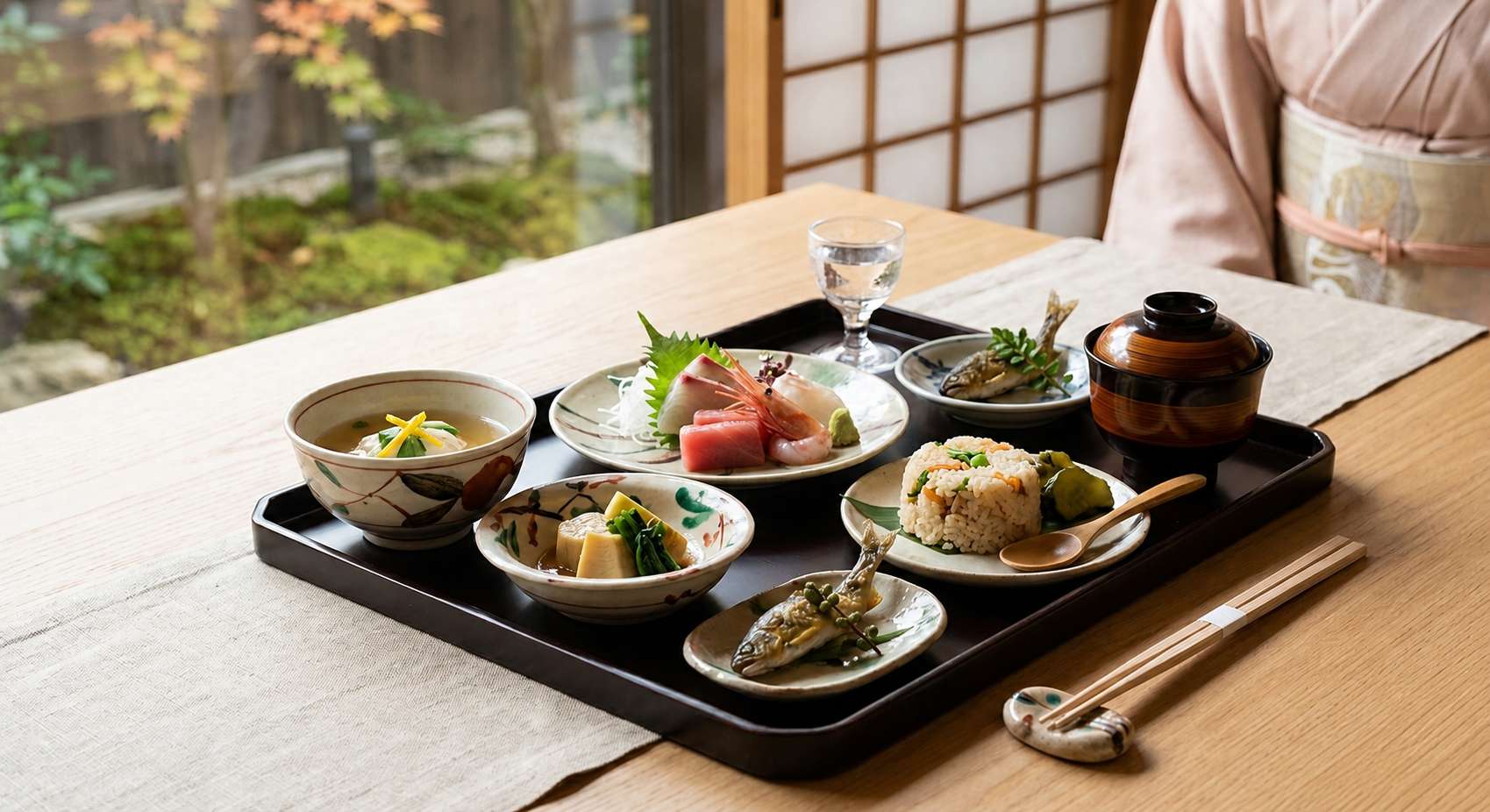
Kaiseki is a Japanese multi-course dining style that expresses season, place, and the chef’s judgment through a sequence of small dishes. It is often translated as Japanese haute cuisine, but that label does not fully explain the experience: tableware, temperature, aroma, negative space, and the rhythm between courses are considered alongside flavor.
There is no single mandatory menu shared by every restaurant. A Kyoto ryotei, a Tokyo hotel, and a countryside ryokan may all serve kaiseki differently. The consistent idea is a composed progression rather than a collection of unrelated luxury ingredients.
Kaiseki Is a Sequence, Not One Dish
A kaiseki meal may move from a small opening course to soup, sashimi, grilled food, simmered food, rice, and a seasonal finish. The names and order vary, and chefs may add, remove, or combine courses. The Japan National Tourism Organization’s official kaiseki guide likewise describes kaiseki as a predetermined multi-course meal centered on seasonal ingredients and presentation rather than a fixed universal checklist.
This flexibility matters for diners. A course called yakimono indicates a grilled preparation, not one required ingredient. Owan refers to a lidded bowl course, often a clear soup whose dashi, garnish, and seasonal main ingredient work as one composition.
Two Meanings Sit Behind the Word Kaiseki
Kaiseki can be written with two different sets of kanji. 懐石 is associated with the restrained meal served in the context of tea ceremony, while 会席 refers to a banquet-style meal often enjoyed with sake. Modern restaurant usage overlaps, and English menus do not always distinguish them.
The Ministry of Agriculture, Forestry and Fisheries explains in its English guide to cha-kaiseki and modern kaiseki that the tea meal begins with rice and soup, while later restaurant kaiseki developed a more flexible course sequence and commonly serves rice near the end.
A Typical Kaiseki Course Sequence
The restaurant form of kaiseki—especially kaiseki written 会席—developed as a meal enjoyed with sake. Its course names help the kitchen create a beginning, a rise in intensity, and a settled finish. The following sequence is representative, not mandatory: restaurants may combine, omit, rename, or reorder dishes.
- Sakizuke: a small seasonal opening dish that introduces the chef’s direction and gently starts the appetite.
- Owan or suimono: a lidded clear soup based on first dashi. From the kitchen’s perspective, this is often the restaurant’s calling card because stock, salt, aroma, garnish, and temperature have nowhere to hide.
- Mukozuke: seasonal sashimi presented with condiments and botanical garnishes. Knife direction and thickness are chosen for the fish rather than for decoration alone.
- Hassun: a visually composed selection of small foods that connects ingredients from the sea and mountains. It often supplies the most explicit seasonal imagery and works naturally with sake.
- Yakimono: grilled fish, shellfish, or occasionally meat. Char, smoke, fat, and a hotter serving temperature create a stronger middle movement.
- Takiawase: vegetables, tofu, seafood, or meat cooked separately as needed and brought together so each keeps its own color and texture while sharing a dashi-based harmony.
- Shiizakana: literally an additional dish encouraged with sake. It may be vinegared food, a small hot pot, or another substantial preparation.
- Shokuji, konomono, and tomewan: rice, pickles, and a final soup turn the course from drinking into a settled meal. Seasonal clay-pot rice may be the closing centerpiece.
- Mizumono or kanmi: fruit or a restrained sweet leaves a fresh final impression.
Temperature is part of the story. A clear soup should arrive fragrant and hot, sashimi cool but not numbingly cold, and a grilled course before its surface loses crispness. Service timing therefore depends on communication between the dining room and the kitchen.
What a Kaiseki Course Is Trying to Do
| Common course | Typical role | What to notice |
|---|---|---|
| Sakizuke | Small opening dish | The first seasonal signal |
| Owan or suimono | Clear soup | Dashi, aroma, temperature, and bowl |
| Mukozuke or otsukuri | Sashimi course | Knife work, garnish, and fish condition |
| Yakimono | Grilled course | Browning, smoke, fat, and seasonality |
| Takiawase | Separately cooked ingredients combined | Individual textures and unified broth |
| Shokuji | Rice, soup, and pickles | A calm return to the meal’s foundation |
| Mizugashi or kanmi | Fruit or sweet finish | Season and a clean ending |
The table is descriptive, not compulsory. A restaurant may use different terminology, insert a fried course, serve a hot pot, or emphasize local specialties. The value lies in how one course prepares the senses for the next.
Seasonality Includes More Than Ingredients
Season can appear through young bamboo shoots in spring, cooling glassware in summer, mushrooms and chestnuts in autumn, or warming pottery in winter. Leaves, flowers, serving vessels, and the temperature of a dish may reinforce the same message.
This approach connects kaiseki with the broader values of washoku. UNESCO describes washoku as a social practice involving knowledge and traditions related to producing, preparing, and consuming food, with respect for nature and locally sourced ingredients; the full definition appears on the UNESCO Intangible Cultural Heritage page.
Dashi and Knife Work Often Carry the Meal
Kaiseki is not necessarily strongly seasoned. A clear soup may reveal the quality of dashi, while a sashimi course depends on fish selection, temperature, and cutting. Our guide to sashimi explains why thickness and direction of the cut change texture even when the fish is the same.
The restraint is deliberate. One course may be delicate because the next introduces smoke, fat, acidity, or sweetness. Judging every plate by intensity alone misses the design of the sequence.
Kaiseki, Omakase, and Teishoku Are Different Formats
Omakase means entrusting the selection to the chef and can apply to sushi or other cuisines. Kaiseki describes a multi-course Japanese meal with an established cultural vocabulary. A meal can be both omakase and kaiseki, but the words are not synonyms.
Teishoku is a set-meal format in which rice, soup, a main dish, and sides commonly arrive together. Kaiseki unfolds over time, course by course, and places greater emphasis on progression and presentation.
Price, Duration, and Reservations
Kaiseki prices vary enormously with the city, restaurant, private-room charge, ingredients, drinks, tax, and service charge. The ranges below are planning estimates for dedicated fine-dining restaurants, not a national tariff.
| Meal | Useful planning range per person | Typical time to allow | What to confirm |
|---|---|---|---|
| Lunch | About ¥8,000–¥15,000 at many upscale restaurants; simpler meals may cost less | About 1.5–2 hours | Whether lunch is a full kaiseki progression or a shorter seasonal set |
| Dinner | About ¥18,000–¥40,000 or more at high-end restaurants | About 2–2.5 hours | Drinks, tax, service charge, private-room fee, and cancellation policy |
| Ryokan stay | Often included within an accommodation plan | Confirm the fixed dinner start | Whether the displayed rate is per person and includes breakfast and dinner |
As a current real-world reference rather than a universal benchmark, the Imperial Hotel Tokyo lists a lunch kaiseki at ¥15,500 and a dinner kaiseki at ¥28,000 at Tokyo Nadaman, including tax and service charge at the time checked. Menus and prices change, especially around New Year and premium seasons.
- Book early: one month ahead is a useful target for a specific popular restaurant, but booking windows vary. Some famous venues require more time; others accept reservations closer to the date.
- State allergies and restrictions when booking: dashi, sauces, and garnishes may contain fish, shellfish, soy, wheat, egg, or alcohol even when they are not visible. A request such as “no raw fish” can require redesigning much of the menu and may not be possible on the day.
- Check cancellation terms: ingredients may be purchased and prepared specifically for the reservation. JNTO advises arriving on time and cancelling well in advance.
- Allow time: tell the restaurant before booking if you must finish by a fixed hour. Compressing a two-hour progression after arrival can diminish both the cooking and the service.
What First-Time Diners Should Confirm Before Booking
- Price: tax, service charges, drinks, and private-room fees may be separate.
- Duration: allow enough time for a paced multi-course meal.
- Allergies: explain them when reserving, not after the course has begun.
- Dietary restrictions: dashi, garnishes, and sauces may contain fish or shellfish even when the visible ingredient is a vegetable.
- Cancellation policy: ingredients are often purchased and prepared for the reservation.
A restaurant may be unable to redesign the menu for extensive restrictions. Giving clear notice allows the kitchen to say honestly what it can accommodate.
How to Eat Kaiseki Without Overthinking Etiquette
Follow the course order, eat dishes while they are at their intended temperature, and treat the tableware carefully. Lift small rice and soup bowls when appropriate, but leave large plates and trays on the table. If a lidded bowl arrives, open it gently so the first aroma is not lost.
You do not need to identify every flower, vessel, or classical reference. Notice what changes from course to course and ask respectful questions when the staff has time. Kaiseki is hospitality, not an examination.
Dress and Table Manners That Actually Help
There is no nationwide kaiseki dress code. A hotel dining room may request smart casual clothing, while a ryokan or neighborhood restaurant may be more relaxed. Check the restaurant’s official policy. Neat clothing, quiet footwear, and avoiding beachwear are practical defaults.
- Wear socks for a tatami room: if shoes will be removed, clean socks or stockings are a thoughtful convention. A Kyoto ryotei owner interviewed by the city’s official tourism site describes socks on tatami as considerate, while also noting that formal dress is not an absolute rule.
- Protect the tableware: large rings, bracelets, or watches can knock against lacquerware and antique ceramics. You do not need to remove every accessory automatically, but handle vessels with care and remove anything likely to scratch them.
- Avoid strong fragrance: perfume, scented hair products, and tobacco odor can overwhelm first dashi, grilled aromas, and the scent released when a lidded bowl is opened.
- Photograph briefly: ask when photography rules are unclear and avoid delaying hot soup or grilled food. The problem is not the camera itself; it is allowing the intended temperature and texture to disappear.
- Follow the vessel: small rice and soup bowls may be lifted. Large plates and trays generally remain on the table. Replace a lacquer lid normally rather than forcing it upside down against the vessel.
Kansai and Kanto: Useful Tendencies, Not Rules
Regional language can help a traveler notice differences, but “Kansai is delicate and Kanto is strong” is too simple to describe modern kitchens.
- Kyoto and parts of Kansai: kombu-centered dashi, light-colored soy sauce, restrained seasoning, seasonal vegetables, and pale simmered dishes are influential features. Presentation often protects the ingredient’s natural color.
- Tokyo and parts of Kanto: cooks may draw more assertively on katsuobushi, dark soy sauce, mirin, grilled aromas, and traditions connected with Edo cuisine.
Water, local produce, historical trade, restaurant lineage, and an individual chef’s training all complicate the picture. A Tokyo chef may cook in a Kyoto tradition, and a Kyoto restaurant may use ingredients and techniques from across Japan. Treat regional difference as context, not as a promise that every dish will be light or dark.
Common Mistakes That Disrupt the Meal
- Arriving late without calling: synchronized soup and grilled courses lose quality, and private ingredients may already be prepared. Contact the restaurant as soon as a delay becomes likely.
- Declaring major restrictions at the table: tell the restaurant during booking and repeat them briefly on arrival. Do not assume every stock can be changed to vegetarian at the last minute.
- Using strong perfume: skip it on the day of the meal so other guests can experience the food’s aroma.
- Letting hot dishes wait for photographs: take one quick picture if permitted, then taste the dish while the kitchen’s intended texture and fragrance remain.
- Assuming the displayed course price is the final bill: confirm drinks, service charge, tax, and room fees before booking.
How a Cook Reads the Flow of the Course
When I look at a kaiseki meal as a cook, I pay attention to the transitions rather than judging every plate in isolation. A delicate opening should leave room for what follows. A clear soup can reset the palate, while a grilled or simmered dish may bring deeper aroma and richness before rice and soup settle the meal near the end.
The exact order is not universal, and the best-known course names do not guarantee the same sequence at every restaurant. What matters is whether flavor, temperature, texture, and portion size create a coherent progression. Two excellent dishes can still feel poorly placed if both are heavy, cold, or strongly seasoned in succession.
Timing is part of that progression. A dish intended to be hot loses more than temperature if it waits; aroma and texture change as well. Good service therefore depends on communication between the kitchen and dining room, and on noticing the pace of the guests without making them feel rushed.
A Better Way to Understand Kaiseki
Do not look for one definitive list of dishes. Look for relationships: cool followed by warm, raw followed by grilled, delicate dashi followed by deeper seasoning, and seasonal imagery carried from food to tableware. Kaiseki becomes easier to understand when read as a chef’s carefully paced story of place and time.
If this article deepened your understanding of Japanese food culture, you can support Japan Food Compass on Ko-fi and help us continue sharing carefully researched guides and original kitchen stories.
Sources for This Kaiseki Guide
- Ministry of Agriculture, Forestry and Fisheries: The Washoku Way—Cha-kaiseki and Kaiseki
- Japan National Tourism Organization: Kaiseki Guide
- UNESCO: Washoku, Traditional Dietary Cultures of the Japanese
- JNTO: A Master Class in Kaiseki Ryori
- JNTO: Making Reservations for a Seamless Trip
- Kyoto City Official Travel Guide: Introduction to Ryotei
- Imperial Hotel Tokyo: Tokyo Nadaman Menu