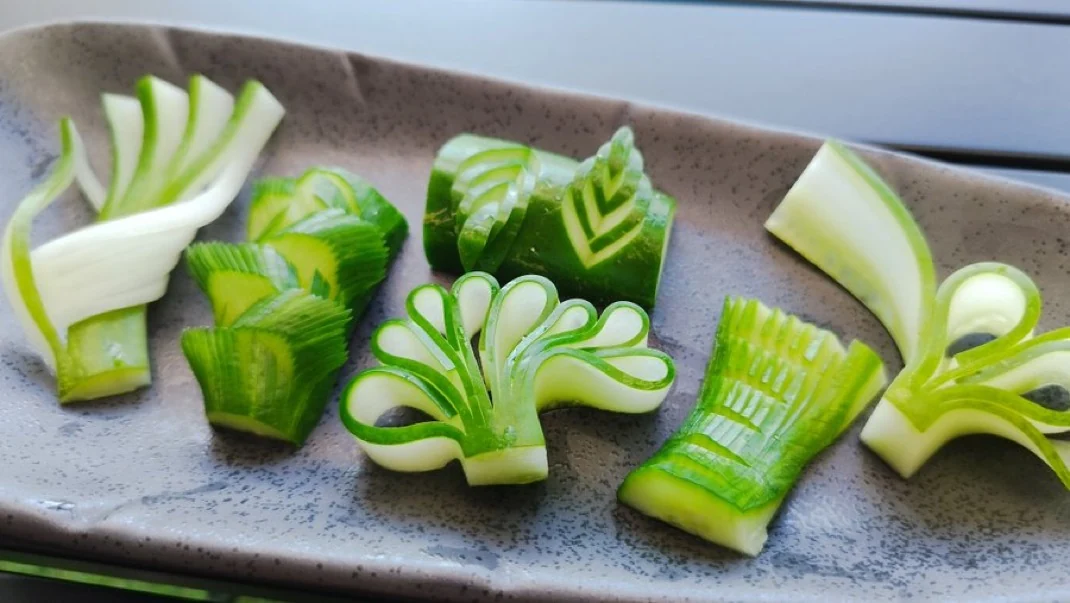
Japanese cucumbers are commonly valued for tender skin, juicy flesh, and a crisp, clean bite. Those qualities make them easy to eat raw, but they also give restaurant chefs a useful material for ashirai: edible garnishes and accompaniments that add color, texture, balance, and seasonal character to a plate.
A cucumber can therefore have two roles at the same meal. It may be sliced simply for a salad or sushi roll, or cut into fans, loops, and layered shapes that show the control of the person holding the knife. The decoration varies from restaurant to restaurant because there is no need for every chef to express the ingredient in exactly the same way.
The Japanese Cucumber Most Shoppers Recognize
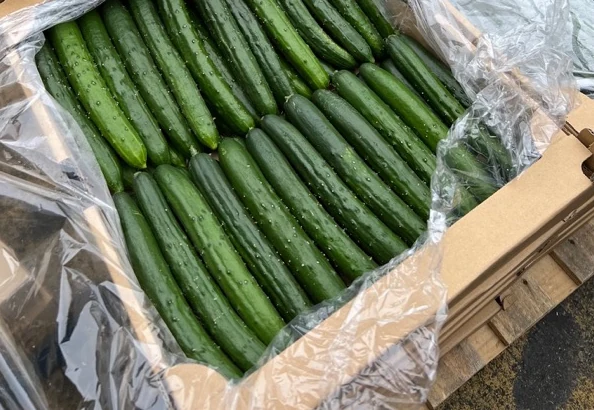
“Japanese cucumber” is a useful English label, but Japan grows more than one type. The cucumber most often seen in Japanese supermarkets is usually slender, dark green, and covered with small bumps. According to Japan’s Agriculture & Livestock Industries Corporation, more than 90 percent of cucumbers produced in Japan are now white-spined types. They are known for relatively thin skin, juicy flesh, and a crisp bite.
This is why Japanese recipes often leave much of the green skin in place. Peeling is not always necessary for tenderness, and the contrast between the dark exterior and pale center can become part of the presentation. Individual varieties still differ, so “thin-skinned” should describe the mainstream type rather than every cucumber grown in Japan.
Choosing a Similar Cucumber Outside Japan
In the United States, a cucumber may be sold as Japanese, Asian, Persian, or English, but those labels do not guarantee the same variety. For raw Japanese dishes, look first for firm flesh, a fresh green surface, and a peel tender enough to eat. A long, relatively straight cucumber is also easier to divide into even strips.
For decorative work, condition can matter more than the marketing name. A limp cucumber will not hold crisp curves, and a very thick or waxed peel may resist tight bends. Persian cucumbers are smaller, while English cucumbers are usually longer and smoother; either may be useful when a true Japanese type is unavailable, but the size, skin, and moisture will change the finished shape. This article therefore describes the mainstream Japanese cucumber rather than promising an exact one-for-one substitute.
Why Japanese Cucumbers Are Often Eaten Raw
A fresh cucumber contributes water, a gentle green aroma, and a clean snap rather than a heavy flavor. In Japan, it may appear in salads, salt-seasoned side dishes, vinegared sunomono, pickles, or sushi. The mild flesh accepts seasoning quickly while retaining enough structure to feel refreshing.
Preparation changes that balance. A thick slice emphasizes juiciness and crunch. A thin slice feels more delicate and takes on dressing more readily. Salt can draw out water and soften the bite, while Japanese rice vinegar provides the light acidity associated with many cucumber sunomono dishes.
In kappa maki, cucumber is cut into a long strip and rolled with vinegared rice and nori. The ingredient is simple, but the crisp center gives the roll a clear textural identity. It is one example of why sushi does not have to contain fish.
Ashirai Is More Than Nonedible Decoration
In this context, ashirai does not mean placing an arbitrary ornament beside the food. It refers broadly to something arranged with the main item to complete the plate. Depending on the dish, an ashirai may provide a contrasting color, a fresh aroma, a crisp bite, or a visual suggestion of the season.
Cucumber works especially well because its two main colors are already built in. A chef can remove selected strips of dark skin, expose pale flesh, or keep a narrow green border around a curved slice. The result can look intricate without introducing a food that clashes with the main dish.
The garnish remains edible. A successful cucumber ashirai should still look fresh and appetizing, not merely demonstrate how many cuts a chef can make.
How the Knife Creates Fans, Loops, and Layers
Many decorative forms begin with repeated shallow cuts. If the knife stops at a consistent depth, a section of cucumber stays connected while the thin layers spread into a fan. A longer ribbon can bend into a loop, while alternating cuts can create a flexible section that would not be possible with one straight slice.
The technical challenge is control. Cuts that are too deep may separate the piece; cuts that are too shallow may not let it open. Uneven spacing makes the pattern look rough and can produce an inconsistent bite. Moist cucumber also moves easily, so a sharp knife and stable working position matter. Our guide to Japanese knife types explains the broader roles of common kitchen blades.
These forms are possibilities rather than a mandatory set of named restaurant cuts. Chefs may learn established techniques, adapt them to a particular plate, or create a simpler form that fits the food better.
Decorative Cutting Also Changes the Bite
Knife work is not purely visual. Fine cuts alter how a cucumber bends, how easily it separates between the teeth, and how much surface is available for seasoning. A thick block remains firm and juicy. A finely layered section feels lighter, even when it comes from the same cucumber.
This principle resembles the scoring used on squid, although the ingredients behave differently. The article on Japanese squid knife work shows how shallow cuts help sauce cling and adjust a resilient texture. With cucumber, the chef is working with crisp flesh and a contrasting green skin, so flexibility and visual rhythm become more prominent.
How Restaurants Use Cucumber to Complete a Plate
A restaurant does not need to use the most complicated form every time. A few angled slices may be enough beside a strongly shaped main item. On a larger plate, a layered fan can fill space and draw the eye without adding heaviness. Dark green edges can also separate pale or brown foods visually.
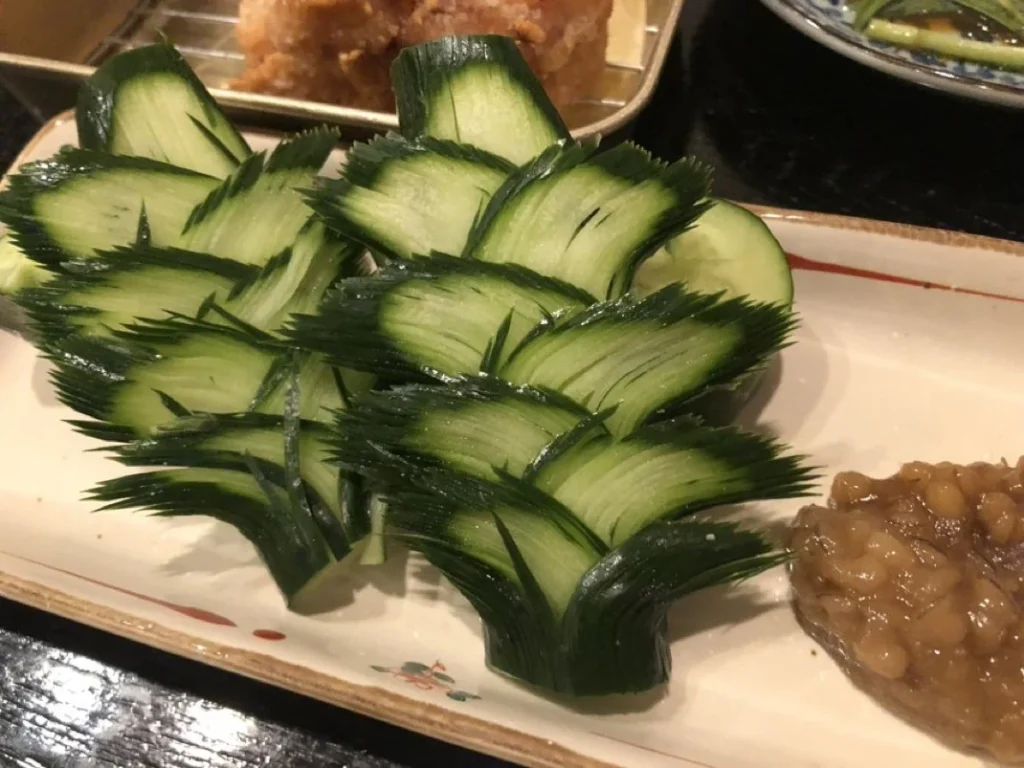
The best choice depends on the restaurant’s style, the size and color of the plate, and the food beside it. That freedom is why two chefs can begin with similar cucumbers and produce very different arrangements. The variation is part of the craft, not evidence that one design is the universal correct form.
What Diners Can Notice
When cucumber arrives as an ashirai, first notice whether the skin has been used to outline the shape. Look at the spacing of repeated cuts and whether the piece opens naturally without falling apart. Then eat it: a garnish may provide the crisp, cool contrast that the richer main item needs.
Japanese cucumber preparation ranges from an unadorned raw slice to precise decorative work. Thin skin and juicy flesh make the mainstream type versatile, but the ingredient does not become interesting through appearance alone. Its value comes from the combination of freshness, texture, knife control, and a clear purpose on the plate.