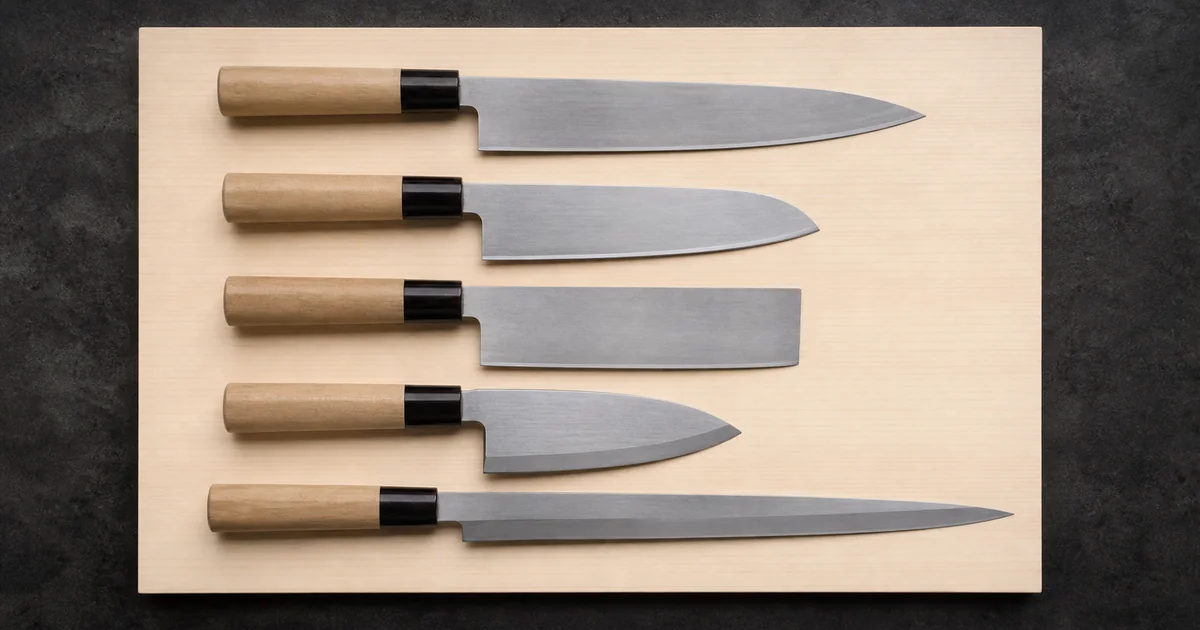
Japanese knife types are designed around different ingredients and cutting tasks. Gyuto and santoku are versatile; nakiri is made for vegetables; deba breaks down whole fish; and yanagiba makes clean slices of boneless fish for sashimi. They are not interchangeable.
For most home cooks, a gyuto or santoku is the sensible first purchase. Nakiri suits vegetable-heavy preparation, while a traditional deba requires specific technique and sharpening.
Five Knives, Five Different Jobs
| Knife | Main use | Typical character | Beginner suitability |
|---|---|---|---|
| Gyuto | Meat, fish, vegetables, general prep | Longer blade with a pointed tip and curved edge | Excellent if workspace allows |
| Santoku | Everyday meat, fish, and vegetables | Shorter, taller, and relatively flat | Excellent for most home cooks |
| Nakiri | Vegetables | Thin rectangular blade with a straight edge | Good as a second knife |
| Deba | Butchering and filleting whole fish | Thick, heavy, usually single-beveled | Specialist choice |
| Yanagiba | Slicing boneless fish for sashimi | Long, narrow, usually single-beveled | Specialist choice |
Gyuto often run about 180–240 mm, while santoku and nakiri are commonly around 165–180 mm. Deba sizes vary with the fish, and yanagiba are typically longer to complete a slice in one stroke. These are reference ranges, not rules.
What Does Wa-Bocho Mean?
Wa-bocho means Japanese kitchen knife. In retail and professional use, it often points to traditional specialist knives such as deba, yanagiba, and usuba.
Many traditional wa-bocho use a single-bevel edge. Modern Japanese-made gyuto, santoku, and nakiri are usually double-beveled. Classification varies, so “Japanese knife” does not automatically mean single-beveled, carbon steel, or handmade.
This specialization reflects the importance of controlled preparation and presentation in washoku, or traditional Japanese cuisine. A clean cut can influence texture and appearance as well as portion size.
Gyuto: The Longer All-Purpose Knife
Gyuto literally means “beef knife,” but the modern gyuto is not limited to meat. It fills a role similar to a Western chef’s knife and can portion boneless meat, slice fish, chop herbs, and prepare vegetables.
Compared with a santoku, a gyuto usually has more length, a pronounced point, and more curve near the tip. This helps with large ingredients, long slicing strokes, detail work, and some rocking motion.
A gyuto is a strong first knife when board space allows. A 210 mm model is common, but a shorter blade may feel more controlled. Do not twist a thin gyuto through hard squash or use it on frozen food or bones unless the maker permits it.
Santoku: The Compact Everyday Choice
Santoku is commonly associated with “three virtues” or three categories of food: meat, fish, and vegetables. It is designed as a versatile household knife rather than a specialist blade.
A santoku is generally shorter and taller than a gyuto, with a flatter edge and less prominent tip. Its height provides knuckle clearance and helps transfer chopped ingredients. The compact length suits small kitchens.
Choose santoku for push-cutting and straight chopping. Choose gyuto for larger ingredients, a precise tip, or long slicing strokes. Neither is automatically sharper; that depends on geometry, steel, and maintenance.
Nakiri: A Vegetable Specialist
A nakiri has a rectangular profile, thin blade, and straight edge. It works well for cabbage, daikon, onions, leafy greens, and repeated vertical cuts. The broad blade also moves prepared vegetables easily.
Despite its shape, a nakiri is not a bone cleaver. Its thin edge can chip on bones, frozen food, or very hard ingredients. Most modern nakiri are double-beveled and easier for home use than a single-bevel usuba.
A nakiri is most useful as a second knife for someone who prepares vegetables frequently. If you want only one knife, a gyuto or santoku remains more versatile because it can also handle boneless meat and fish.
Deba: A Traditional Knife for Whole Fish
A deba is a thick, heavy knife for breaking down whole fish. Its heel can handle fish heads and smaller bones, while the edge supports controlled filleting. It is not a general meat cleaver.
Traditional deba are usually single-beveled and made for the right or left hand. The asymmetrical edge steers differently from a double bevel and needs an appropriate sharpening method. A pull-through sharpener is not a universal solution.
A deba makes sense for cooks who regularly prepare whole fish. Someone who buys fillets will usually get more value from a gyuto or santoku.
Yanagiba: A Long Slicer for Sashimi
Yanagiba means willow-leaf blade, describing its long, narrow profile. It is designed to slice boneless fish with a smooth pulling stroke. The length helps the cook complete a cut without sawing back and forth, supporting a clean surface and controlled presentation.
Traditional yanagiba are usually single-beveled and made in right- or left-handed versions. They are not intended for fish bones, frozen food, or general chopping. A cook typically uses deba for breaking down the fish and yanagiba only after bones and tougher structures have been removed.
Yanagiba is worthwhile for frequent sashimi preparation but unnecessary for most beginners. A sharp gyuto or sujihiki is more versatile for occasional slicing. Our guide to what sashimi is explains why the quality and direction of the cut matter when fish is served without rice.
Single Bevel vs. Double Bevel
A double-beveled knife is sharpened from both sides. Home-use gyuto, santoku, and nakiri commonly use this geometry. Traditional deba, yanagiba, and usuba are often single-beveled and may have a hollowed back. Handedness matters, and sharpening must follow the maker’s design.
How to Choose Your First Japanese Knife
- Start with the food you actually prepare. Choose santoku for compact everyday work, gyuto for greater reach, nakiri for vegetable-heavy cooking, or deba for regular whole-fish preparation.
- Choose a manageable length. The best blade is one you can control safely on your existing cutting board.
- Consider steel maintenance. Stainless steel resists corrosion more easily. Reactive carbon steel can develop rust if it is not washed and dried promptly.
- Check handedness and bevel. This is especially important for traditional single-bevel knives.
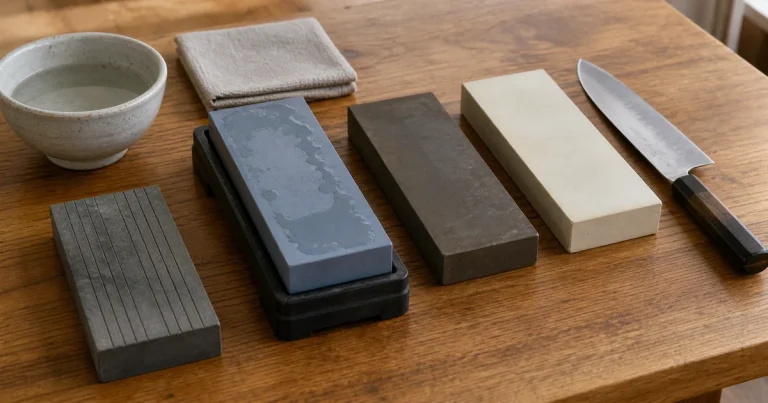
- Plan for sharpening. A premium knife still becomes dull. Confirm whether you will use Japanese whetstones or a professional familiar with its geometry.
If you are building a kitchen from the beginning, our guide to Japanese kitchen tools worth buying first helps balance a knife purchase against equipment such as a rice cooker, grater, and donabe.
Basic Care and Safety
- Use a stable wood or suitable synthetic cutting board, not glass, stone, or ceramic.
- Wash and dry the knife promptly; do not leave it wet in a sink.
- Avoid dishwashers unless the manufacturer explicitly approves them.
- Do not scrape the cutting edge sideways across the board.
- Store it securely to protect both the edge and the user.
Practical Buying Links
Choose the knife type and length before comparing brands, and confirm whether the blade is single- or double-beveled.
Disclosure: As an Amazon Associate, Japan Food Compass earns from qualifying purchases.
- Long all-purpose knife: compare Japanese gyuto knives on Amazon.
- Compact everyday knife: compare Japanese santoku knives on Amazon.
- Vegetable-focused knife: compare Japanese nakiri knives on Amazon.
Questions to Ask Before Buying a Japanese Knife
Is gyuto better than santoku?
Gyuto is better for cooks who want a longer blade, pointed tip, and longer slicing motion. Santoku is often easier in a compact kitchen and suits straight, everyday chopping. The better choice depends on space, hand comfort, and cutting style.
Does a beginner need a deba?
Usually not. A deba is worthwhile when whole-fish butchery is a regular task and the user is prepared to learn single-bevel technique and sharpening. It is unnecessary for cooks who mainly buy fish fillets.
Choose a Knife by Task, Not by Prestige
Gyuto and santoku are the best starting points for most home cooks. Nakiri adds efficiency for vegetable work. Deba and yanagiba form a specialized pair for whole-fish preparation and sashimi slicing. Traditional wa-bocho reward correct technique, but their task-specific shapes and bevels must be respected.
Choose by function, comfortable length, bevel, and maintenance needs before comparing decorative finishes or prestige. One suitable, well-maintained knife is more useful than a large set of overlapping blades.