An electric rice cooker can produce excellent rice with almost no supervision. A donabe asks for more: the cook must understand the pot, the burner, the water, and the moment when boiling should give way to gentler heat and then rest. That extra attention does not make clay automatically superior. It makes the result more directly connected to the cook’s decisions.
When those decisions work, the rice can emerge glossy and plump, with distinct grains, a clean aroma, and—if the pot and method allow it—a thin layer of nutty okoge at the bottom. When they fail, the same pot can give you hard centers above and a black, bitter crust below. I have produced both.
This guide keeps the practical information a first-time buyer needs, but follows the rice all the way through the pot. The central rule comes first: donabe differ substantially. The manufacturer’s directions for first use, heat source, rice capacity, water, flame, and cooling take priority over any general method on the internet, including this one.
A Donabe Is a Category, Not One Standard Pot
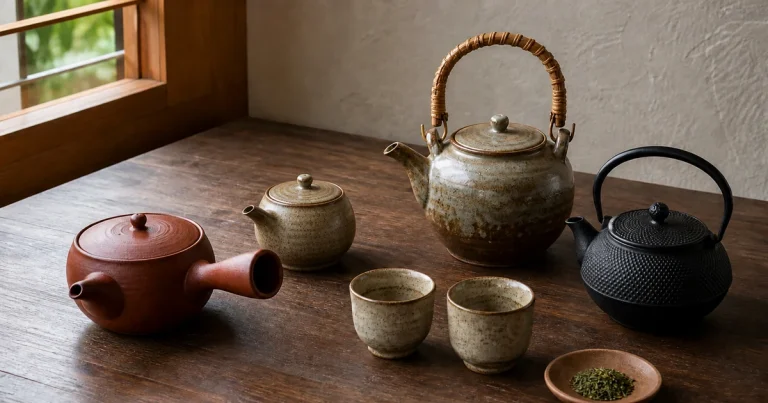
Donabe means clay pot: do is clay and nabe is pot. The term covers traditional vessels for hot pot, soup, and braising as well as purpose-built rice cookers, steamers, smokers, and models designed for dry heat. Clay, wall thickness, glaze, lid construction, firing, and intended heat source vary.
That variety explains why advice that is correct for one donabe can damage another. A standard moist-heat pot should not be assumed safe for frying, empty preheating, an oven, or a grill. Traditional models are often intended for gas flame and may not work on induction. Some specialized products support induction, but even those can have restrictions: Nagatani-en, for example, advises against cooking rice in its IH donabe because the pot may be damaged as the water disappears near the end.
A donabe remains useful beyond rice. It can carry dashi-based hot pot, soup, vegetables, tofu, or steamed dishes from the stove to a heat-safe trivet at the table. If rice is your priority, however, a rice-specific model with a suitable lid and clearly stated batch range is the easier purchase to justify.
What Clay Changes—and What It Does Not Prove
Compared with a thin metal saucepan, a thick clay body generally responds more slowly to changes in the burner and retains heat longer after the flame is reduced or switched off. This thermal inertia can soften sudden changes and continue cooking during the resting stage. It also means an overheated pot does not cool instantly when you notice a problem.
Donabe manufacturers may describe far-infrared radiation as part of the cooking effect. Ceramic surfaces do emit thermal radiation, but the popular claim that special rays race deep into every grain and cook it “from the inside” is too simple. Rice cooks because heat moves through the pot, water, steam, and grains. Pot geometry, lid seal, boiling pattern, and retained heat are practical explanations a home cook can actually control.
The same caution applies to sweetness. Enzymes in rice and temperature history can affect sugar formation, but a donabe is not guaranteed to pass through 40–60°C at the same rate, nor does every donabe produce sweeter rice than every electric cooker. Modern rice cookers also use programmed temperature stages. Rice variety, storage, washing, soaking, water, and freshness all influence the result.
A skilled cook can obtain superb rice from a simple metal pot, while an unattended donabe can burn it. The reason to choose clay is control, retained heat, table presentation, and the pleasure of reading the process—not a promise that material alone creates maximum flavor.
Read the Boil Before You Read the Clock
A practical donabe method usually has three phases: bring the contents to a controlled boil, complete cooking at the heat level specified for the pot, then rest with the lid closed. Some rice donabe are engineered for one heat setting and do not require an adjustment. Others call for reducing the flame after boiling. This is why transferring a timing formula between pots can fail.
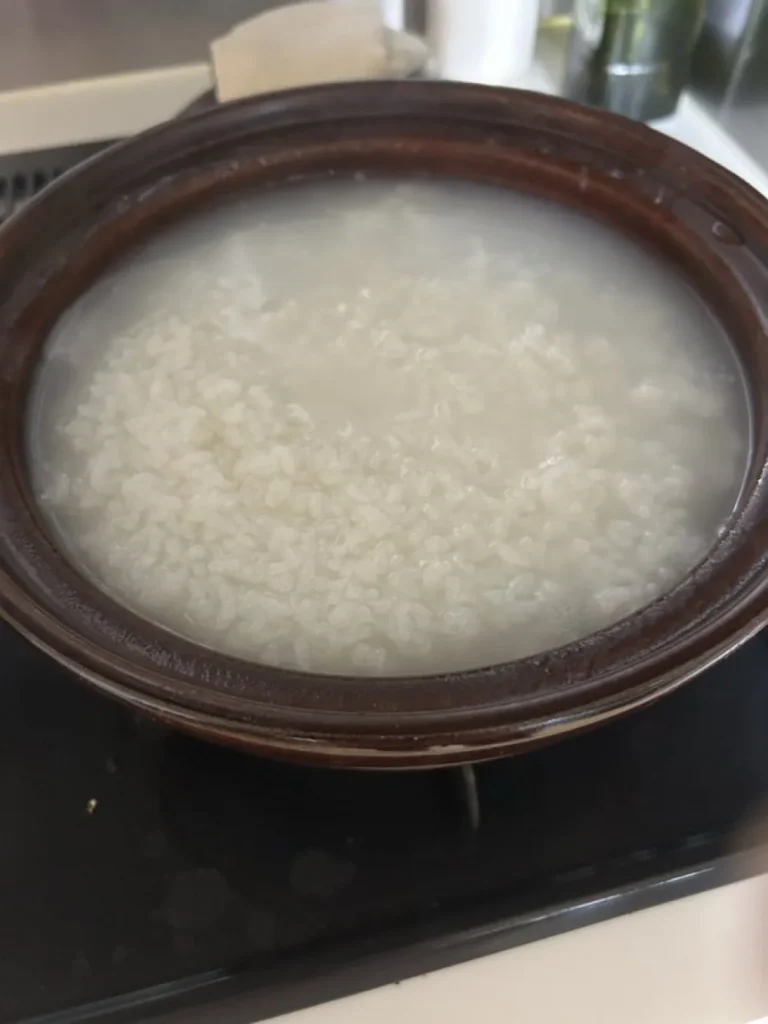
I listen for the change from quiet heating to a steady simmer and watch the steam when the lid design makes it visible. Violent sputtering, liquid forcing its way from the rim, or a scorched smell arriving before the rice should be dry are signals to check the setup rather than blindly wait for the timer.
The resting stage is active cooking, not dead time. Heat stored in the pot and the hot water-vapor environment continue equalizing moisture. Opening the lid early releases steam and changes that process. Resting cannot, however, repair rice that began with far too little water or was burned by excessive heat.
Kani-ana Are Steam Channels, Not a Certificate of Perfection
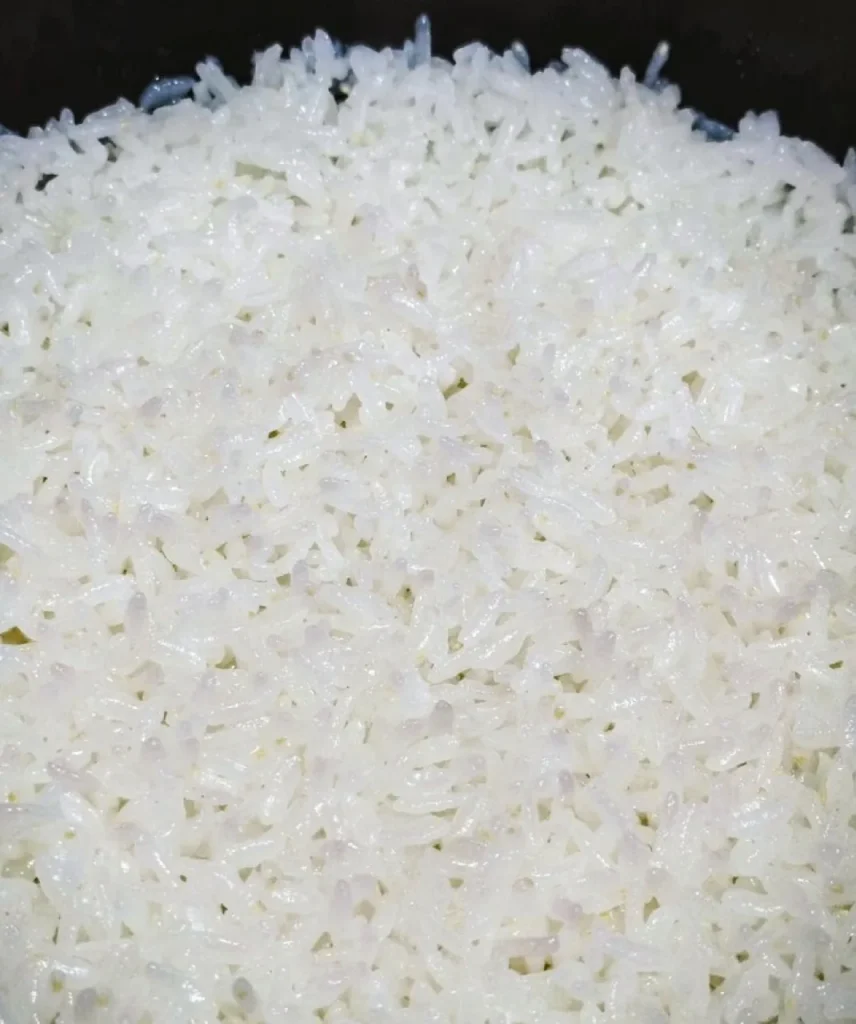
Small holes sometimes visible across freshly cooked rice are called kani-ana, or “crab holes.” They form where vapor and boiling water have traveled upward through the rice bed. They can be a reassuring sign that the batch boiled and formed channels rather than remaining a motionless, waterlogged mass.
They do not prove that every grain is perfectly cooked, that heat was uniform, or that the rice is sweeter. Their size and visibility change with the rice, water, pot shape, batch depth, and heating pattern. Excellent rice may show few obvious holes; poor rice can display holes while still being too firm or too wet.
Judge the cooked rice in several places. Lift from the center and near the side. Look for grains that are plump rather than burst, then taste for a tender center without a chalky core. The surface should not be soupy, and the bottom should not smell acrid.
Okoge Should Be Browned Rice, Not Carbon
Okoge is the browned layer at the bottom of the pot. At its best, it runs from gold to chestnut brown, gives a light crispness, and adds a toasted aroma without making the whole batch bitter. It is optional. White rice without a crust is not a failed donabe meal.
Some recipes call for a brief increase in heat at the end, while purpose-built rice pots may form okoge through their normal program. The extra time or flame must come from the specific pot’s directions and your experience with the burner. Smell is useful: toasted cereal and roasted nuts suggest browning; sharp smoke and an eye-stinging odor mean the rice has moved past okoge.
When serving, loosen the rice from the sides and turn it gently so excess steam can escape without crushing the grains. Expose a patch of okoge rather than scraping black material into the entire batch.
My Two Expensive Lessons in Clay
The new pot that split over the burner
As a trainee, I once put a new donabe into service without checking its first-use requirements. I skipped medome, added stock, and pushed the heat because I wanted the preparation finished quickly. A dry cracking sound came from the base, the pot split, and the contents spilled over the cooking area.
At the time, I blamed the entire accident on skipping medome. I cannot prove that was the sole cause. A wet exterior base, excessive initial heat, thermal stress, hidden damage, or a combination of factors may also cause clay cookware to crack. The correct lesson is broader: never infer a pot’s limits from its appearance. Read its manual, complete any required first-use treatment, dry the exterior thoroughly, and use the permitted heat.
Medome commonly means cooking a thick rice porridge so starch fills fine pores in a porous clay body. Nagatani-en requires it for most of its Iga donabe, with stated exceptions. Other manufacturers sell treated products that do not require it. Unnecessary seasoning is not a safety upgrade when it conflicts with the maker’s directions.
The batch with a raw top and a black bottom
My second failure came from trying to shorten cooking during a rush. I kept the burner high from beginning to end. The first toasted smell seemed promising, but when I opened the pot, the base was carbonized while rice near the top still had hard centers.
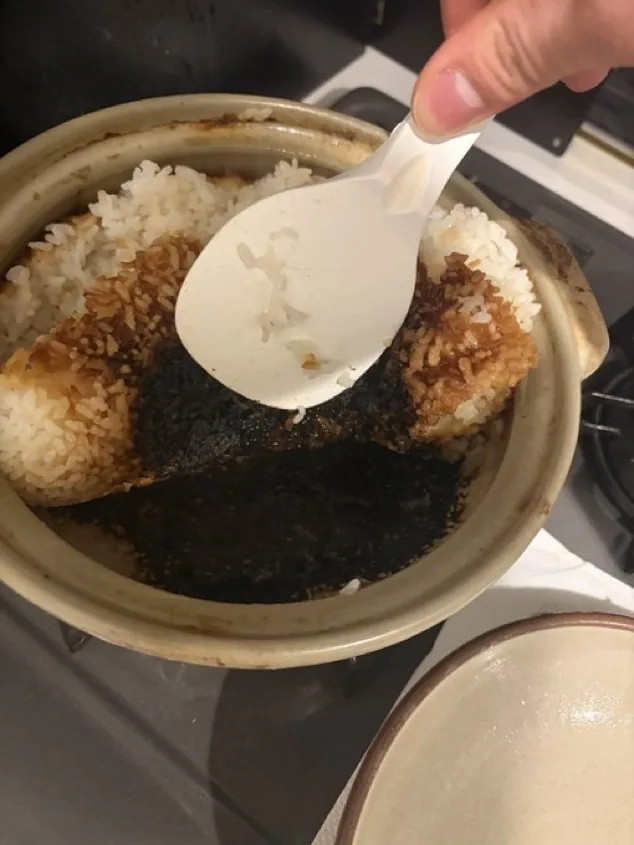
The photograph captures the difference between browning and burning. A stronger flame had not moved useful heat evenly through the batch; it had driven the base beyond recovery. I learned to treat the first scorched note as a warning, not as proof that desirable okoge had formed.
A Repeatable Starting Method—Not a Universal Formula
For a compatible conventional donabe without a model-specific rice program, the Ministry of Agriculture, Forestry and Fisheries provides a useful Japanese starting method: water at approximately 1.2 times the rice volume, soaking for about 30 minutes in summer or one hour in winter, medium heat until boiling, then low heat for roughly 10–15 minutes, an optional brief high-heat finish, and about 10 minutes of resting.
Use that as a documented baseline, not an “absolutely fail-proof” law. Different rice, room temperature, altitude, pot capacity, lid, and burner change the result. A rice-donabe manual may specify a different amount of water or may instruct you not to reduce the heat at all.
- Measure consistently. Use the same rice cup or a scale for both testing and later batches. Do not mix weight and volume ratios.
- Wash without grinding the grains. Drain according to the rice and recipe, then soak for the stated time.
- Dry the exterior base. Water on porous clay can contribute to damage when heated.
- Stay within the stated capacity. Too shallow or too deep a rice bed changes boiling and steam movement.
- Follow the pot’s heat sequence. Use visible steam, sound, aroma, and time together; do not rely on only one signal.
- Rest with the lid closed. Then open, loosen, and taste from more than one area before changing the next batch.
Change only one variable at a time. If the center is firm, first consider soaking and water before simply lengthening high heat. If the bottom is too dark, reduce the final heat or shorten that stage. Record the rice, water, burner setting, and timing; memory becomes unreliable after several similar trials.
How to Choose a Donabe You Will Actually Use
- Purpose: Choose a rice cooker for rice, a wide communal pot for hot pot, or a model explicitly rated for steaming or dry heat. One donabe does not necessarily do everything.
- Heat compatibility: Confirm gas, radiant electric, induction, oven, and microwave compatibility for the exact model. An adapter plate does not automatically make an unsuitable pot safe.
- Capacity: Check the recommended rice range or liquid capacity, not diameter alone. Also consider filled weight and storage.
- Instructions and replacement parts: A serious maker should explain medome, maximum heat, cleaning, drying, and whether lids or bodies can be replaced.
- Your routine: If unattended cooking, delay timers, and keep-warm matter most, an electric rice cooker may be the better tool. The comparison of electric, gas, and manually heated rice cookers explains those trade-offs.
A donabe also demands simple care: allow it to cool before washing, avoid abrupt temperature changes, do not leave detergent soaking in porous clay, and dry the body and lid completely before storage. Fine glaze crazing may be normal, but a structural crack or persistent leak requires the maker’s advice and may mean the pot should no longer be used.
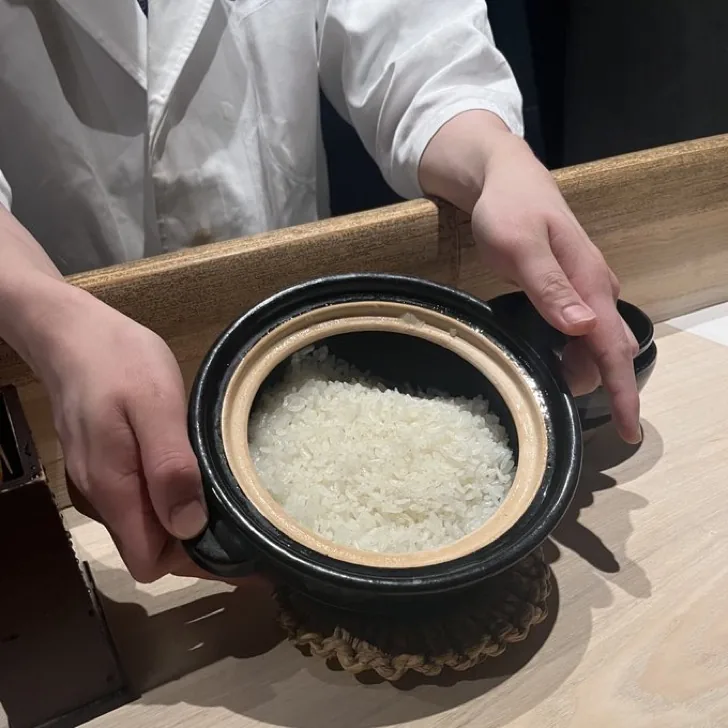
That moment is the real appeal of donabe rice. It asks you to smell the steam, look beyond a single dramatic crab hole, distinguish golden okoge from bitterness, and notice how the grains change after resting. The pot does not replace judgment. It makes judgment visible.
For the ingredient behind the technique, read the guide to Japanese rice varieties, washing, soaking, and texture. For a broader purchasing order, see which Japanese kitchen tools are worth buying first.
Sources for Donabe Use, Rice Cooking, and Care
- Nagatani-en: Official Donabe FAQ on Medome, Heat Sources, Washing, Drying, and Damage
- Nagatani-en: Iga-yaki Donabe Materials and Purpose-Built Designs
- Ministry of Agriculture, Forestry and Fisheries: Donabe Rice Starting Method
- Ministry of Agriculture, Forestry and Fisheries: Cooking Rice Without an Electric Rice Cooker