Disclosure: This article may contain affiliate links. If you purchase through these links, Japan Food Compass may earn a commission at no additional cost to you.
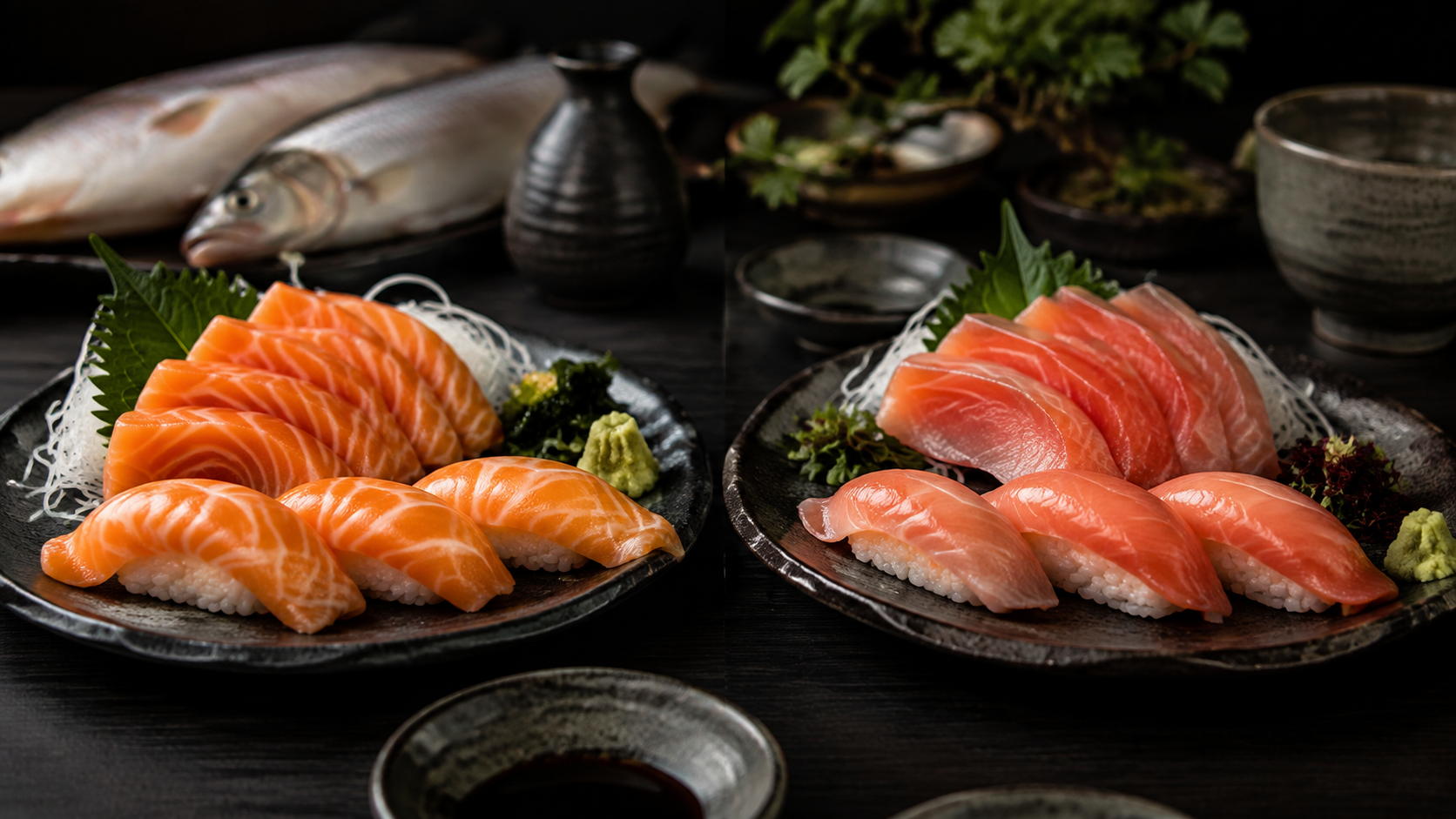
Salmon is now one of the most familiar toppings in modern sushi. Its rich texture, mild flavor, and bright orange color make it popular in nigiri, rolls, sashimi, and lightly seared dishes.
However, the difference between salmon and trout is not always obvious. Japanese labels may use words such as sake, shake, masu, or “trout salmon,” and these names do not create a simple biological division.
This guide explains salmon vs. trout in Japanese food, the species commonly sold in Japan, and how to choose fish intended for sushi.
Understanding Salmon, Sake, and Masu
Salmon and trout belong to the salmonid family. In everyday English, salmon often refers to fish that migrate between rivers and the sea, while trout may describe closely related fish that spend more time in freshwater. Nature and commercial labeling do not always follow that distinction neatly.
In Japanese, sake or shake generally means salmon in a food context. It is written with a different character from the Japanese word for rice wine. The word masu is commonly translated as trout.
Even this Japanese distinction is not absolute. Sakuramasu, for example, is known in English as masu salmon, while nijimasu is rainbow trout. The names reflect tradition, life cycle, species, and commercial usage rather than one universal rule.
Are Salmon and Trout Different?
They can be different species, but “salmon” and “trout” are not two perfectly separate scientific categories.
Atlantic salmon belongs to the genus Salmo. Many Pacific salmon and several fish called trout belong to the genus Oncorhynchus. Rainbow trout, commercially important for Japanese sushi, is Oncorhynchus mykiss and is closely related to Pacific salmon.
The same species can also develop different forms. A rainbow trout that migrates to the sea is commonly called steelhead in English. Farming methods and marketing names create further overlap.
For shoppers, the species name and intended use are therefore more informative than the word salmon or trout alone.
Why Salmon Sushi Is Relatively Modern in Japan
Salmon has a long history in Japanese food, but raw salmon sushi is comparatively modern.
Wild salmon can carry parasites, and Japanese salmon was traditionally salted, grilled, simmered, preserved, or otherwise cooked. Raw consumption existed in limited regional preparations, but it was not historically a standard nationwide sushi topping.
From around the 1990s, farmed Atlantic salmon and products marketed as trout salmon became widely distributed in Japan for raw consumption. Reliable aquaculture, cold-chain transportation, and controlled processing helped salmon become a familiar sushi and sashimi ingredient.
This history explains an informal distinction sometimes seen in Japan: “salmon” often suggests farmed fish intended for raw use, while sake may suggest Japanese salmon prepared by cooking. This is a market tendency, not a guaranteed rule.
For more background on how ingredients fit into sushi, see our guide to Japanese sushi culture.
Common Types of Salmon and Trout in Japan
| Fish | General Character | Common Uses |
|---|---|---|
| Atlantic salmon | Rich, fatty, mild, and soft | Sushi, sashimi, rolls, and seared dishes |
| Rainbow trout or trout salmon | Mild, moderately rich, and tender | Sushi, sashimi, and cooked dishes |
| Chum salmon or shirozake | Leaner, firmer, and distinctly savory | Salted salmon, grilling, soup, and rice dishes |
| Coho salmon or ginzake | Rich, tender, and moderately fatty | Grilling and raw preparations when sold for that purpose |
| Sockeye salmon or benizake | Deep red, firm, and strongly flavored | Grilling, smoking, and cooked dishes |
| Cherry salmon or sakuramasu | Delicate, seasonal, and moderately fatty | Regional dishes and controlled raw preparations |
These descriptions are general. Flavor, color, fat content, and texture vary with diet, season, farming method, origin, and processing.
What Is Trout Salmon?
“Trout salmon” is a commercial name rather than the name of a separate species. In Japan, it commonly refers to large farmed rainbow trout raised for food, often in seawater or controlled aquaculture environments.
The name helps distinguish the product from smaller freshwater rainbow trout. Its orange flesh, mild flavor, and fat content make it suitable for sushi and sashimi when processed and sold for raw consumption.
A product labeled trout salmon is therefore genuinely related to trout, but it is marketed in a way that communicates its similarity to familiar salmon products.
How Salmon Is Used in Japanese Sushi
Salmon Nigiri
Salmon nigiri places a slice of salmon over seasoned sushi rice. The fish is usually cut across the grain to create a soft texture. A small amount of Japanese wasabi may be placed between the fish and rice.
Because salmon is naturally rich, it pairs well with green onion, grated daikon, citrus, or a restrained amount of soy sauce.
Aburi Salmon
Aburi salmon is briefly seared with a flame. The heat softens the surface fat and creates a roasted aroma while leaving the center less cooked.
Restaurants may add grated daikon, onion, mayonnaise, ponzu, or citrus zest, although simpler preparations make the salmon’s own flavor easier to appreciate.
Salmon Rolls
Salmon is used in maki, inside-out rolls, and hand rolls. Its soft texture contrasts with crisp nori, cucumber, green onion, or pickled vegetables.
Many salmon rolls developed outside traditional Edomae sushi and reflect the international growth of sushi culture.
Ikura
Ikura is salmon roe rather than salmon flesh. The eggs are commonly seasoned with soy sauce or a dashi-based liquid and served as gunkan sushi or over rice.
Ikura has a briny flavor and a delicate outer membrane that releases liquid when bitten. Its storage and handling requirements differ from those of salmon fillets.
What Do Salmon and Trout Taste Like?
Atlantic salmon is generally fatty, soft, and mild. Its richness makes it accessible to people who find leaner raw fish too firm or strongly flavored.
Farmed rainbow trout sold as trout salmon can taste very similar. Depending on its diet and growing conditions, it may be slightly leaner or have a more delicate finish.
Wild chum and sockeye salmon are often firmer and leaner, with a more pronounced flavor. Their stronger character works well in grilled, salted, smoked, and simmered preparations.
Species alone does not determine quality. Freshness, feed, handling, cutting technique, storage, and serving temperature all influence the final taste.
How to Choose Salmon for Sushi
Do not assume that ordinary salmon is suitable for raw consumption merely because it looks fresh. Fish intended for sushi must be sourced and handled specifically for raw use.
- Choose fish explicitly sold for raw consumption, sashimi, or sushi.
- Buy from a supplier that can explain the species, origin, and handling method.
- Keep the fish refrigerated and follow the use-by date.
- Prevent contact with cutting boards or utensils used for uncooked foods.
- Follow local food-safety advice concerning parasite controls and freezing.
Farmed salmon may have a different parasite risk profile from wild salmon, but farming alone is not a universal guarantee of safety. The complete supply chain and processing method still matter.
People who are pregnant, immunocompromised, elderly, or otherwise at greater risk from foodborne illness should follow medical and local public-health guidance before eating raw fish.
Is salmon sushi always raw?
No. Salmon sushi may use raw fish, briefly seared aburi salmon, smoked salmon, or fully cooked salmon. The menu or restaurant can clarify how it has been prepared.
Is trout salmon really trout?
Usually, yes. Trout salmon commonly refers to farmed rainbow trout raised to produce a large fish with orange flesh suitable for salmon-style products. It is a commercial category, not a separate biological species.
Why is salmon called sake in Japanese?
Sake and shake are established Japanese names for salmon. The word is unrelated in meaning to rice wine, even though both may be written as “sake” in the Latin alphabet.
Can supermarket salmon be eaten raw?
Only when it is clearly labeled and sold for raw consumption. Salmon intended for cooking should be cooked, even if its appearance and smell seem normal.
Which is better for sushi, salmon or trout?
Neither name guarantees a better product. Farmed Atlantic salmon and farmed rainbow trout can both make excellent sushi. The intended use, freshness, fat balance, handling, and personal preference are more important than the label alone.
Names Matter Less Than Species and Handling
The difference between salmon and trout is less straightforward than it first appears. They are closely related salmonids, and their common names overlap across biology, migration patterns, regional language, and commercial labeling.
In Japanese sushi, Atlantic salmon and farmed trout salmon are the most familiar raw products. Traditional Japanese salmon species remain important, but many are more commonly salted, grilled, or simmered.
Instead of relying only on the words salmon, trout, sake, or masu, check the species, origin, intended use, and handling instructions. This provides a much clearer guide to flavor and raw-fish suitability.
If this look behind the sushi counter deepened your appreciation of the craft, you can support Japan Food Compass on Ko-fi and help us continue sharing carefully researched guides and original kitchen stories.
Editorial Sources
- Fisheries Agency of Japan — Changes in Salmon and Trout Consumption
- Japan Fisheries Research and Education Agency — Salmonids of Japan
- Ministry of Agriculture, Forestry and Fisheries — Cherry Salmon Aquaculture
- U.S. Food and Drug Administration — Fish and Fishery Products Hazards and Controls Guidance