Raw eggs in Japan are commonly eaten, but eating any raw egg carries some food-safety risk. Eggs intended for raw consumption are produced, sorted, packed, labeled, and refrigerated with that use in mind. This helps reduce risk; it does not make every egg sterile or guarantee that illness is impossible.
Travelers should use eggs labeled for raw consumption, follow the printed date and storage instructions, reject cracked or dirty eggs, and eat them promptly after cracking. Young children, older adults, pregnant people, and anyone with a weakened immune system should choose thoroughly cooked eggs.
Why Do People Eat Raw Eggs in Japan?
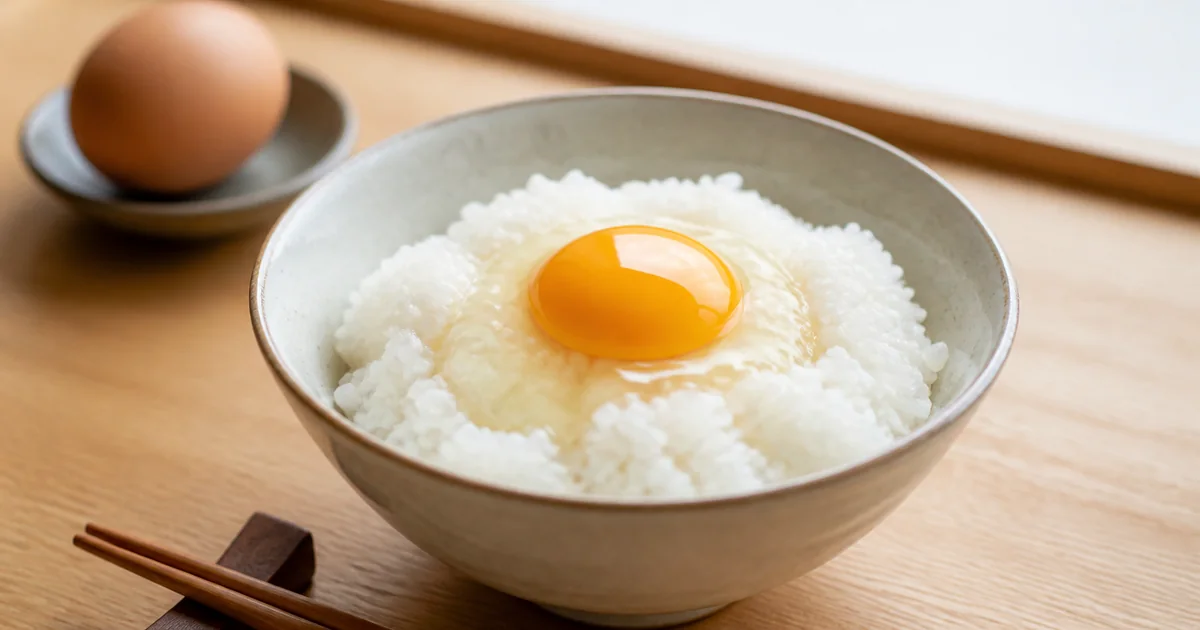
Raw and lightly cooked egg appears in familiar Japanese meals rather than being treated as an unusual challenge. The best-known example is tamago kake gohan, often shortened to TKG: a raw egg mixed into hot steamed rice and seasoned with soy sauce. Natto is another common rice accompaniment, and some diners combine it with egg.
Raw beaten egg may also be served as a dipping sauce with sukiyaki. Other dishes use yolk as a rich topping, while onsen tamago and soft-cooked eggs retain a flowing texture without being completely raw.
Egg adds creaminess and softens salty or strongly seasoned food. In TKG, it coats the cohesive grains described in our guide to Japanese rice. These uses are part of everyday food culture, but custom alone is not evidence that risk has disappeared.
Why Are Japanese Eggs Commonly Used Raw?
Japan has controls at several stages of the egg supply chain. Farms work to limit Salmonella, and grading and packing facilities—often called GP centers—sort eggs, inspect them for damage or contamination, and may wash and sanitize shells before packing. Packages provide dates and storage or use instructions.
These measures are important because Salmonella may be present on a shell or, less commonly, inside an egg. Visual freshness cannot prove that an egg is free from harmful bacteria. Washing and inspection reduce hazards but do not turn a raw agricultural product into a risk-free food.
Rules and practices also vary by country. The fact that an egg was safe for a particular use in Japan does not mean that any egg purchased abroad should be eaten raw. Follow the labeling and public-health advice where the egg was sold.
What Does the Date on a Japanese Egg Package Mean?
For shell eggs sold for raw consumption, the printed best-before date is used as the deadline for eating them raw when they have been stored as directed. The Food Safety Commission explains that eggs should remain refrigerated at 10°C (50°F) or below and should not be left at room temperature after cracking.
Do not interpret the date in isolation. The shell must be intact, the egg must have been stored correctly, and the package must indicate that raw use is intended. If the date has passed, follow the package instructions and use thorough cooking rather than serving the egg raw or runny.
| Check | Suitable approach | Do not use raw when… |
|---|---|---|
| Label | Package permits raw consumption | It says heating is required or the use is unclear |
| Date | Within the printed raw-use period | The date has passed |
| Shell | Clean and intact | Cracked, leaking, or noticeably dirty |
| Storage | Continuously refrigerated as directed | Temperature history is uncertain |
How to Handle a Raw Egg More Safely
- Buy eggs from a reputable refrigerated retailer and read the entire label.
- Place them in a refrigerator promptly and keep them in their original carton.
- Do not use an egg with a cracked, leaking, or contaminated shell.
- Wash your hands and use a clean bowl and utensils.
- Crack the egg immediately before eating rather than preparing it in advance.
- Keep shell surfaces and raw egg away from ready-to-eat foods.
- Eat the prepared dish promptly and discard leftovers that have sat out.
Do not wash a store-bought egg again at home unless authoritative local instructions specifically direct you to do so. Incorrect washing can spread contamination around the sink or move it through small shell defects. The package instructions remain the safest starting point.
Who Should Avoid Raw or Undercooked Eggs?
Japanese food-safety guidance recommends thoroughly cooked eggs for people more likely to become seriously ill from Salmonella. This includes older adults, young children, pregnant people, and people with weakened immune systems. Individual medical circumstances differ, so a clinician’s advice takes priority.
Cooking is also the sensible choice when the label is missing, the storage history is uncertain, the shell is damaged, or the egg has been left unrefrigerated. Do not let a restaurant’s reputation or an attractive orange yolk substitute for basic safety checks.
What Should Travelers Do at Restaurants?
At an established restaurant, the kitchen is responsible for sourcing and handling its ingredients. You can still ask whether a dish contains raw or partly cooked egg, especially when ordering sukiyaki, rice bowls, noodles, homemade sauces, or desserts.
If you prefer not to eat it, say nama tamago wa taberaremasen, meaning “I cannot eat raw egg,” and ask whether the egg can be omitted or fully cooked. With sukiyaki, the dipping egg is normally optional. For TKG, choose a different breakfast dish rather than trying to remove egg after it has been mixed into the rice.
Avoid assuming that all yellow sauces or soft toppings are raw egg; likewise, do not assume a warm dish means the egg is fully cooked. Asking directly is more reliable.
Raw Egg, Onsen Tamago, and Soft-Boiled Egg
These terms describe different preparations:
- Nama tamago: an uncooked egg.
- Onsen tamago: gently heated so the white is soft and the yolk remains creamy.
- Hanjuku tamago: a general term for a soft or partly cooked egg.
- Hard-cooked egg: both white and yolk are fully set.
A soft texture does not prove that a preparation has reached a temperature and time sufficient to eliminate pathogens. Diners who have been advised to avoid undercooked egg should request a fully cooked option.
Questions Travelers Ask Before Eating Raw Egg in Japan
Are Japanese eggs pasteurized?
Do not assume that ordinary shell eggs are pasteurized. Sorting, shell washing, sanitation, refrigeration, and labeling are not the same as pasteurization. Check the individual product if pasteurized egg is required.
Does a dark orange yolk mean the egg is safer?
No. Yolk color is influenced mainly by pigments in the hen’s diet. It does not show whether Salmonella is present, how the egg was stored, or whether it is approved for raw consumption.
Can I eat raw eggs outside Japan if they look similar?
Appearance is not a safety standard. Use only eggs that local authorities and the product label consider suitable for raw dishes. Requirements, farming systems, refrigeration practices, and advice differ between countries.
When Raw Egg Is—and Is Not—a Sensible Choice
Eating raw eggs in Japan is an established part of dishes such as tamago kake gohan and sukiyaki. Japan’s production controls, inspection, labeling, cold storage, and raw-use dates are designed to manage the risk, not eliminate it.
For a healthy adult who chooses to try raw egg, the practical safeguards are straightforward: use an intact egg labeled for raw consumption, keep it refrigerated, stay within the printed date, crack it just before eating, and use clean utensils. When any of those conditions is uncertain—or when a person is in a higher-risk group—choose a thoroughly cooked egg. That cautious approach fits the broader emphasis on careful handling found throughout Japanese food culture.