A5 Wagyu is beef that received Japan’s highest yield grade, A, and highest overall meat-quality grade, 5. The letter and number measure different things. A does not mean “authentic,” and 5 is not based on marbling alone. Understanding those two scores makes a restaurant menu or retail label much easier to read.
The grade also does not tell you the breed, region, cut, cooking method, or whether a large portion will suit your taste. A5 can be exceptionally rich and tender, but the best choice depends on how it will be served.
Read “A5” as Two Separate Scores
| Part of the grade | What it evaluates | Scale |
|---|---|---|
| A | Estimated yield of usable meat from the carcass | A, B, or C |
| 5 | Overall meat quality based on four assessed factors | 1 through 5 |
| BMS | Degree of marbling in the rib-eye section | No. 1 through No. 12 |
Japan’s beef carcass system combines three yield grades with five quality grades, creating 15 possible combinations from C1 to A5. The Japan Meat Grading Association applies the national transaction standard to chilled carcasses rather than grading a finished steak at the table.
The A Is About Yield, Not Flavor
Yield estimates how much usable meat a carcass should provide. The calculation considers the rib-eye area, rib thickness, carcass weight, and subcutaneous fat thickness. Under the current standard, A represents an estimated yield of 72 or higher, B is 69 to below 72, and C is below 69, subject to specified adjustments.
This matters commercially, but it does not mean that an A-grade piece automatically tastes better than a B-grade piece. Calling A “the best flavor” confuses production yield with eating quality.
The 5 Is an Overall Quality Grade
The quality grade evaluates four areas: marbling; meat color and brightness; firmness and texture; and fat color, luster, and quality. The lowest of those four individual evaluations determines the final quality number. For example, excellent marbling cannot by itself produce a quality grade of 5 if another required factor is graded lower.
That makes “A5” more precise than a casual description such as “very fatty beef.” It records how a carcass met a defined Japanese transaction standard at a particular inspection section.
Where BMS Fits—and Where It Does Not
BMS means Beef Marbling Standard. It runs from No. 1 to No. 12 and evaluates visible intramuscular fat in the rib-eye section. Under the JMGA standard, the marbling component of quality grade 5 begins at BMS No. 8. Grades 4, 3, 2, and 1 begin at lower BMS thresholds.
A high BMS can suggest abundant marbling, but BMS and A5 are not interchangeable. BMS addresses one quality factor; A5 combines yield with the overall quality result. A menu that lists only “BMS 10,” for example, has not necessarily told you the complete Japanese carcass grade.
Wagyu, A5, and Kobe Beef Are Not Synonyms
Wagyu refers to designated Japanese cattle breeds and their permitted crosses. Japan’s Ministry of Agriculture identifies four principal breeds: Japanese Black, Japanese Brown, Japanese Shorthorn, and Japanese Polled. Japanese Black accounts for most Wagyu raised in Japan, but “Wagyu” by itself is not a quality grade.
A5 is also not a regional brand. Kobe Beef is a protected qualification for eligible Tajima cattle that meet the rules of the Kobe Beef Marketing & Distribution Promotion Association, including origin, processing, yield, quality, BMS, and carcass-weight requirements. Qualifying Kobe Beef may be A4, A5, B4, or B5; therefore, not all Kobe Beef is A5, and most A5 Wagyu is not Kobe Beef.
In Japan, domestically raised cattle also carry a 10-digit individual identification number that supports traceability. When provenance matters, a restaurant or retailer should be able to provide more than a decorative “Wagyu” claim.
Why A5 Is Not Automatically the Best Portion for Everyone
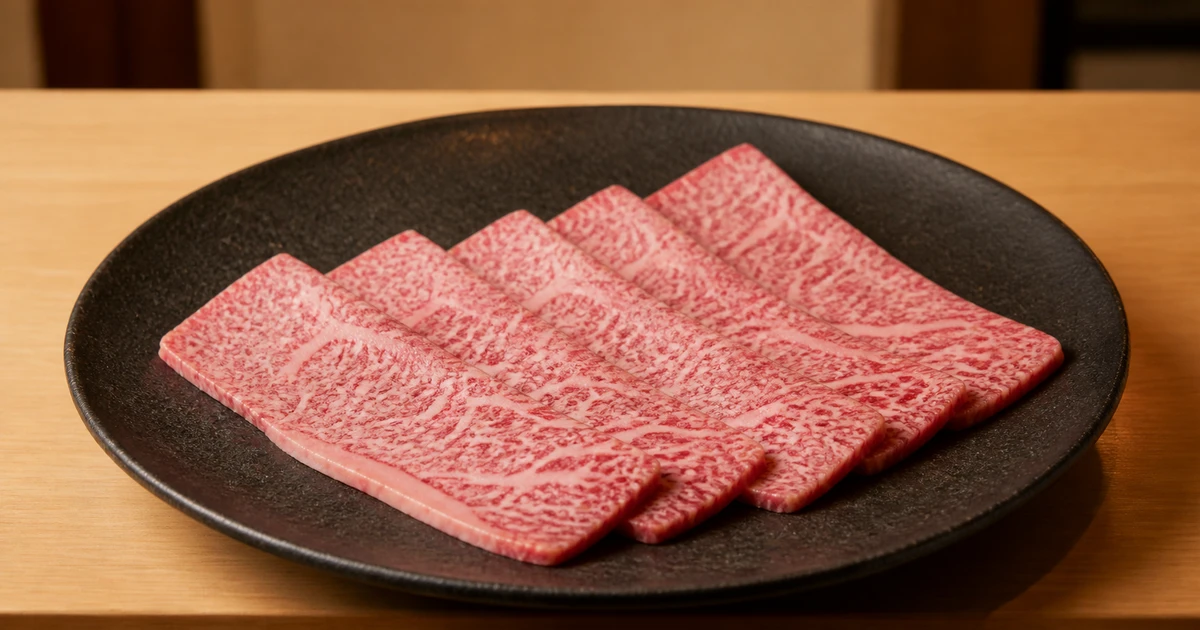
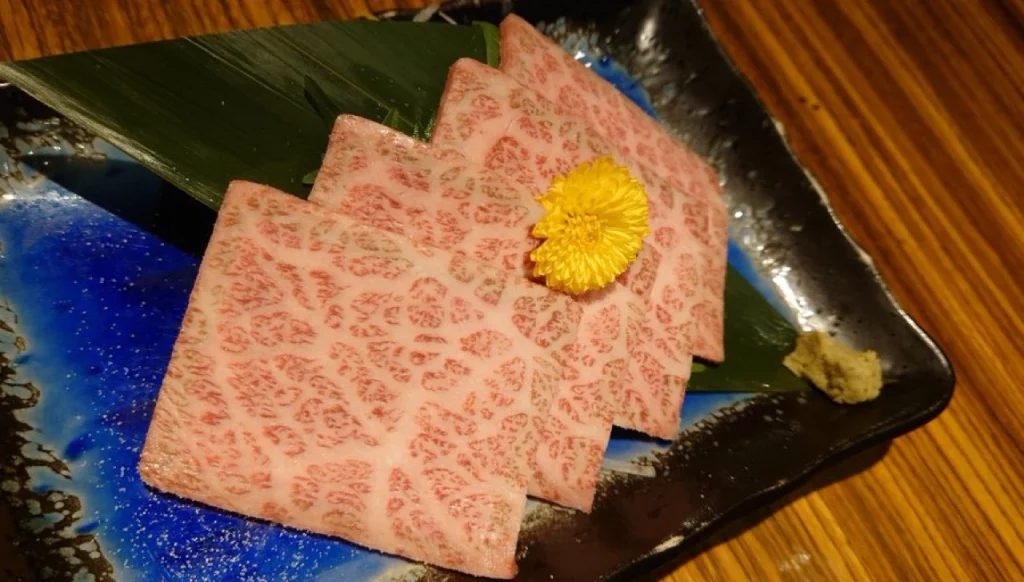
Fine marbling changes the experience as the fat warms. A small bite can feel tender, aromatic, and intensely savory. That richness connects with the broader idea of umami, but fat, aroma, seasoning, and browning all contribute to the impression; the grade does not measure “deliciousness” as one universal score.
For a thick Western-style steak, a very large A5 portion can become tiring before the plate is finished. Japanese service often suits rich beef to smaller cuts: thin yakiniku slices, bite-size teppanyaki pieces, shabu-shabu, sukiyaki, or a small special course. A4 or leaner Wagyu may offer more contrast between beef flavor, chew, and fat for diners who want a larger serving.
Cut still matters. Sirloin, rib, tenderloin, and round do not eat the same way even when they come from the same graded carcass. Ask about the origin, full grade, cut, portion size, and preparation instead of choosing by “A5” alone.
How A5 Wagyu Can Appear at a Sushi Counter
Fish remains the center of traditional nigiri, but an omakase counter may occasionally include a non-fish course. At the restaurant represented in these photographs, suitable A5 Wagyu is sometimes available when overseas guests visit. The kitchen may cut it thinly and shape it over seasoned sushi rice as a special variation rather than a standard item served every day.
In this restaurant’s preparation, the surface is seared immediately before the nigiri is served. Browning adds roasted aroma, warms and softens the fine fat, and creates contrast with the vinegared rice. A restrained amount of soy-based seasoning and a small dab of wasabi can keep the bite from tasting one-dimensional. For more about the role of rice and seasoning, see the guide to eating sushi in Japan.
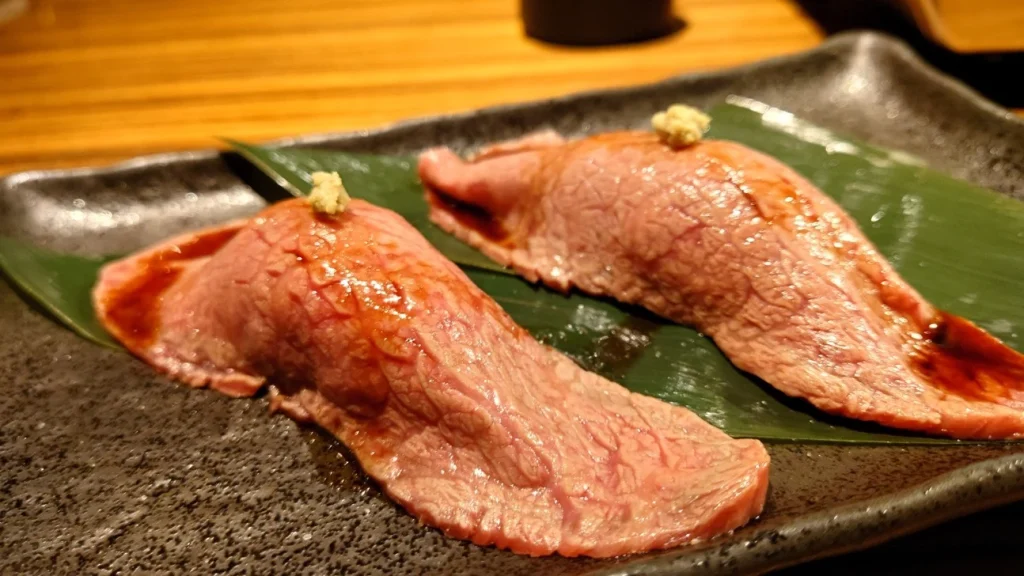
This example should not be read as a rule that Wagyu nigiri is common at every sushi restaurant. It shows how one kitchen adapts a prized ingredient for a compact, rice-based course.
Surface Searing Is Not a Universal Safety Guarantee
Visible browning does not, by itself, prove that beef is safe to eat. Safe service depends on approved sourcing, the type and condition of the cut, refrigeration, clean equipment, prevention of cross-contamination, staff training, validated processing, and the rules where the food is prepared. Japan has specific standards for beef intended to be served raw; simply buying A5 meat does not make it suitable for raw or lightly cooked service.
For home cooking in the United States, USDA guidance recommends cooking whole beef steaks, chops, and roasts to at least 145°F (62.8°C), measured with a food thermometer, followed by a three-minute rest. Ground beef requires a higher temperature. Travelers and home cooks should follow local public-health guidance and should not copy a restaurant’s lightly seared presentation with ordinary retail meat.
A Better Way to Read a Wagyu Menu
- Separate breed, brand, and grade. “Wagyu,” “Kobe,” and “A5” answer different questions.
- Ask for the full grade. A quality number or BMS alone is incomplete.
- Check origin and traceability. Specific information is more useful than luxury wording.
- Choose the portion for the cooking style. A few rich bites may be more satisfying than a large steak.
- Treat safety separately from prestige. Price and marbling do not replace proper handling and cooking.
A5 is meaningful because it summarizes a defined carcass assessment. It becomes truly useful only when combined with the cut, provenance, portion, and preparation. Read the label carefully, then choose the form of Wagyu that matches how you actually want to eat it.
Sources
- Japan Meat Grading Association: Beef Carcass Transaction Standard
- Ministry of Agriculture, Forestry and Fisheries: Wagyu Breeds
- Kobe Beef Marketing & Distribution Promotion Association: Classification Criteria
- Japan Ministry of Health, Labour and Welfare: Prevention of Food Poisoning from Beef
- USDA Food Safety and Inspection Service: Beef Cooking Temperature