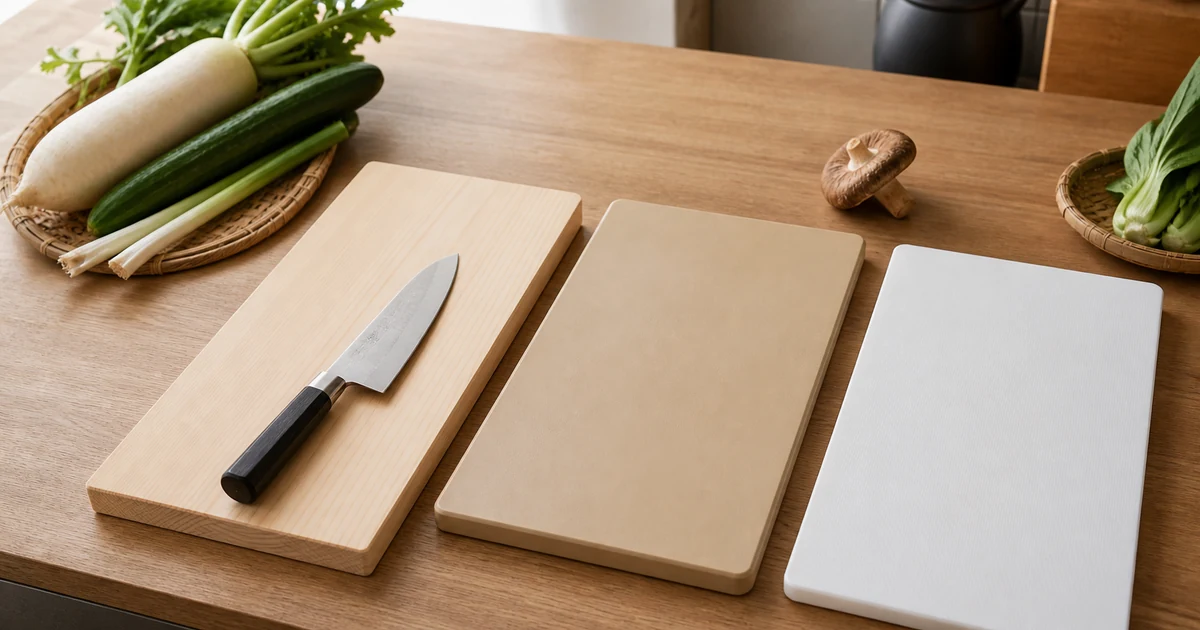
A good Japanese cutting board should suit both your knife and your cleaning routine. Hinoki is light and soft under a blade, synthetic rubber is resilient and low-absorption, and plastic is affordable and widely available.
None is automatically best. A beautiful wooden board is a poor choice if it stays damp, while a premium rubber board may be unnecessarily heavy or expensive for an occasional cook. This guide compares the materials and the practical details that matter before buying.
The Board Should Protect the Knife and Control Moisture
| Material | Cutting feel | Main advantage | Main drawback |
|---|---|---|---|
| Hinoki wood | Soft, quiet, and responsive | Lightweight and gentle-feeling | Needs prompt washing and thorough drying |
| Synthetic rubber | Resilient and slightly grippy | Low absorption and controlled knife contact | Can be heavy; heat limits vary |
| Plastic or polyethylene | Varies from firm to moderately soft | Affordable and easy to replace | Deep scoring eventually makes cleaning difficult |
In this article, “rubber” means boards made from synthetic rubber or elastomer-based materials. “Synthetic board” refers mainly to common plastic or polyethylene boards. Manufacturers use different formulations, so the label and care instructions are more reliable than appearance alone.
Why the Cutting Surface Matters for Japanese Knives
Every cut ends with the edge contacting the board. A surface with some give feels less abrupt than glass, stone, or ceramic, which are not sensible everyday cutting surfaces for a fine edge.
This matters with thin Japanese blades, especially when the user presses hard or twists the knife. No board prevents damage from poor technique, bones, frozen food, or lateral force. Our guide to Japanese knife types explains the roles of gyuto, santoku, nakiri, deba, and yanagiba.
Hinoki Cutting Boards
Hinoki is Japanese cypress, a pale, aromatic wood used for cutting boards and many traditional objects. Its medium-soft surface has a little give under the knife. It is also lighter than many thick hardwood boards, making a large board easier to lift and wash.
The tradeoff is maintenance. Knife marks are normal, and trapped moisture can contribute to warping, staining, odor, or mold. Some manufacturers advise wetting the surface before use, washing promptly, and drying both faces in a ventilated position.
Do not assume every hinoki board is dishwasher-safe. KAI, for example, sells models that must be hand-washed and other treated models labeled for dishwasher use. Coatings, adhesives, construction, and thickness differ. Follow the directions for the exact product rather than a general rule for the species.
Choose Hinoki If…
- You value a quiet, traditional wood cutting feel.
- You want a large board without excessive weight.
- You can wash it promptly and let both sides dry fully.
Avoid it if you routinely leave boards soaking, depend on a dishwasher, or have no ventilated storage space.
Synthetic Rubber Cutting Boards
Japanese synthetic rubber boards are popular in professional-style preparation because they combine a resilient surface with low water absorption. The material may grip food more than slick plastic, although the feel varies from firm to very soft.
Construction matters. A solid rubber board can be dense and heavy. Some Hasegawa models place a soft plastic surface around a rigid wood core, while Parker Asahi uses solid synthetic rubber for its Cookin’ Cut line. These products are not interchangeable simply because sellers call both “rubber boards.”
Heat tolerance and dishwasher compatibility are model-specific. Hasegawa says most of its boards are dishwasher-safe, with stated exceptions. Parker Asahi’s English instructions say its household rubber boards are not dishwasher-safe. Check temperature limits, permitted cleaners, and whether resurfacing is allowed before purchase.
Choose Synthetic Rubber If…
- You want a resilient, low-absorption surface.
- You prepare fish or vegetables with precise slicing cuts.
- You are willing to check the model’s weight and care limits carefully.
Soft rubber can feel different from wood and may catch a deeply pressed edge. It rewards clean slicing rather than forceful twisting.
Plastic and Polyethylene Boards
Plastic boards are inexpensive, widely available, and easy to dedicate to a food group. Many are dishwasher-safe, but only when the manufacturer says so and the board fits properly.
Quality and hardness vary. A thin mat may bend, move, or develop cuts quickly, while a thicker polyethylene board can be stable but heavy. Color coding can help a household remember which board is for raw proteins, but color itself does not make the board hygienic.
Plastic is not maintenance-free. Knife grooves accumulate with use. USDA guidance says excessively worn boards, or boards with hard-to-clean grooves, should be discarded. A low purchase price is useful only if you are prepared to replace the board when its surface is no longer cleanable.
How to Choose the Right Size and Thickness
Measure the counter, sink, dishwasher, and storage space before comparing brands. The board should support your usual knife and ingredients. A small board may suit fruit but frustrate anyone cutting cabbage, fish fillets, or using a 210 mm gyuto.
- Compact board: easy to wash and store, but offers limited prep space
- Medium board: the most versatile choice for ordinary home cooking
- Large board: useful for batch preparation, but check sink fit and weight
Thickness usually improves rigidity but increases weight. Feet can make one side unusable, while a juice groove reduces flat cutting area. Choose these features only when useful.
If you are equipping a kitchen from the beginning, see our guide to Japanese kitchen tools worth buying. The cutting board should support the knife you use most rather than become another specialty item.
Cleaning and Food Safety
USDA guidance allows wood or a nonporous board. The important habits are cleaning, separation, drying, and replacement when the surface becomes difficult to clean.
- Wash the board with hot, soapy water after each use, then rinse and dry it.
- Consider separate boards for raw meat, poultry, and seafood and for produce or ready-to-eat foods.
- Use only sanitizers suitable for food-contact surfaces and follow their labels.
- Never rely on “antibacterial” marketing as a substitute for normal cleaning.
- Replace a board with deep, hard-to-clean grooves, cracks, or damaged layers.
Do not soak a wooden or wood-core board unless its manufacturer expressly permits it. Do not use boiling water, a dishwasher, bleach, oil, sandpaper, or a board scraper merely because another product allows it. Care instructions depend on the material and construction.
Practical Buying Links
Check the board dimensions, care instructions, and compatibility with your workspace before buying.
Disclosure: As an Amazon Associate, Japan Food Compass earns from qualifying purchases.
- Wooden option: compare hinoki cutting boards on Amazon.
- Synthetic-rubber option: compare synthetic-rubber cutting boards on Amazon.
Care Questions That Determine Board Life
Is Hinoki Better Than Rubber for Japanese Knives?
Not universally. Hinoki offers a light, traditional feel, while synthetic rubber resists water absorption and may be easier to maintain. The better choice is the one that fits your cutting technique, cleaning routine, weight tolerance, and storage space.
Can I Put a Japanese Cutting Board in the Dishwasher?
Only if the specific manufacturer and model permit it. Material names are not enough: one hinoki or rubber board may be dishwasher-safe while another can warp, split, or delaminate.
Do I Need Two Cutting Boards?
Using a separate board for raw meat, poultry, and seafood is a practical way to reduce cross-contamination with produce and ready-to-eat food. Both boards still need proper cleaning after use.
The Best Board Is the One That Fits Your Knife and Routine
Choose hinoki for a lightweight board with a soft, traditional cutting feel, provided you can wash and dry it carefully. Choose synthetic rubber for a resilient, low-absorption surface, after checking weight and exact care limits. Choose plastic for affordability, easy separation by task, and straightforward replacement.
The best Japanese cutting board is large enough for safe preparation, suitable for the knife, stable on the counter, and compatible with the way you maintain kitchen tools.